

Right, let's get one thing straight. "Creative problem solving" sounds like a fluffy buzzword from a corporate retreat, doesn't it? We imagine some kind of rare genius striking an artist or an inventor.
But that’s not what it is at all. It’s far more grounded and, frankly, more useful than that.
What Is Creative Problem Solving Anyway?
Think of it less like trying to catch lightning in a bottle and more like being a detective with a seriously clever toolkit. It's not about waiting for a magical "aha!" moment. It's a structured way of thinking that anyone can learn.
Creative problem solving (CPS) is the deliberate process of looking at a challenge from an odd angle to find a solution that isn’t obvious. It’s about consciously breaking out of your usual thought patterns to see a problem in a new light. This isn't about throwing logic out the window; it's about mixing analytical thinking with a bit of playful imagination.
Creative problem solving is a mindset. It turns roadblocks into puzzles just waiting for a clever solution. It’s how you start seeing possibilities where everyone else sees a dead end.
Why This Skill Matters Now
In a world where Google can give you standard answers in a split second, the real value is in tackling the messy, complicated problems that don't have a user manual. This is where CPS becomes your secret weapon.
It's for the software developer stuck on a bizarre bug, or the marketing manager trying to connect with a new audience. The ability to approach old problems with fresh eyes is a massive advantage.
The whole thing is built on a few core ideas:
- Question Everything: Actively challenge the "rules" and assumptions that box a problem in.
- Ideas First, Judgement Later: Focus on generating a ton of options before you even think about which ones are good.
- Get Comfortable with Ambiguity: Learn to work on problems that aren't fully defined yet. That's where the interesting stuff happens.
Ultimately, CPS is a skill you can practise and improve. It gives you a reliable framework for coming up with new ideas and the confidence to not just face down tough challenges, but to actively look for them.
Exploring Core Creative Problem Solving Frameworks
Relying on random flashes of inspiration is a losing game. While creativity can feel messy and unpredictable, several proven frameworks provide a structured path, turning abstract thoughts into a concrete process.
Think of these frameworks as blueprints for repeatable innovation. They organise your thinking, making sure you explore a problem from every angle before jumping to a conclusion. They don't guarantee a perfect outcome every time, but they dramatically improve your odds of finding a brilliant solution.
This concept map shows that creative problem solving isn't some mystical talent—it's a learnable, structured skill essential for getting ahead.
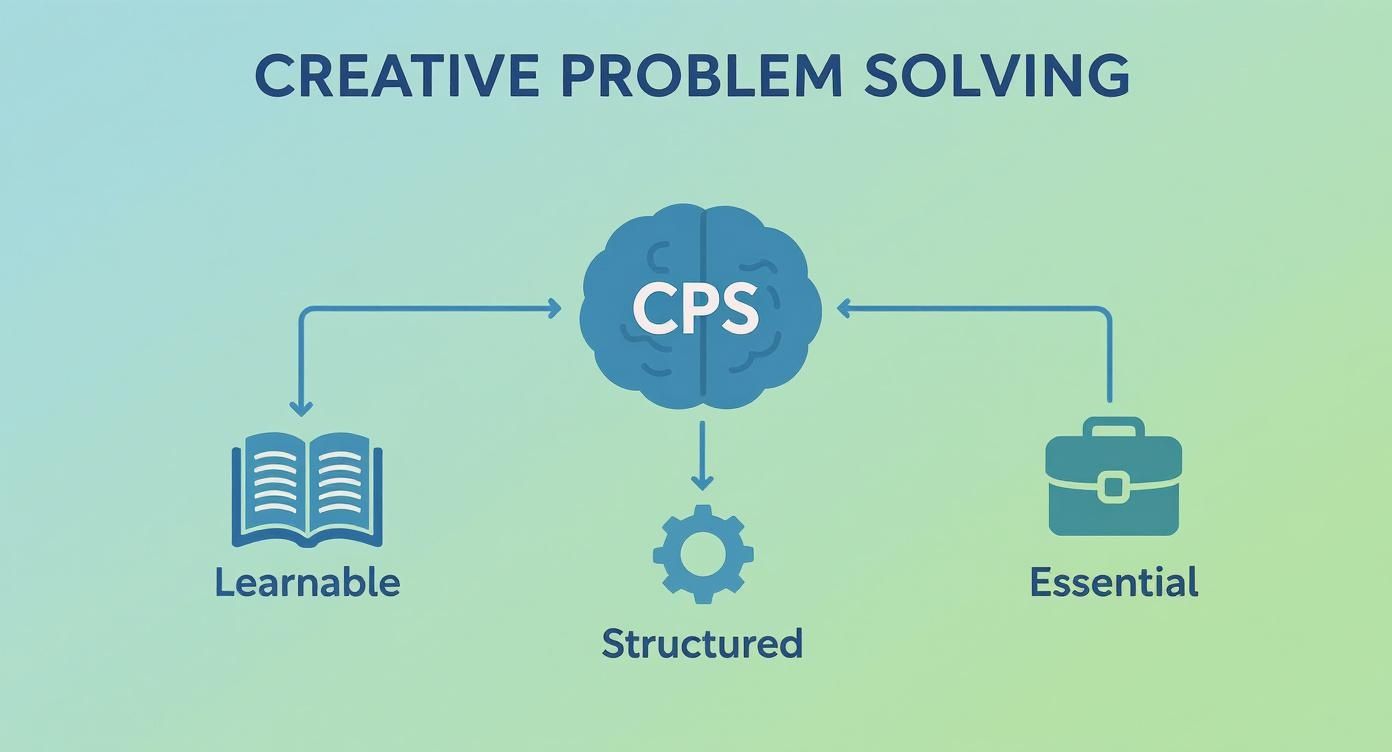
The real takeaway here is that CPS isn't an innate gift. It’s a discipline you can build through practice and by using the right mental models.
Divergent and Convergent Thinking
At the heart of almost every creative framework is the dynamic duo of divergent and convergent thinking. This is the fundamental rhythm of creative work. First you flare, then you focus.
Divergent thinking is the "go wide" phase. Your only goal is to generate as many ideas as possible without any judgment. Quantity over quality is the rule here. Explore every weird, wonderful, and seemingly impractical possibility you can think of.
Convergent thinking is the "narrow down" phase. Once you have a huge pool of ideas, you switch gears. Now it's time to analyse, categorise, and refine those options to pick the most promising one. This is all about making a choice.
The biggest mistake people make is trying to do both at once. Judging ideas as you generate them is the fastest way to kill creativity. For the best results, keep these two phases completely separate.
The Osborn-Parnes CPS Model
This is one of the oldest and most influential frameworks out there. It was created by advertising executive Alex Osborn in the 1950s, who wanted a structured method to guide thinking. His original process has been refined over the years, but it's still widely used in business and education.
The modern Osborn-Parnes model breaks the process down into four clear steps:
- Clarify: Explore the challenge, gather data, and frame the specific problem you need to solve.
- Ideate: This is the pure divergent phase. Brainstorm a massive volume of potential ideas.
- Develop: Refine your best ideas. Combine and strengthen them until they become workable concepts.
- Implement: Create a concrete action plan to bring your chosen solution to life.
Design Thinking
While the classic CPS model is great for solving a well-defined problem, Design Thinking flips the script by putting the human experience at the very centre of the process. It's a deeply empathetic approach that works brilliantly for tackling ambiguous challenges where you don't even fully understand the problem yet.
This framework is less of a straight line and more of an iterative cycle:
- Empathise: Understand the experiences, motivations, and frustrations of the people you're solving for.
- Define: Turn your user insights into a clear, actionable problem statement.
- Ideate: Brainstorm solutions that directly address the specific needs you've identified.
- Prototype: Build a simple, low-cost version of your best idea.
- Test: Get feedback on your prototype from real users, learn from it, and refine your approach.
To help you decide which framework might suit your situation, this table breaks down their core differences.
Comparison of Creative Problem Solving Frameworks
| Framework | Primary Focus | Best For | | :--- | :--- | :--- | | Divergent/Convergent Thinking | The fundamental rhythm of generating and then selecting ideas. | A core principle to apply within any creative process or meeting. | | Osborn-Parnes CPS Model | A structured, linear process for moving from a defined problem to a solution. | Business challenges where the problem is clear but the solution is not. | | Design Thinking | Understanding human needs to solve ambiguous, user-centred problems. | Developing new products, services, or experiences where the user is key. |
Each of these frameworks offers a different lens for looking at a challenge. Getting good at them requires a mix of flexible thinking and methodical action—a skill set that can be trained with systematic practice. To build this mental muscle, read our guide on how to improve strategic thinking.
Practical Techniques to Ignite Your Creativity
Knowing the theory is one thing, but getting your hands dirty is where the real breakthroughs happen. Let's move from the abstract frameworks to concrete techniques you can start using today.
Think of these methods as a multi-tool for your brain. Each one is designed for a different kind of problem, whether you need a flood of brand new ideas or just a clever way to refine an old one.
Classic Brainstorming Done Right
Everyone thinks they know how to brainstorm, but most sessions flop because people start criticising ideas too soon. To make it actually work, you need one non-negotiable rule: defer all judgment. The goal is quantity over quality.
Here’s how to run a session that gets results:
- Define the Focus: Start with a sharp, specific question. Don't ask, "How can we increase sales?" Instead, try, "What are ten weird ways we could find new customers this month?"
- Generate Ideas Silently: First, give everyone five minutes to jot down ideas on their own. This simple step prevents groupthink and gives introverts a chance to contribute their best stuff.
- Share and Build: Go around the room, with each person sharing just one idea at a time. Encourage others to riff on what they hear, creating new hybrids and combinations.
- Discuss and Cluster: Only when every single idea is on the board do you start talking. Group similar concepts, find the themes, and see what sparks.
Mind Mapping for Visual Exploration
Often, the biggest obstacle isn't the problem itself, but the tangled web of information in our own heads. Mind mapping is a visual trick to get it all out on paper, letting you see hidden connections and explore a challenge from every angle.
Stick your main problem in the centre of a page. From there, draw branches for big themes or components. Then, add smaller sub-branches for related thoughts, questions, or facts. It's a non-linear process that breaks you out of the rigid thinking of lists and outlines.
A mind map is really just a conversation with your own ideas. It gets your thinking out where you can see it, making it easier to spot patterns and find gaps without getting lost in the weeds.
The SCAMPER Method for Innovation
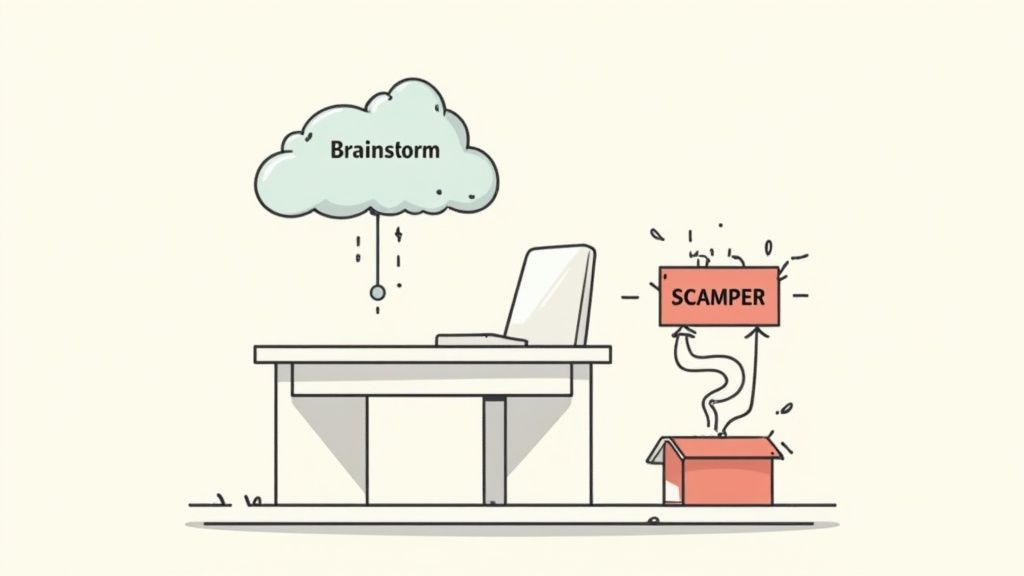
What if you don't need a totally new idea, but a way to make an existing product or process better? SCAMPER is a powerful checklist of seven prompts that forces you to look at what you already have through a different lens.
- Substitute: What can you swap out? (e.g., swapping plastic packaging for a compostable material)
- Combine: Can you merge two separate ideas? (e.g., a phone case that's also a wallet)
- Adapt: How could you adapt this for a totally different use? (e.g., using delivery drones for medical supplies)
- Modify: Can you change its size, shape, or colour? (e.g., creating a mini version of a best-selling product)
- Put to another use: Who else could use this? In what other industry?
- Eliminate: What can you remove to simplify it? (e.g., getting rid of buttons for a touchscreen interface)
- Reverse: Can you flip the process or turn it upside down? (e.g., a subscription box where customers return unwanted items)
Reverse Brainstorming for Proactive Problem Finding
Instead of asking, "How do we solve X?", reverse brainstorming flips the script. It asks, "How could we cause X?" or "How could we make this situation even worse?"
This weirdly fun technique is fantastic for finding weak spots in a plan before they blow up. Once you have a long list of ways to create the problem, you can then work backwards to find a solution for each potential point of failure. It's a powerful way to bulletproof your strategy.
These techniques are just a starting point. For more strategies, check out our full guide on how to improve problem-solving skills.
Using Strategic Games to Train Your Brain
Building your creative problem-solving skills doesn’t have to feel like homework. In fact, one of the best ways to sharpen your mind is through structured, strategic games that force you to think in new ways. These aren’t just for fun; they are powerful training grounds for the mental muscles you need for real-world challenges.
Think of these games as a gym for your brain. They give you a clear goal but surround it with a rigid set of rules, forcing you to find clever solutions within tight limitations. This is exactly what you face in business or technical projects, where budgets, resources, and regulations create firm boundaries.
The N-Queens Puzzle as a Mental Workout
A perfect example of this is the classic N-Queens Puzzle. The goal seems simple: place N chess queens on an N×N chessboard so that no two queens threaten each other. This means no two queens can be on the same row, column, or diagonal. It’s a surprisingly tough challenge that demands a methodical yet inventive approach.
You can't just place pieces randomly and hope for the best. To solve it, you have to:
- Work Within Constraints: The rules are absolute. Every single move has to be strategic.
- Recognise Patterns: After a few tries, you start to see which placements are dead ends and which ones open up possibilities.
- Backtrack from Dead Ends: You will absolutely place a queen in a spot that makes a solution impossible. The key skill is recognising this, undoing your last few moves, and trying a different path without getting frustrated.
This image shows one solution for the standard 8-queens puzzle.
Notice how each queen owns its row and column, but also cleverly avoids any diagonal threats. It's a perfect picture of successfully navigating tight constraints.
Translating Puzzle Skills to Real-World Problems
The discipline you learn from the N-Queens puzzle translates directly to professional life. Imagine you’re managing a project. Your "chessboard" is the project timeline, and your "queens" are your team members or key resources. You need to assign them to tasks (placing them on the board) without creating conflicts, like two people needing the same equipment at the same time.
When you hit a roadblock—a dead end—that backtracking skill becomes invaluable. Instead of panicking, you learn to calmly reassess, undo the decision that created the conflict, and explore another way forward.
Strategic puzzles teach you how to be both creative and systematic. They prove that innovation often flourishes not from total freedom, but from the challenge of finding a clever way to succeed within a strict set of rules.
By playing puzzles like this regularly, you're not just passing time; you're running drills for your mind. You build patience, get better at spotting patterns, and become more comfortable with the trial-and-error process that drives all creative problem-solving. If you want more ways to challenge your mind, you can find a great list of top brain training games to get started.
Building a Culture of Creative Problem Solving
Individual skill is a great start, but it's not enough. A truly innovative team needs the right environment to thrive. Fostering creative problem solving is less about grand, top-down initiatives and more about creating a space where new ideas are safe to grow.
The goal is to shift from relying on a few "lone geniuses" to empowering everyone to contribute. It means moving beyond just saying you value creativity and actually building the systems that prove it.

Cultivate Psychological Safety
Fear is the single biggest killer of creativity. If people are afraid of looking foolish or getting penalised for a failed experiment, they’ll stop taking risks. Simple as that.
Psychological safety is the shared belief that it’s okay to speak up, offer a weird idea, or admit you made a mistake without getting punished.
Leaders can build this by:
- Celebrating noble failures: When an experiment doesn't work, frame it as a learning opportunity, not an error.
- Actively asking for input: Use phrases like, "What am I missing here?" or "What's a completely different way we could look at this?"
- Responding with curiosity: When someone brings you a half-baked idea, meet it with interest, not immediate judgement.
The foundation of a creative culture is trust. When people feel safe, they’re willing to venture into the unknown and share the unconventional ideas that lead to breakthroughs.
Make Space for Unstructured Thinking
Innovation rarely happens in back-to-back meetings. Our brains need downtime to connect the dots and see problems from a fresh angle.
This doesn't have to be complicated. It could be as simple as encouraging "no-agenda" walks, scheduling regular "deep work" blocks with zero interruptions, or running sessions modelled after jazz jam sessions, where improvisation is the whole point.
This principle scales up, too. A look at the UK's creative geography shows how innovation clusters in certain regions. Back in 2014-2015, the creative industries added a massive £81.4 billion to the UK economy. A study identified 47 "creative clusters"—with about a third in London and the South-East—proving how the right environment drives real growth. You can dive into the full report on UK creative geography to see the data.
Establish a Process for Ideas
Great ideas often die from simple neglect. Without a clear path for capturing, evaluating, and acting on them, even the most enthusiastic teams will just stop trying.
Create a lightweight system that everyone gets. This could be a dedicated digital channel, a specific slot in a weekly meeting, or even a physical whiteboard. The key is making it dead simple for anyone to submit an idea and trust that it will get a thoughtful review, not just be dismissed out of hand.
Clear pathways turn creative potential into actual results.
A Few Common Questions
When you start digging into creative problem solving, a few questions always seem to pop up. Here are some quick thoughts on the most common ones.
Can You Actually Learn Creative Problem Solving?
Absolutely. There’s a stubborn myth that creativity is some kind of magical gift you’re either born with or you’re not. That’s just not true.
Creative problem solving is a skill. It’s a mindset. And just like any other skill, you get better with practice, by learning a few solid frameworks, and by making a real effort to step outside your usual thought patterns. It’s far more about method than magic.
How Does This Work in Analytical Jobs?
This is where it gets really interesting. Creative problem solving is a massive advantage in technical and analytical fields. It isn’t about throwing data and logic out the window; it’s about what you do when the numbers don’t point to an obvious answer.
An engineer might use it to find a totally new way to fix a bug that keeps reappearing. A financial analyst could spot a hidden market trend that standard reports completely miss. In these roles, creativity is simply applying your analytical mind to new and different possibilities.
What’s the Biggest Thing That Kills Creativity in a Team?
Easy. The single biggest barrier is the fear of looking stupid.
When people are afraid they’ll be judged or penalised for a "bad" idea, they just shut down. They stop offering up the weird, half-formed thoughts that often lead to breakthroughs. This crushes psychological safety and nudges everyone toward boring, safe-but-uninspired solutions.
To fix this, leaders have to go out of their way to celebrate experimentation. They need to frame failures as learning opportunities and model curiosity themselves. A safe environment is the soil where great ideas actually grow.
Ready to train your brain with a fun, strategic challenge? Queens Game offers the perfect puzzle to sharpen your creative problem solving and logical thinking skills. Play now at queens.game.