


Becoming a great problem-solver isn't something you're born with. It's a skill you build, like a muscle, through deliberate practice. It comes from learning a few core mental frameworks, setting up a consistent practice routine, and then actually applying those strategies to real-world challenges. This isn't a passive trait—it's an active discipline.
Why Problem Solving Is a Career Superpower

In today's workplace, being a sharp problem-solver isn't just a nice-to-have skill for your CV. It’s the engine that drives your entire career forward. It's what separates people who just complete tasks from those who innovate and lead. Think of it as a career superpower—it unlocks promotions, builds influence, and makes you indispensable.
Whether you're a software developer debugging a complex bit of code or a healthcare manager trying to improve patient flow, the people who really get ahead are the ones who can break a problem down, find its true root cause, and implement a solution that lasts. They don't just put plasters on symptoms; they re-engineer the whole process.
Beyond the Buzzwords
When we talk about problem-solving in a professional setting, we’re talking about something tangible and measurable. It shows up in a few key ways:
- Increased Efficiency: You get good at spotting the bottlenecks in any workflow, which saves everyone time and resources.
- Driving Innovation: Instead of just accepting "the way things are done," you start questioning the assumptions behind the status quo and suggesting better alternatives.
- Enhanced Leadership: Your knack for navigating messy, ambiguous situations and guiding your team to a solution builds trust and signals you're ready to lead.
- Greater Autonomy: When managers see you can handle tough challenges, they trust you with bigger projects and more responsibility.
This isn't just a feeling; the data from the UK job market backs it up. Investing in this kind of training pays off. In 2022/23, 60% of UK employers funded or arranged training for their staff for this very reason. A massive 21% of businesses named 'problem solving' as a top skill they desperately need, with skills shortages now causing around 36% of all job vacancies. You can dig into the full government report on the UK data skills gap to see the numbers for yourself.
In essence, learning how to develop problem-solving skills is an investment in your own career trajectory. It’s the ability to see a challenge not as a roadblock, but as an opportunity to create value.
The Mental Models You Will Master
Throughout this guide, we're going to get practical. We’ll move past abstract ideas and focus on the cognitive strategies that form the bedrock of expert problem-solving. These are the tools that let you bring structure to chaos and clarity to confusion.
To give you a quick preview, here are the core frameworks we'll be breaking down. Think of this as your toolbox.
Core Problem Solving Strategies At a Glance
| Strategy | Core Principle | Best Used For | | :--- | :--- | :--- | | Decomposition | Breaking a large, complex problem into smaller, manageable parts. | Overwhelming or multi-faceted challenges where the starting point is unclear. | | Pattern Recognition | Identifying recurring themes or similarities to previously solved problems. | Situations where experience can provide a shortcut to a known solution. | | Hypothesis Testing | Forming an educated guess about a solution and systematically testing it. | Problems with an unknown root cause, like diagnosing a technical fault. |
By the end, you'll have a clear, repeatable, and effective framework to tackle any challenge that comes your way.
Master Your Cognitive Toolkit for Problem Solving
Great problem-solving isn't some innate gift; it's a skill you build. It’s about having a mental toolkit of proven strategies that bring structure to chaos. Instead of feeling overwhelmed, you learn to see a clear path forward.
We're going to focus on three of the most powerful tools in that kit: Decomposition, Pattern Recognition, and Hypothesis Testing. Think of them as your core frameworks. Once you get the hang of using them, you'll start approaching problems differently, whether it's a stalled project at work or a tricky personal decision.
Deconstruct the Overwhelming with Decomposition
First up, Decomposition. This is simply the art of breaking a big, messy problem into smaller, bite-sized pieces. A huge goal like "increase team productivity" is intimidating. But when you break it down into "analyse current workflows," "pinpoint time-wasting tasks," and "test new communication tools," it suddenly feels doable.
Let's say a marketing campaign is failing. The problem "fix the campaign" is way too vague. Deconstruct it.
- Audience: Are we even talking to the right people?
- Message: Is the copy actually compelling? Is it clear?
- Channels: Where's the money going? Which platforms (social media, email, ads) are dead weight?
- Landing Page: When people click, does the page convince them to act?
By isolating each part, you can tackle one thing at a time. Fixing a weak headline is a concrete task. "Fixing the campaign" is just a source of stress. Decomposition turns that anxiety into an action plan.
This approach turns a single, giant roadblock into a series of small, achievable steps. It's about setting yourself up for a chain of small wins that solve the bigger puzzle.
Spot Clues Through Pattern Recognition
Once a problem is broken down, it's time for Pattern Recognition. This is your ability to see how a current issue connects to things you've seen before. It’s about using your own experience—or your team's—to find a shortcut to the solution.
A customer service manager might notice complaints always spike around the 25th of the month. That's a pattern. Digging in, they find it's a recurring bug in the billing system. Without spotting the pattern, they'd just be fighting fires one by one, never finding the source.
Developing this skill isn't just about waiting for history to repeat itself. You have to actively look for the connections.
- Ask yourself: "Where have I seen something like this before?" The context might be different, but the underlying logic could be identical.
- Look for cause and effect: If A happens, does B consistently follow?
- Keep a "problem-solved" log: A simple document tracking what went wrong and how you fixed it becomes your personal playbook for the future.
Pattern recognition is like a detective noticing the same signature detail across multiple crime scenes. Those clues point you to the culprit much faster. The better you get at this, the more efficient you become. Of course, this requires mental clarity. For more on that, check out our guide on how to improve concentration and focus.
Validate Your Ideas with Hypothesis Testing
So you've broken the problem down and spotted a few patterns. Now you probably have some educated guesses. This is where Hypothesis Testing comes in. It’s the scientific method for everyday challenges: form a theory, test it, and use the results to see if you were right.
It’s how you go from "I think this is the issue" to "I know this is the issue."
Let's go back to that failing marketing campaign. You decomposed it and recognised a pattern: lots of people click the email ad, but almost nobody signs up on the landing page.
Your hypothesis: "The call-to-action button is buried. People aren't seeing it, so they're leaving."
Time to test it. An A/B test is perfect for this.
- Control (A): The original landing page.
- Variation (B): A copy of the page, but with a bigger, brighter call-to-action button.
- Test: Send 50% of your ad traffic to Page A and 50% to Page B.
- Analyse: Check the numbers. Which page got more sign-ups?
If Page B wins by a clear margin, you've proved your hypothesis. You found a fix based on data, not just a hunch. If there's no difference, the hypothesis was wrong, and you can move on to testing the next one, like "Maybe the sign-up form is too long."
This stops you from wasting time on fixes that don't work. It’s a disciplined, evidence-based approach—the same logic players use when solving a puzzle in the Queens Game, where every move is a hypothesis tested against the rules of the board.
Build a Consistent Problem Solving Practice Routine
Knowing the theory is one thing, but real skill comes from practice. It’s like learning an instrument or a sport—you can’t just read the manual. You have to get your hands dirty. The goal is to weave problem-solving into your daily and weekly life until it becomes second nature.
This isn’t about adding hours of stressful work to your day. It’s about small, consistent habits that build on each other. A few minutes here, a focused hour there. That’s how you forge a powerful new way of thinking.
Weave Practice into Your Daily Life
The best way to start is small. Find things you can do in 10-15 minutes, maybe on your commute or during a coffee break. Consistency beats intensity every time.
A few ideas for a quick daily brain warm-up:
- Brain Teasers and Logic Puzzles: Apps and websites are full of short logic puzzles, riddles, and lateral thinking challenges. They're a perfect way to fire up your analytical mind.
- Sudoku or KenKen: These number puzzles are fantastic for sharpening your logical deduction and pattern-spotting abilities without feeling like a chore.
- Word Puzzles: Games like crosswords or Wordle work different mental muscles, hitting vocabulary, pattern recognition, and quick-fire hypothesis testing.
Interestingly, the desire for these skills is stronger than you might think. Data from 2022 showed Manchester had the UK's highest search rate for 'problem-solving skills', hitting around 128 searches per 100,000 people. That’s nearly double the national average, showing a clear demand for practical training.
Building a routine isn’t just a nice personal project—it’s a genuine professional advantage.
This simple flow shows how the core cognitive tools—Deconstruction, Pattern Recognition, and Testing—fit together.
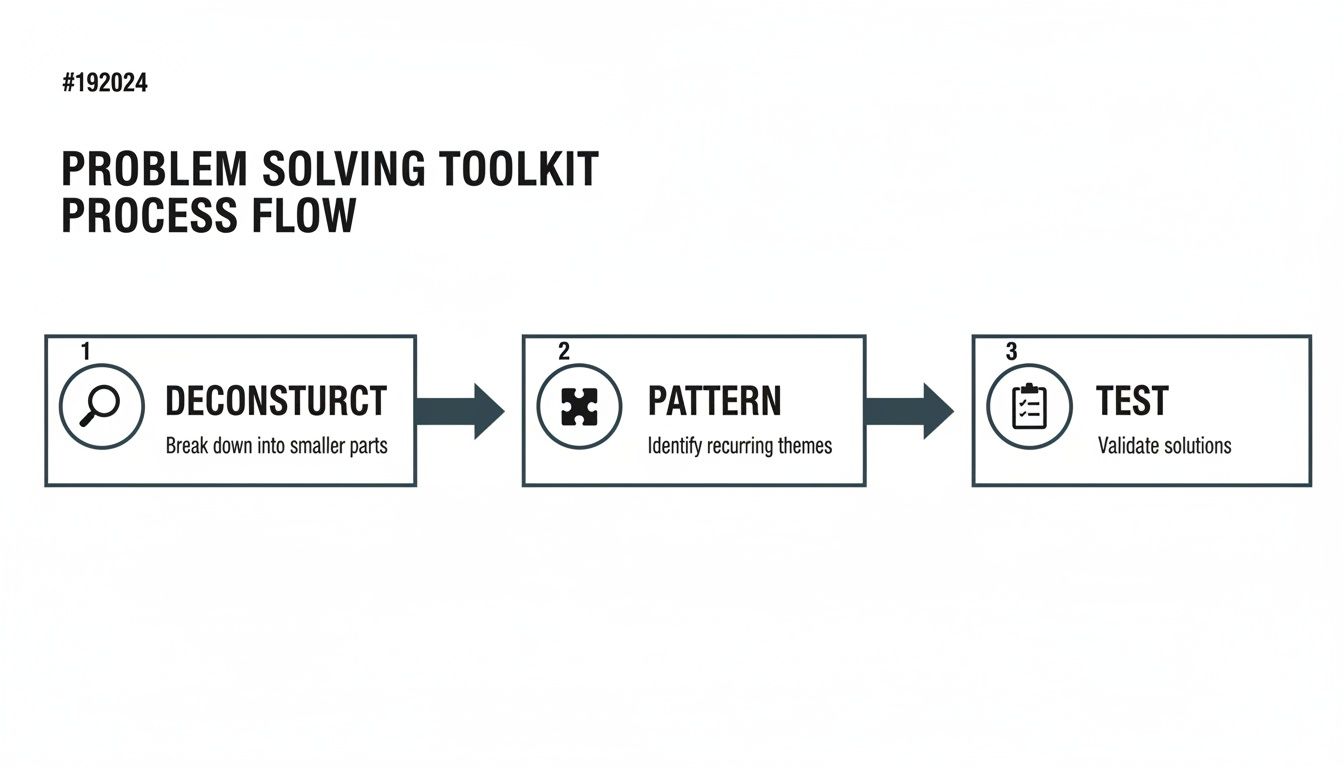
Think of it as a cycle: you break a big problem down, spot familiar patterns, and then test your ideas to find a way forward.
Create a Weekly Challenge Structure
Daily habits keep you sharp, but a weekly challenge lets you go deeper. Block out a dedicated 45-60 minutes—maybe a Sunday afternoon—to tackle something more complex. This is your time to consciously use frameworks like decomposition and hypothesis testing.
Your weekly challenge could be:
- A Chess-Based Logic Puzzle: A game like the Queens Game is ideal. It operates on clear rules and constraints, forcing you to plan ahead, test theories about placements, and spot patterns as they emerge on the board.
- An Online Case Study: Look up short case studies from business schools. Read one, and spend an hour mapping out how you'd break down the problem and what solutions you’d want to test.
- A "Fix-It" Project: Pick something small and inefficient in your own life—a messy cupboard, a clunky weekly shopping routine—and apply proper problem-solving principles to design a better system.
The trick is to treat this like a real appointment. This deeper, consistent work is what builds mental stamina and strategic thinking. If you need more ideas, check out our list of the best brain training games.
A consistent routine trains your brain to default to a structured, analytical mode when faced with ambiguity, rather than reacting with stress or guesswork. It makes problem-solving a reflex.
Here’s a sample plan you can borrow or adapt. The idea is to mix things up to keep it fresh and work out different cognitive muscles.
Sample Weekly Problem Solving Practice Plan
This schedule provides a great mix of activities to ensure you're exercising a full range of problem-solving skills throughout the week.
| Day | Activity (15-20 mins) | Skill Focus | | :--- | :--- | :--- | | Monday | Sudoku or KenKen Puzzle | Logical Deduction, Constraint Satisfaction | | Tuesday | 5 Lateral Thinking Puzzles | Creative Thinking, Questioning Assumptions | | Wednesday | Read and Deconstruct a News Article | Information Analysis, Identifying Key Issues | | Thursday | Play Queens Game | Strategic Planning, Hypothesis Testing | | Friday | Reflective Journaling on a Work Problem | Root Cause Analysis, Self-Awareness | | Saturday | Brainstorm a "Life Hack" | Creative Solution Generation | | Sunday | Work on a Complex Logic Puzzle (e.g., Logic Grid) | Multi-Step Reasoning, Decomposition |
Remember, the best routine is the one you actually stick with. Customise this to fit what you enjoy and what your schedule allows. Consistency is way more important than perfection. Start small, build momentum, and you’ll develop skills that truly last.
Apply Your Skills in Real World Scenarios
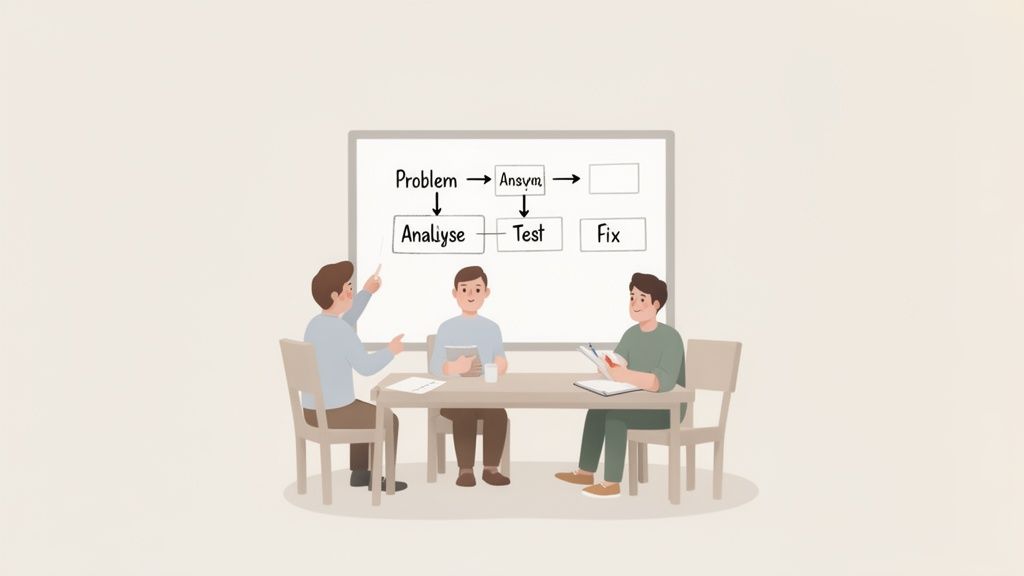
The real payoff from structured practice isn't just getting faster at logic puzzles. It’s about taking those cognitive muscles—decomposition, pattern recognition, hypothesis testing—and flexing them in high-stakes situations at work or university. This is where your new skills truly start to deliver.
But moving from a clean puzzle to a messy professional problem isn't automatic. It requires a conscious effort to apply the same frameworks. You have to learn to see an angry client, a failing project, or a dense essay question for what they are: puzzles waiting to be deconstructed.
From Puzzles to Professional Performance
The trick is building a bridge between the abstract and the practical. Next time you face a challenge at work, just pause and ask yourself: "If this were a Queens Game puzzle, how would I start?" This one question forces you to sidestep panic and engage your analytical mind.
Let's take a common scenario. You’re in a meeting trying to figure out why sales have dipped for the third month straight. The conversation could easily devolve into guesswork and finger-pointing. Instead, you bring structure.
- Decomposition: First, break it down. Is this a lead generation issue? A conversion problem? Or are we losing existing customers? Tackle one piece at a time.
- Hypothesis Testing: Now, propose and test ideas. "My theory is that our new checkout process is too confusing. Let's look at the user journey data to see where they're dropping off."
- Pattern Recognition: Look for history. Did this happen last year? Does this dip line up with a competitor's big marketing push or a seasonal trend?
This methodical approach turns a chaotic meeting into a productive analysis. It shows leadership and clear thinking—qualities every manager looks for.
Applying these mental models in your professional life is the ultimate goal. It shows you can bring clarity and structure to ambiguous situations, making you an invaluable member of any team.
While formal education in the UK provides a strong foundation, there's often a gap. In 2023, 60.6% of 25–34‑year‑olds in the UK held a university degree, and the country produced nearly 228,000 STEM graduates in 2022. Yet, skills shortages persist, showing a disconnect between academic knowledge and what the workplace demands. You can explore more data on the UK skills puzzle to see how training can bridge this divide.
Structuring Your Thinking for Others to See
Getting better at solving problems is only half the battle. You also have to communicate your thought process. Whether you're presenting to your boss, working with colleagues, or explaining your logic to a tutor, clarity is everything.
Imagine you're troubleshooting an issue for a frustrated client. They don't just want a fix; they want to feel confident you have a plan.
A weak response is: "I don't know, I'll look into it."
A much better, structured response sounds like this: "I can see why this is frustrating. To get to the bottom of it, I'm going to first replicate the error on my end. Then, I'll check the system logs from that specific time to isolate the cause. I’ll have an update for you within the hour."
This communicates a clear, logical process. It shows you aren't just guessing—you're being systematic.
A Framework for Academic Challenges
This same skill transfer is critical in academia. Students often get paralysed by broad essay questions that feel overwhelming. The key is to deconstruct the question before you even think about writing.
Let's use this question: "Discuss the impact of industrialisation on 19th-century British society."
- Deconstruct: Break down "impact" and "society." You could look at economic, social, political, and cultural themes. Or you could focus on specific groups: urban workers, rural communities, the new middle class.
- Form a Hypothesis (Your Thesis): Create a central argument. For example: "While industrialisation brought economic growth, its primary social impact was the creation of vast urban inequality."
- Gather Evidence: Now you can systematically find sources to support each part of that argument.
This process turns a daunting task into a manageable project. It's the exact same cognitive skill set you use for a complex puzzle, just in a different context. Mastering this transfer is fundamental to your development. To sharpen your strategic thinking even further, check out our guide on effective decision-making techniques.
Measure Your Progress and Stay Motivated
Knowing the right techniques is a solid start, but how can you be sure you’re actually getting better? The secret to long-term growth is building your own feedback loop. It's about seeing the results of your hard work, celebrating the small victories, and knowing what to do when you inevitably get stuck.
Without some way to measure your development, it's just too easy to lose steam. Your brain needs proof that the effort is paying off—that's what turns a passing interest into a real, lasting skill. Building problem-solving skills is a marathon, not a sprint, and these tools will help you keep up the pace.
Make Your Growth Tangible
You need concrete proof that your skills are evolving. Vague feelings of "getting better" aren't enough to keep you going. You need data, even if it's simple stuff. This transforms your progress from an abstract idea into a visible achievement, and that’s a massive motivator.
Here are a few practical ways to track your journey:
- Time Yourself on Puzzles: Pick a specific puzzle type, like a Sudoku or a level in the Queens Game. See how long it takes you to solve it. Next week, try a similar one and check your time. Watching that number go down is direct, undeniable proof you're improving.
- Keep a "Win Journal": Grab a notebook and dedicate it to your problem-solving wins. Every time you untangle a tricky issue—a bug at work, a complex logic puzzle—write it down. Note the problem, your steps, and what you learned. This journal becomes a powerful reminder of what you're capable of when you feel discouraged.
- Ask for Specific Feedback: Don't just ask your manager, "Am I doing okay?" Get targeted. Ask something like, "In that last meeting, how clearly did I explain the logic behind my proposed solution?" This kind of specific question gets you advice you can actually use.
Tracking your progress isn't about creating pressure; it's about building evidence. This evidence is what you'll lean on to stay motivated when you hit a difficult patch.
Overcoming Plateaus and Roadblocks
Everyone hits a wall. Sooner or later, you'll face a problem that feels impossible or feel like you've stopped improving altogether. This is a totally normal part of learning, not a sign you’re failing. The trick is having a plan for when it happens.
When you get stuck, don't just push harder—push smarter.
- Change Your Scenery: Seriously, get up from your desk. Go for a walk. A simple change of environment can be enough to reset your brain and let a new perspective sneak in.
- Explain it Out Loud: Try to describe the problem to a colleague, a friend, or even the classic rubber duck on your desk. The simple act of putting it into words often reveals the flaw in your logic you’ve been missing.
- Work Backwards: Instead of starting from the problem, start from the solution you want. What would need to be true for that solution to work? This can often illuminate the path you need to take.
Staying motivated is all about celebrating your progress and having a game plan for the tough days. By making your growth visible and knowing how to navigate roadblocks, you create a system that will keep you improving for the long haul.
Common Questions About Problem-Solving
As you start consciously building these new thinking habits, a few questions always seem to come up. Let’s tackle them head-on so you can keep moving forward with confidence.
How Do I Use These Skills in a Team?
This is a great question because teamwork changes your role. You shift from being the sole problem-solver to the person who structures the group's thinking. Your job is to facilitate, not just dictate.
Instead of just throwing out your own ideas, guide the team through a clear process. For instance, you could say, "This is a huge issue. Let's spend the next ten minutes just breaking it down into smaller, manageable parts." This simple act gets everyone on the same page, tackling the same well-defined problem. Encourage the team to brainstorm hypotheses together and then, as a group, decide which ones are worth testing first.
What Should I Do When I'm Completely Stuck?
Hitting a wall is part of the process. It's not a failure; it's a signal. The absolute worst thing you can do is just keep pushing the same failed approach.
When you feel that mental block, it’s time to change your perspective. Here are three things I do that almost always work:
- Explain the problem out loud. Grab a colleague (or even just talk to yourself). The simple act of articulating the challenge forces you to structure your thoughts and often reveals the exact flaw in your logic.
- Work backwards. Seriously. Start with the ideal outcome you want and trace the steps back to where you are now. It’s a classic trick that can instantly show you a path you completely missed.
- Step away. Go for a walk. Switch to a totally different task. Give it at least 20 minutes. Your brain needs an "incubation" period to let your subconscious connect the dots. You'd be surprised how often the solution just pops into your head when you return.
Are There Any Software Tools You'd Recommend?
While the real work happens in your head, the right tools can definitely help you organise your thoughts, especially when things get complicated.
- Mind-mapping software like Miro or MindMeister is fantastic for decomposition. It helps you visually explode a big problem into all its tiny components.
- Project management tools such as Trello or Asana are brilliant for tracking your hypothesis testing. You can create cards for each test, assign tasks, and see your progress clearly.
- Diagramming tools like Lucidchart let you map out processes in flowcharts, making it much easier to spot bottlenecks or potential points of failure.
Remember, a tool is just a scaffold for your thinking, not a replacement for it. The goal is to use software to support your cognitive framework. A well-organised Trello board, for example, can be an incredibly powerful way to track a complex, multi-stage problem without letting anything fall through the cracks.
Ultimately, learning how to develop problem solving skills is a journey of continuous practice, not a destination you arrive at.
Ready to put these strategies into practice? Queens Game offers the perfect environment to sharpen your logical deduction and strategic planning skills. Start playing today and turn theory into skill.