

Learning to think strategically is about more than just making plans. It’s about developing the ability to see the whole board—to anticipate what’s coming next and connect dots that other people miss. It’s the difference between just reacting to problems and actively shaping the future you want.
What Is Strategic Thinking and Why It Matters Now

People often confuse strategic thinking with planning, but they’re two very different things. Planning is about creating a sequence of steps to reach a goal you’ve already set. Strategic thinking is the creative process you use to decide what those goals should even be.
Think of it this way: planning is figuring out the best route to a city on a map. Strategic thinking is deciding which city is actually worth travelling to in the first place, considering the terrain, your resources, and where you ultimately want to end up.
The Core Components of a Strategic Mindset
Becoming a strategic thinker isn't a one-off event. It’s a mental muscle you build over time by focusing on a few key skills.
- Foresight: The knack for looking at today's information and seeing tomorrow's trends, threats, and opportunities.
- Systems Thinking: Understanding that everything is connected. A strategic thinker sees how a decision in one area creates ripples across the entire system—be it a team, a market, or a project.
- Pattern Recognition: The ability to spot connections and underlying patterns that aren't obvious on the surface.
- Adaptability: Being willing to scrap a plan when new information comes to light. It’s about flexibility, not rigidity.
These skills are what separate someone who just puts out fires from someone who builds a fireproof organisation. They let you get ahead of the curve.
A strategic thinker is someone who consistently applies long-term, forward-looking thinking to complex situations—anticipating change, aligning actions with broader goals, and making decisions that create lasting value.
A Real-World Scenario: Strategic Thinking vs. Planning
Let’s say you’re thinking about a big career change, moving from marketing into data science.
A planning-focused approach would look like a to-do list: sign up for an online course, polish your CV, start applying for jobs. It’s a necessary process, but it’s purely operational.
A strategic-thinking approach starts way earlier and digs deeper. You'd analyse industry trends to confirm data science has real long-term growth potential. You’d think about how your marketing skills, like communication and storytelling, could give you a unique advantage over other candidates. You might even start networking with data scientists months before applying, just to absorb the culture and learn what the job really requires.
This wider perspective leads to a smarter, more resilient career move. You aren’t just following a plan; you’re designing a better outcome for yourself.
This is where tools that train your mind to see these connections become so valuable. Logic puzzles and games like Queens Game act like a mental gym. They build the underlying muscles—constraint analysis, foresight, pattern recognition—that you need to tackle complex, real-world challenges.
Your Mental Toolkit for Strategic Thought
Strategic thinking isn’t some abstract talent reserved for a select few. It’s a disciplined process, and like any discipline, it relies on having the right tools for the job.
Just as a carpenter has different saws for different cuts, a strategic thinker needs a toolkit of mental models to dissect problems from every angle. These frameworks give your thoughts structure, helping you see beyond the obvious and make far more robust decisions.
Developing this toolkit starts with one simple act: pausing. When faced with a challenge, our default is often to jump to the quickest, most direct solution. But genuine strategic thought demands we step back and consider the entire system.
See the Ripples with Second-Order Thinking
First-order thinking is easy. It’s fast. It looks at the immediate result of an action: "If we adopt this new software, we'll complete tasks 15% faster." It's a necessary calculation, but it’s dangerously incomplete.
Second-order thinking forces you to ask the most important follow-up question there is: “And then what?” This simple query makes you trace the ripple effects of a decision across the entire pond.
Let's stick with that software example.
- First-Order Consequence: We complete tasks faster. Simple.
- Second-Order Consequences:
- The team needs extensive training, causing an initial productivity dip for two months.
- The software doesn’t integrate with our old client database, which means costly data migration.
- One team member, an expert in the old system, now feels devalued and starts job hunting.
- The faster output in one department creates a massive bottleneck in the next, as they can't handle the increased workload.
Suddenly, a simple decision to "improve efficiency" looks incredibly complex. Second-order thinking isn’t about pessimism; it's about being realistic and prepared. It helps you anticipate and defuse downstream problems before they ever happen.
Solve Problems Backwards with Inversion
Sometimes the best way to figure out how to succeed is to start by imagining total, catastrophic failure. This is the core of inversion, a powerful mental model popularised by the legendary investor Charlie Munger.
Instead of asking, "How can we achieve our goal?" you flip it on its head and ask, "What would absolutely guarantee we fail?"
Imagine your goal is to launch a successful marketing campaign. Using inversion, you’d brainstorm all the ways it could spectacularly bomb:
- The messaging is muddled and confuses the audience.
- We target the wrong demographic completely.
- Our entire budget is blown on channels our customers don't even use.
- A technical glitch on the landing page prevents anyone from signing up.
By identifying these potential disasters ahead of time, you can proactively build safeguards to avoid them. This method bypasses our natural optimism bias and forces a clear-eyed assessment of real-world risks. You're no longer just hoping for success; you're systematically eliminating every possible path to failure.
“Invert, always invert. Turn a situation or problem upside down. Look at it backward. What happens if all our plans go wrong? Where don’t we want to go, and how do you get there? Instead of looking for success, make a list of how to fail.”
Match Your Approach to the Problem with Cynefin
Not all problems are created equal. Trying to solve a complex issue with a simple checklist is just as useless as overanalysing a straightforward task. This is where the Cynefin framework comes in. It helps you categorise problems so you can apply the right kind of thinking.
Cynefin divides situations into four main domains:
- Clear: The link between cause and effect is obvious to everyone. The solution is known. (Think: Processing a standard invoice).
- Complicated: There's a clear link between cause and effect, but it requires expert analysis to see it. There might be several right answers. (Think: Fixing a server outage).
- Complex: Cause and effect can only be understood in hindsight. There are no "right" answers, only emergent patterns you can respond to. (Think: Shifting your entire company culture).
- Chaotic: There is no relationship between cause and effect. The top priority is to act immediately to establish some kind of order. (Think: Managing a sudden, major PR crisis).
Using this framework stops you from falling into the "one-size-fits-all" trap. For a clear problem, you follow best practices. For a complex one, you experiment, learn, and adapt. Applying these frameworks consistently requires deep work, which is why it's also crucial to learn how to improve concentration and focus as a complementary skill.
These mental models are your intellectual Swiss Army knife. The key is knowing which tool to pull out and when.
A Comparison of Strategic Thinking Frameworks
To make it easier, here’s a quick-glance table breaking down when to use each of these powerful frameworks.
| Framework | Core Concept | Best Used For | | :--- | :--- | :--- | | Second-Order Thinking | Tracing the downstream consequences of an action ("And then what?"). | Evaluating major decisions with long-term impacts, like hiring, new product launches, or policy changes. | | Inversion | Identifying and avoiding paths to failure ("How could this go wrong?"). | Risk management, project planning (pre-mortems), and de-biasing your decision-making process. | | Cynefin Framework | Categorising problems to match the correct decision-making style. | Leadership situations where you must adapt your approach based on the level of uncertainty and complexity. |
Mastering these models gives you a massive advantage. You'll stop just reacting to events and start shaping them.
Purposeful Exercises to Build Your Strategic Mind
Knowing a few mental models is like having a new set of weights in your home gym. It’s a nice start, but the real strength comes from putting in the reps. This is where you move from theory to practice, turning abstract ideas into hardwired mental habits through focused, deliberate training.
These aren't just thought experiments. They're practical routines you can weave into your work and daily life to train your mind to spot the bigger picture, anticipate what’s coming next, and see the hidden connections that really drive results.
Anticipate Failure With a Pre-Mortem
One of the most potent and practical strategic exercises out there is the Pre-mortem. Instead of waiting for a project to go off the rails and then doing a post-mortem to figure out what went wrong, you do it right at the beginning. It’s a simple but profound flip in perspective.
Here’s how it works. Before a new project kicks off, get your team together and pose this question: "Imagine it's six months from now. The project was a total disaster. What happened?"
This framing gives everyone the freedom to voice concerns without feeling like they’re being negative or unsupportive. You’ll quickly uncover a whole range of potential landmines:
- Resource Miscalculations: "We assumed we'd have the senior developer full-time, but she got pulled into three other 'urgent' tasks."
- External Factors: "A key supplier jacked up their prices by 30% mid-project, which completely blew our budget."
- Communication Breakdowns: "It turned out marketing and product had completely different ideas of who we were even building this for."
By flagging these potential points of failure upfront, you can build contingency plans and make your strategy stronger from day one. You’re no longer just hoping for the best; you're systematically dismantling the odds of failure.
Map the Future With Scenario Planning
Strategic thinkers don't just plan for one future; they prepare for several. Scenario planning is a disciplined way to explore a range of plausible outcomes so you're ready for whatever comes. It’s not about predicting the future with a crystal ball—it’s about building resilience.
This process is so effective that it's embedded in high-level government strategy. Futures thinking and foresight tools are central to UK civil service development, with scenario planning helping to reduce policy blind spots by an estimated 40% in some cases. By applying these techniques, they aim for a 25% uplift in policy robustness by 2030, showing how vital this exercise is for navigating uncertainty. You can learn more about how the UK government applies these strategic tools in their official guide.
To try it yourself, pick two major uncertainties facing your team. For example, will a new technology actually get adopted? Will a major competitor enter your market?
By exploring the best-case, worst-case, and most likely scenarios for these uncertainties, you can develop flexible strategies that work regardless of which future unfolds. This practice moves you from a rigid, single-track plan to an adaptable strategic posture.
Sharpen Your Mind With Logic Puzzles
Beyond professional frameworks, you can train your strategic mind with tools designed to build your core analytical muscles. Logic puzzles, especially those based on constraints and foresight, are the perfect training ground. They give you a low-stakes environment to practise the very skills needed for high-stakes decisions.
This diagram illustrates how to structure your thinking process using some of the core strategic tools we've discussed.
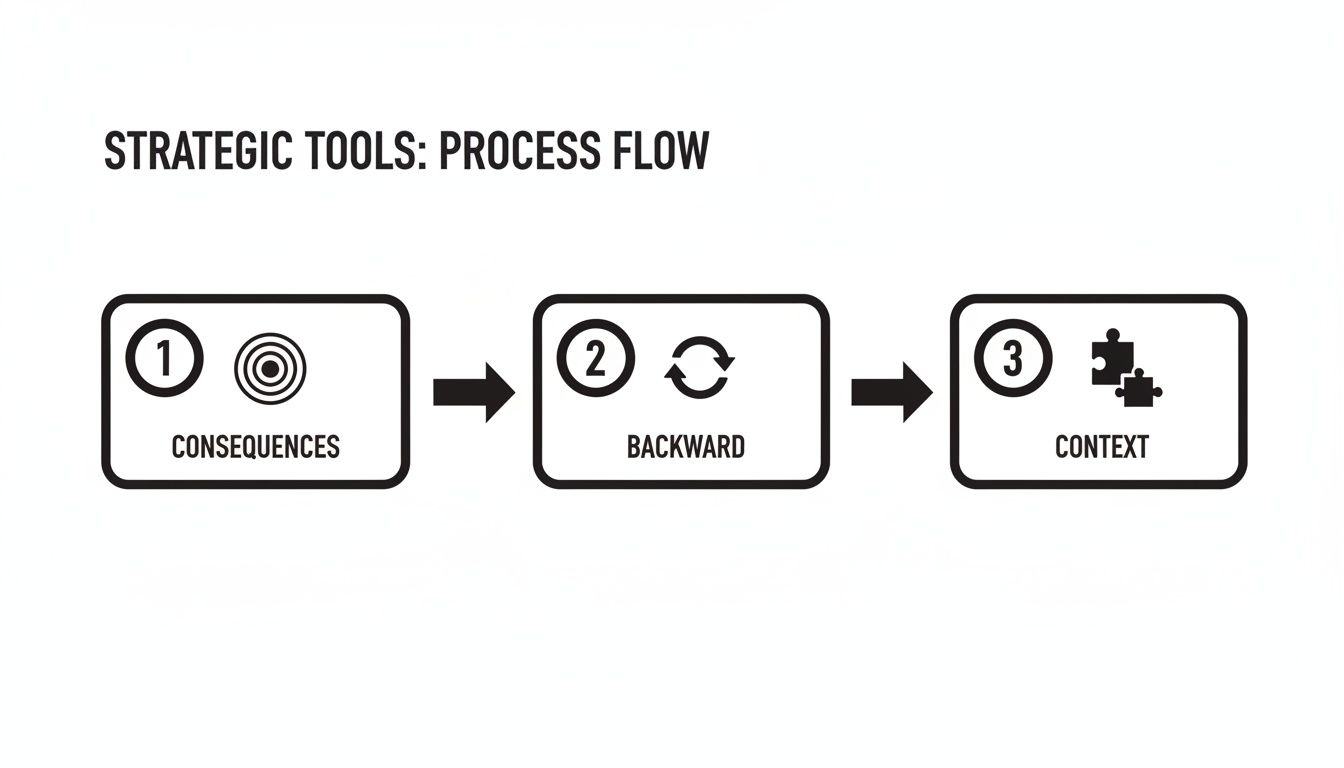
The visual shows that good strategy involves looking forward (Consequences), working backward from a goal (Inversion), and understanding the current landscape (Context).
Queens Game is a perfect example of a puzzle that trains all three. It challenges you to place queens on a board so that none can attack each other. It looks simple, but it’s a powerful workout for your strategic mind.
A Walkthrough: Queens Game as a Strategic Exercise
Let’s break down how solving a Queens Game puzzle directly maps to real-world strategic skills. The goal is to place queens on a grid where no two threaten each other horizontally, vertically, or diagonally.
Each move you make mirrors a core strategic principle:
- Constraint Analysis: Your very first move creates a web of constraints. Placing a queen in a corner immediately blocks off numerous squares. This is exactly like making a business decision—such as choosing a specific technology—which immediately closes off other options and defines your path forward.
- Pattern Recognition: As you place more queens, you’ll start to see recurring patterns. You’ll learn that certain placements are inherently weak because they restrict too much of the board too early. This is the same skill as recognising market patterns or team dynamics that signal either opportunity or risk.
- Hypothesis Testing: You’ll often place a queen, follow the logical consequences, and realise it leads to a dead end. This forces you to backtrack and try a different line of attack. This is the essence of experimentation in business—launching a small pilot, seeing what happens, and being ready to pivot if your first idea was wrong. Puzzles like these are excellent for strengthening your creative problem-solving skills.
- Resource Allocation: Every square on the board is a resource. A poorly placed queen "wastes" valuable territory. A strategic player places queens to control just enough space while leaving maximum flexibility for future moves. This is the same logic you use when allocating a budget or your team's time to a project—you want to hit your objective with maximum efficiency.
By regularly engaging in exercises like these, you're not just passing the time. You are building powerful, transferable skills in a focused, repeatable way, making strategic thinking a natural part of your cognitive toolkit.
Applying Strategic Thinking in the Real World
This is where theory hits the road. All the mental models and exercises we’ve talked about are great, but they’re only valuable when they lead to real, tangible results.
When you practice anticipating consequences or analysing constraints in a game, you’re building the exact mental muscles needed to drive business outcomes. It’s the difference between a team that just reacts to market shifts and one that sees them coming, turning disruption into an advantage.
From Puzzle Logic to Professional Impact
Think about what you do when solving a logic puzzle like Queens Game. You're constantly scanning the board, seeing how one move limits every future choice, and testing ideas until you find the right path.
That same process plays out in the professional world every single day.
A project manager with these skills doesn't just make a to-do list. They see the entire system of dependencies, predicting how a delay in one spot will jam up everything else down the line. They see the whole board, not just the next move. This is how you go from being an operational manager to a genuine strategic leader. A great starting point is getting comfortable with a few core decision-making techniques.
Data-Driven Strategy in the UK Market
Nowhere is this clearer than in the rise of data-driven strategy. UK firms, for example, are showing how powerful this kind of structured, analytical thinking can be on a global scale.
A recent 2025 State Street Data Study found that 74% of UK companies said data-led insights delivered their biggest business returns. That’s miles ahead of the global average of 58%.
This data-first mindset allows UK firms to respond 20-30% faster to changes. On top of that, 63% of them are excellent at using data to manage compliance and outsourced work—nearly double the global average.
This isn't luck. It's the direct result of a culture that values looking past the immediate numbers to find the underlying patterns. That’s the very essence of strategic thinking.
Cultivating a Strategic Mindset Daily
So how do you actually use this stuff day-to-day? The key is to start small. Treat every minor challenge as a chance to flex your strategic muscles.
Before you send that important email, pause. What are the second-order effects? Who else will this impact? What new questions will it create?
When you plan your week, don't just list tasks. Think about them as resource allocation. Which activities give you the highest return on your time and energy?
Here are a few ways to start wiring this into your routine:
- Question Assumptions: Before you tackle a problem, ask, "Is this the real issue, or just a symptom?"
- Seek Diverse Perspectives: Grab a colleague from another department and ask for their take. It’s the fastest way to find blind spots in your own thinking.
- Run Mini "Pre-Mortems": For any small task, ask yourself, "If this goes wrong, what's the most likely reason?" This five-minute check can save you hours of fixing things later.
By making these small shifts, strategic thinking stops being something you do and starts becoming part of who you are. It turns an abstract skill into a real-world advantage.
How to Measure Your Growth as a Strategic Thinker
Developing strategic thinking is a journey, not a destination. But without a way to track your progress, it’s easy to feel like you’re just spinning your wheels.
How do you know the mental models and exercises are actually working? The trick is to move beyond just feeling smarter and build a real feedback loop for your own development. This means shifting from passively hoping you'll improve to actively hunting for proof that you are. It’s not about getting a score; it's about gaining the self-awareness to see what's working and where you still need practice.
Keep a Decision Journal
One of the most powerful and simple methods is keeping a decision journal. Whenever you face a significant choice—at work or at home—just write it down.
- The Situation: Briefly outline the problem and its context.
- Your Reasoning: Jot down the options you considered, any mental models you used (like Second-Order Thinking), and exactly why you picked one path over the others.
- Expected Outcome: What do you honestly believe will happen because of this decision? Be specific.
Then, just set a reminder to look at that entry in a few months. This little trick forces you to compare what you thought would happen with what actually happened. You’ll start seeing patterns fast—maybe you always underestimate risks, or maybe you forget to consider a key group of people. It’s a personal, data-driven way to sharpen your instincts over time.
By reviewing past decisions, you stop relying on faulty memory and start learning from hard evidence. This is how you systematically find your blind spots and upgrade your entire decision-making process.
Seek Targeted Feedback
Self-reflection is crucial, but an outside perspective is gold for spotting the biases you can't see yourself. Don't just ask a mentor or trusted colleague, "How am I doing?" That’s way too vague.
Instead, ask focused questions about your process. Walk them through a recent problem you tackled and explain your thinking.
Then ask sharp, probing questions like:
- "What factors would you have looked at that I might have missed?"
- "Did you notice any weak assumptions in my logic?"
- "What were the second- or third-order consequences you saw that I overlooked?"
This kind of feedback gives you actionable insights, not just generic praise or unhelpful criticism.
Assess Your Ability to Anticipate
A huge sign of growth is a better ability to see what's coming. You can measure this by looking at how well your plans hold up when something unexpected happens. Are your strategies brittle, shattering at the first sign of trouble? Or are they resilient and built to adapt?
This idea of strategic foresight is critical everywhere. In the UK government, for example, strategic thinking has been vital for putting solid analysis at the heart of major decisions. Their Analysis Function has matured by using shared tools, which has cut down on duplicated work by an estimated 20-30%. Now, they're looking to empower analysts with AI, projecting a 15% efficiency boost for foresight exercises by 2028. You can read more about the government's strategy for analysis.
When you make a plan, make a quick note of the potential disruptions you saw coming. Over time, you'll see if your ability to predict and prepare for those ripple effects gets any better. That’s tangible proof your foresight is getting sharper.
Your Top Questions About Strategic Thinking
As you start getting serious about strategic thinking, a few questions always pop up. It's totally normal. You're not just memorising a few frameworks; you're rewiring how your brain approaches problems, and that can feel a bit strange at first. Let's clear up some of the most common hurdles.
Having solid answers helps you set realistic expectations, stay motivated, and see how this all fits into the bigger picture of your career and life.
How Long Until I See a Real Difference?
There's no set timeline, because everything depends on how consistently you practise. But you can start to feel a shift in your mindset surprisingly fast.
If you can carve out just 15-20 minutes a day for focused practice—maybe applying a mental model to a news story or playing a few rounds of a logic game like Queens Game—you'll start noticing a change within weeks. The biggest initial win? You’ll start asking much better questions and seeing connections you used to miss.
More concrete results, like making noticeably better decisions at work or building more robust plans, usually start to show up within three to six months. It’s not about the clock; it’s about the consistency.
Is This a Natural Talent or Can It Be Learned?
This is the big myth that stops so many people before they even start. While it’s true some people might have a natural knack for big-picture thinking, strategic thinking is overwhelmingly a learned skill.
Think of it like learning an instrument. Nobody is born a concert pianist; they get there through deliberate practice. The same goes for your mind.
Every time you apply a framework like Second-Order Thinking, play a strategy game, or review a past decision, you are literally building and strengthening the neural pathways for strategic thought. Great strategists aren't born; they're built.
How Can I Use This Stuff Outside of My Job?
Strategic thinking isn't just a business tool—it's a life skill. The principles apply everywhere and can bring a huge amount of clarity to your personal life.
Here are a few quick examples:
- Personal Finances: Instead of just making a monthly budget (that's operational), you can think strategically about long-term financial goals. This means looking ahead to big expenses like a home or education, understanding market cycles for investments, and making smart trade-offs now for security later.
- Health and Fitness: A strategic approach to health sees the whole system—sleep, nutrition, stress, and exercise. It's about creating a sustainable plan that anticipates bumps in the road, like holidays or a crazy week at work, so you don't get derailed.
- Family and Relationships: You can use strategic foresight to think through the likely consequences of your words and actions, especially in tricky family situations. This helps you build stronger bonds and sidestep needless arguments.
The core skills—seeing the system, planning for what-ifs, and thinking a few steps ahead—are just as powerful at the kitchen table as they are in the boardroom.
What’s the Best Way to Get My Team Thinking More Strategically?
You can't just tell a team to "be more strategic." You have to change the environment. It starts by shifting the team culture from rewarding the fastest answer to rewarding the most thoughtful process.
The easiest place to start is with the questions you ask. Instead of asking, "What should we do?", try asking things like:
- "What could go wrong with this plan?"
- "What are the knock-on effects if we do this?"
- "What key information are we missing?"
Run exercises like project pre-mortems, where the team imagines the project has already failed and works backwards to figure out why. This creates a safe space to poke holes in ideas. Using collaborative tools for practice helps everyone get comfortable thinking out loud and learning from each other. When you praise the quality of the thinking, not just the speed of the reply, you'll start to build a genuinely strategic team.
Ready to put theory into practice? The fastest way to build your strategic muscle is with fun, consistent exercise. Queens Game is the perfect training ground for sharpening your foresight and your ability to work with constraints.
Start playing for free and make strategic thinking a daily habit.