

Solving logic puzzles is a skill, not a talent. It’s a rewarding mental workout that’s all about applying rules methodically, chipping away at impossibilities, and chaining small deductions together until the full picture emerges. At its heart, the process involves turning a set of clues into a logical grid and using pure reason to find the single correct answer.
Building Your Puzzle Solving Foundation
Welcome to the brilliant world of logic puzzles. Forget random guesswork—solving these challenges is about adopting a structured way of thinking. This mindset transforms a seemingly tangled mess of possibilities into a clear path forward. It’s an exercise in patience and sharp thinking that absolutely anyone can master.
This guide is your framework for success. We’ll break down the core principles that drive every solution, starting with the engine of all logic puzzles: deductive reasoning. This is simply using known facts to reach a conclusion that is 100% guaranteed. For instance, if you know "The key is in either the red box or the blue box," and you then learn "The key is not in the blue box," you can deduce with absolute certainty that it must be in the red one.
Key Concepts to Get Started
Before you jump into a complex grid, it helps to internalise a few big ideas. These principles form the bedrock of every strategy you’ll ever use.
To get started, here are the foundational concepts you'll need to solve logic puzzles effectively.
Core Puzzle Solving Principles
| Principle | What It Means | Why It's Important | | :--- | :--- | :--- | | Single Truth Principle | Most standard logic puzzles are designed to have only one correct solution. | This gives you confidence. Every clue is a breadcrumb leading to a unique outcome, so there are no ambiguities to worry about. | | Process of Elimination | Instead of trying to find what is true, you often make more progress by figuring out what must be false. | This is your most powerful tool. It simplifies the puzzle by shrinking the field of possibilities with every cross-out you make. | | Information Chaining | Each piece of information you confirm unlocks new deductions. | A single 'aha!' moment can cause a domino effect, revealing answers across the entire puzzle grid. |
This isn't just a niche hobby; it's a massive cultural activity. A 2022 study in the UK found that a staggering 63% of UK adults solve puzzles at least once a week, spending an average of 169 hours on them every year. That speaks volumes about the universal appeal of a good logical challenge.
The real art of solving a logic puzzle isn’t about being a genius who spots the answer instantly. It’s about having the discipline to follow a process, mark your deductions carefully, and trust that the clues will guide you home.
As you start out, remember that practice makes perfect. Beginning with simpler puzzles is the best way to build both your confidence and your strategic muscles. If you're looking for a consistent way to sharpen your skills, exploring daily challenge puzzles is a fantastic habit to get into. With the right mindset and a structured approach, you'll be untangling even the toughest puzzles in no time.
Translating Clues into Actionable Steps
Getting good at logic puzzles starts when you stop just reading the clues and start dissecting them. Think of yourself as a detective. Every clue is a piece of evidence, but it's your job to figure out what it actually means for your grid.
This isn't about passive reading. It's an active hunt for instructions hidden in plain sight. A single word like "not" or "immediately" can completely change a clue's meaning, and missing it can send your entire solution off the rails.
Understanding Direct and Negative Clues
The easiest clues to work with are direct clues. They’re your anchor points—statements that connect two things with total certainty.
A clue like, "Anna lives in the blue house," is a gift. You get to go straight to your grid and mark the intersection of 'Anna' and 'Blue House' with a tick. That one move does double duty: it also lets you put crosses in all other house colours for Anna, and all other names for the blue house. Solid progress.
Then you have negative clues, which tell you what isn't true. A clue like, "Ben is not the doctor," is just as powerful. It lets you place a definitive cross where 'Ben' and 'Doctor' meet. It doesn’t solve anything on its own, but it chips away at the possibilities, narrowing the field.
These two clue types are your bread and butter for the initial setup.
- Direct Clues: These are your starting facts. Mark them first to build a foundation of truth on your grid.
- Negative Clues: These are for systematic elimination. They clear the board of wrong answers, making the right ones easier to spot.
From Vague Phrases to Concrete Conditions
Of course, not all clues are that simple. Puzzles often throw you curveballs with more nuanced language to see if you're really paying attention.
Take a relational clue like, "The person who ordered tea sits somewhere to the left of the person who ordered coffee." You can’t mark a specific box yet, but you've just been handed a critical rule. It establishes a spatial relationship that must always be true. If coffee ends up in slot 3, you know for a fact that tea has to be in slot 1 or 2.
The goal isn't just to read the words; it's to extract the underlying rule. Every clue, no matter how vague it seems, contains a constraint that limits the possible outcomes.
Here’s another classic example: "Of Charles and Diana, one is the banker and the other is the lawyer." This clue is a goldmine. It creates a self-contained logical pair and tells you four things at once:
- Charles is either the banker or the lawyer.
- Diana is either the banker or the lawyer.
- No one else can be the banker or the lawyer.
- Charles and Diana can’t have any other job.
That single sentence lets you place a whole bunch of crosses on your grid, dramatically reducing the options for everyone else involved.
By carefully taking each clue apart, you turn a simple list of sentences into a series of logical constraints and actionable marks on your grid. This is the groundwork that separates frustrated solvers from confident ones and sets you up for the powerful deductions to come.
Building Momentum with Systematic Deductions
Okay, you’ve got the first clues marked on your grid. Now the real work starts. This is the moment you switch from just taking notes to actively finding new information. Your best friend here is the process of elimination—a straightforward way to figure out what is true by proving what can’t be.
This turns your grid from a static checklist into a dynamic battlefield. Every 'X' you mark is a small victory, closing off one possibility and inching you closer to the one correct answer. It’s all about building momentum; each tiny deduction powers the next.

Think of it like this: the clues are your starting ingredients. Your systematic process is the recipe that turns them into a finished solution. Every mark you make is a step in that recipe.
Embracing a Simple Marking System
To keep your head straight, you need a clear system for marking your grid. Don't overcomplicate it. The classic method is the best because it’s quick and impossible to misread.
- Use a tick (✓) or a solid dot (●) for a definite 'yes' – you've proven a link.
- Use a cross (X) for a definite 'no' – you've proven it's impossible.
When you place a tick—confirming, say, that 'Priya' is the 'Biologist'—that one move sets off a chain reaction. You must immediately place crosses in the rest of Priya's row (she can't have another job) and the rest of the Biologist's column (no one else can be the Biologist). This isn't just tidy; it's essential.
A rookie error is marking the 'yes' but forgetting to follow through with all the 'no's. Filling in those extra crosses isn’t just admin. It’s often how you spot your next move.
Unlocking Answers with Cross-Contextual Deduction
As you start filling things in, you'll notice how different categories talk to each other. This is where cross-contextual deduction comes in. It sounds fancy, but it just means using a fact from one part of the grid to eliminate options in a totally different part.
Imagine a puzzle about people, their jobs, and their pets. You get a clue: "The teacher owns a cat." At first, that doesn't tell you who the teacher is.
But later, you figure out that 'Sarah' does not own a cat. Put those two bits of information together, and you get a brand new fact: Sarah cannot be the teacher. Now you can put an 'X' where 'Sarah' and 'Teacher' meet, a move that was impossible with either clue on its own.
This is the very heart of puzzle-solving. You’re constantly scanning the grid for these ripple effects, where one new truth sends waves across all the categories.
Finding the Keystone Clue
Not all clues are made equal. Some are simple warm-ups, but others are keystone clues—the ones that crack open huge sections of the puzzle all at once. Learning to spot them is a skill you develop over time.
A keystone clue will often link several categories or create a powerful restriction. For example: "The person who lives in the yellow house, who is not Mark, is the engineer." This one connects house colour, name, and job, giving you tons of leverage.
When you find one like this, stick with it. Squeeze every last drop of information out of it before you move on. It will almost always blow the puzzle wide open.
These "aha!" moments are a huge part of why logic puzzles are so compelling. And it's a popular pastime; in the UK alone, puzzle enthusiasts make up 5.20% of unique users on some English-language puzzle sites, which is over 87,000 visitors a year.
If you enjoy the kind of structured, strategic thinking found in grid puzzles and chess, there are plenty of mobile games that offer a similar kick. Check out some of the best logic puzzle games like chess available on mobile to practise these skills anywhere.
By sticking to these principles—using a clear system, looking for chain reactions, and spotting those all-important keystone clues—you’ll build an unstoppable momentum that takes you from a confusing grid to a deeply satisfying solution.
Advanced Strategies For When You Get Stuck
We’ve all been there. You've filled in all the obvious clues, chased down every direct link, and stared at the grid until your eyes glaze over. But the puzzle still isn't finished. There’s no clear next move.
This is actually where the real fun begins. Getting unstuck is less about finding a missed clue and more about changing your entire approach. When the easy deductions dry up, it's time to start asking the puzzle questions instead of waiting for it to give you answers.
The Power Of The 'What If' Question
The single best tool for breaking a deadlock is a technique called bifurcation. I just call it the 'What If?' method. It's a fancy term for making a temporary, calculated guess and seeing what happens.
It’s a bit like a controlled experiment. Here’s how it works:
- Find a 50/50 choice. Look for a square with only two possibilities left. For instance, maybe you know that 'Sarah' is either the 'Doctor' or the 'Pilot', but you can’t prove which.
- Make an assumption. Pick one and pencil it in. Let's say, "Sarah is the Doctor."
- Follow the dominoes. Keep solving the puzzle with this new 'fact' in place. See what else it forces to be true.
- Wait for the result. One of two things will happen. Either everything clicks and you solve the puzzle, or you’ll hit a dead end—a contradiction where a rule is broken (like two people having the same job).
If you find a contradiction, you've just struck gold. It proves your assumption ("Sarah is the Doctor") was wrong. Now you can confidently erase all your pencil marks and lock in the only other possibility: Sarah must be the Pilot.
It feels like guessing, but it’s pure logic. By proving one path is impossible, you’ve discovered a 100% certain truth. It turns a frustrating dead end into a massive breakthrough.
Recognising Patterns Beyond The Grid
Top-tier puzzle solving also means seeing the bigger picture. Many complex puzzles are built on core patterns that, once you spot them, make the solution feel almost obvious.
A perfect example is the classic N-Queens Problem. The challenge is to place a set number of queens on a chessboard so that none of them can attack each other. That means no two queens can be on the same row, column, or diagonal.
Here’s one of the twelve core solutions for the Eight Queens Puzzle on a standard 8x8 board.
The image shows a perfect arrangement where every queen is safe.
Solving this isn't about trial and error; it’s about understanding patterns of exclusion. Every queen you place creates "no-go zones" across the board. This same idea applies to grid puzzles. When you confirm 'Mark lives in the red house', you’re also creating no-go zones—Mark can't live anywhere else, and nobody else can live in the red house.
Seeing these underlying structures helps you think more abstractly. If you find this kind of spatial thinking interesting, our deep dive into strategies for solving the Queens Puzzle is a great next step.
Combine the 'What If?' approach with sharp pattern recognition, and you'll have the tools to break through any wall. These advanced strategies transform frustration into a chance for a clever, satisfying win.
A Complete Puzzle Walkthrough From Start to Finish
Talking about strategy is one thing. Watching it dismantle a real puzzle is another. Let's walk through a classic logic grid puzzle together, move by move. I'll break down my thought process so you can see how each small deduction builds on the last one.
Imagine this scenario: four colleagues—Amelia, Ben, Chloe, and David—each bring a different dessert to the office bake-off. We have a Cake, Brownies, Cookies, and a Pie. The goal is simple: figure out who brought what.
Setting Up the Grid and Processing Clues
First, I'll sketch out a simple grid. Names down the side, desserts across the top. This is our canvas. Now, let's look at the clues and turn them into marks on the grid.
Clue 1: "Amelia did not bring the Brownies or the Pie."
This is a direct negative. Easy enough. We find Amelia's row and put a big fat cross (X) in the 'Brownies' and 'Pie' columns. Right away, we know her dessert has to be either the Cake or the Cookies.
Clue 2: "David is allergic to chocolate, so he didn't bring the Cake or the Brownies."
Another negative clue, this time with a bit of real-world logic baked in. Assuming the cake and brownies are chocolatey, we can put an X next to David’s name under both 'Cake' and 'Brownies'. His options are now narrowed down to Cookies or Pie.
Clue 3: "Chloe bought the Cookies from a local bakery."
Bingo. This is the positive clue we’ve been waiting for. It’s the linchpin that will start to crack the puzzle open. We put a tick (✓) where 'Chloe' and 'Cookies' intersect.
This one tick causes a chain reaction. If Chloe brought the Cookies, she couldn't have brought anything else. So, we place an X in all the other boxes in her row (Cake, Brownies, Pie). And if she brought the Cookies, no one else did—so we drop an X in the Cookies column for Amelia, Ben, and David.
This cascade effect is the absolute heart of solving logic puzzles. One solid fact eliminates a whole web of possibilities, clearing the fog across the entire board.
Using Secondary Deductions to Finish the Puzzle
With our grid looking a lot less crowded, let's revisit what we know. Look at Amelia’s row. We crossed out Brownies and Pie from the first clue. Thanks to Chloe, we just crossed out Cookies. Only one box is left: Cake. That gets a confident ✓.
This new fact sets off another round of eliminations. Since Amelia brought the Cake, Ben couldn't have. That’s another X on the board.
Now, glance at Ben's row. The only dessert left for him is Brownies. That’s a ✓. And by simple process of elimination, the last empty spot—Pie for David—must be the final answer. Puzzle solved.
- Amelia brought the Cake.
- Ben brought the Brownies.
- Chloe brought the Cookies.
- David brought the Pie.
Sometimes, even with this methodical approach, you'll get stuck. When that happens, you might have to make a calculated guess and see where it leads, just like this diagram shows.
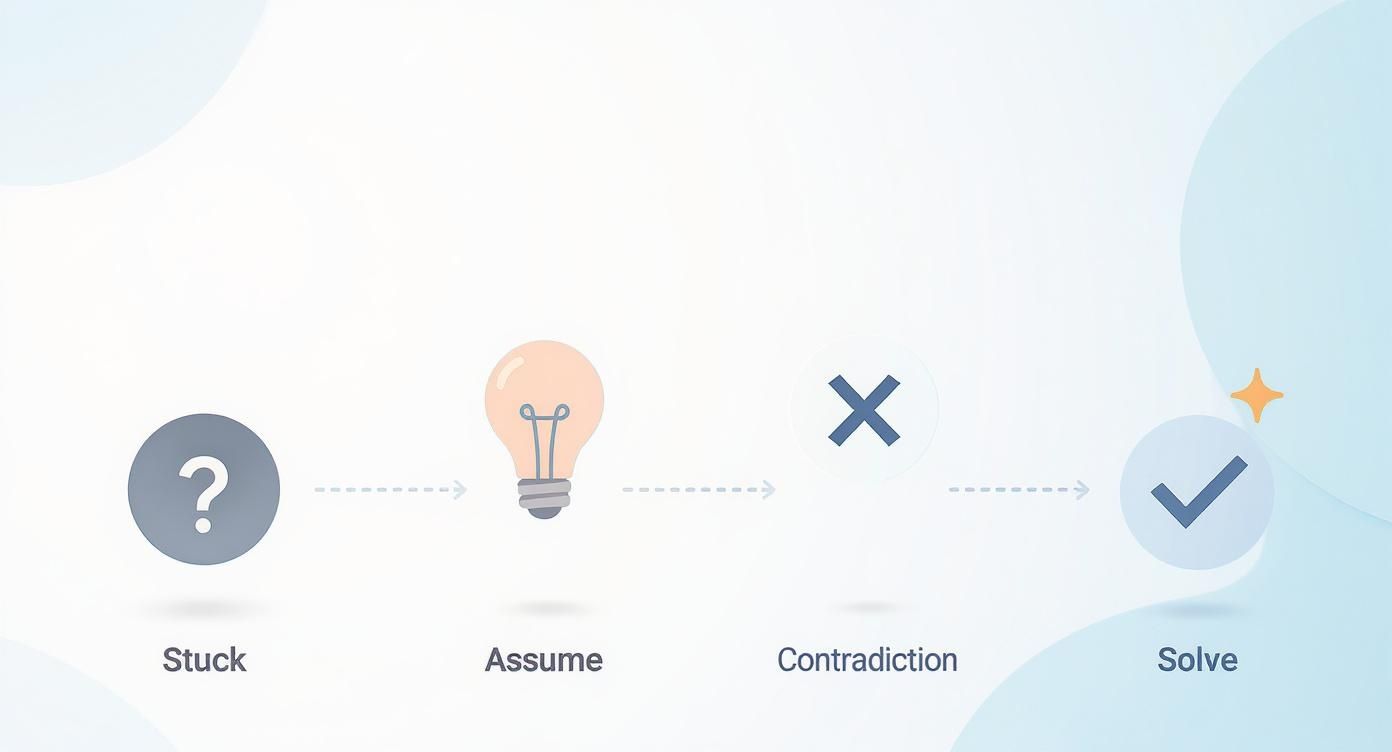
This is the 'What If?' strategy in action. You assume a potential answer, follow it to its conclusion, and see if it breaks the puzzle's rules. If it does, you've just proven that your initial assumption was wrong, which is just as valuable as proving something right. It's a powerful tool for breaking through a tough spot and shows that solving puzzles is all about patient, methodical steps—not one big flash of genius.
Common Questions About Solving Logic Puzzles
Even with a solid strategy, you're going to hit a wall. It happens to everyone. Getting stuck is just part of the process, a sign that the puzzle is pushing you to think differently.
Let's walk through the most common sticking points and how to get past them. Think of this as your troubleshooting guide for when the grid just isn't cooperating.
What Is The Best Way To Start A New Logic Puzzle?
Your first few moves set the stage for everything that follows. Before you put pencil to paper, just read all the rules and clues. A quick scan gives you a mental map of what you're up against.
Once you’ve got the lay of the land, hunt for the anchors. These are the most direct, undeniable clues—the ones that give you a concrete "yes" or a definite "no." A clue like "Sarah is in the green hat" is gold.
Get those facts onto your grid immediately. They create a foundation of truth to build on, instantly wiping out a whole category of possibilities and making your next deductions that much easier.
I've Filled In Everything I Can, But The Puzzle Isn't Solved.
This is the classic wall. You've gone through every clue, marked everything obvious, and the grid is still full of holes. This just means the puzzle is asking you to go a level deeper.
First, go back and re-read every single clue. Slowly. It's shockingly easy to misinterpret a subtle word. Does "next to" mean on either side? Does "between" imply a specific order? A single word can unlock everything.
If that doesn't work, start looking for connections between clues that seem unrelated. This is where the real magic happens. For example:
- Clue A: "The doctor owns a dog."
- Clue B: "Mark does not own a dog."
- New Deduction: Therefore, Mark can't be the doctor.
When you’re truly stuck, it’s time for the 'What If?' technique we covered earlier. Pick a 50/50 square, make a single assumption, and follow that logic to its conclusion. It’s often the only way to break a serious deadlock.
Don't see a sticking point as a failure. It’s an invitation to think more deeply. The best breakthroughs always come right after the toughest moments.
How Do I Avoid Making Mistakes And Having To Start Over?
The temptation to guess is real, especially when you feel like you’re one move away from the solution. But the number one rule is simple: never guess. Only mark something as true or false when you are 100% certain.
A pencil and eraser help, but a systematic approach is your best defence. A clean, consistent marking system lets you track your logic. If you do suspect a mistake, you can retrace your steps instead of wiping the entire grid and starting from scratch.
Are Online Logic Puzzles Different From Paper Ones?
The core logic is identical. Whether it's on a screen or a piece of paper, the skills of deduction, elimination, and pattern spotting are completely the same.
The main difference is that online platforms often add helpful features. Many will automatically fill in corresponding crosses when you mark a tick, which saves time and cuts down on simple mistakes. It lets you focus purely on the logical challenge.
Ultimately, just practise on whichever format you prefer. The skills you build on one will absolutely benefit you on the other.
At Queens Game, we're all about focused, logical challenges that sharpen the mind. If you enjoy the systematic thinking behind logic puzzles, our chess-based brain teasers offer a fresh way to test your skills.
Explore the challenges at Queens Game
Article created using Outrank