

Cracking an abstract reasoning test is the key to turning a daunting recruitment hurdle into a real advantage. It’s all about systematically training your brain to spot logical patterns, sequences, and rules under the clock—a skill that’s non-negotiable for competitive UK graduate roles.
Why You Can't Afford to Skip Abstract Reasoning Practice
Let's be direct. Abstract reasoning tests are a formidable gatekeeper in the UK job market. I’ve seen countless talented and otherwise perfect candidates get filtered out at this early stage, often because they just didn't take the preparation seriously enough.
Top employers in demanding sectors like finance, consulting, and engineering lean on these assessments for a simple reason: they show how you think on your feet.
These tests aren't about what you already know; they measure how you think. They’re designed to gauge your ability to:
- Spot underlying logical rules in completely unfamiliar information.
- Process complex visual data quickly and with precision.
- Apply those rules to solve new problems you’ve never seen before.
- Think critically and methodically when the pressure is on.
Essentially, they offer a clear window into your raw problem-solving horsepower and how fast you can learn. These are invaluable skills in any dynamic professional environment, which is why abstract reasoning test practice is less about memorising answers and more a form of cognitive training.
The Stakes Are Higher Than You Think
In the cut-throat world of UK graduate recruitment, these tests are a make-or-break part of the selection process. The numbers tell a pretty stark story: some research suggests a staggering 60-80% of candidates are rejected based on their aptitude test performance alone.
That statistic, highlighted in resources like Graduates First's 2026 practice guide, shows just how crucial preparation is. If you're aiming for a top-tier career, you simply have to get this right.
A strong performance isn't just about getting the right answers. It's about showing the mental agility and systematic approach that top firms are actively hunting for. It signals that you don't panic when faced with ambiguity and complexity.
Turning a Hurdle Into an Advantage
Here's the good news: abstract reasoning is a skill. And like any skill, it can be massively improved with the right kind of practice. Targeted training builds the necessary mental muscles, transforming what looks like a confusing jumble of shapes into a series of solvable puzzles.
By committing to consistent abstract reasoning test practice, you train your brain to stop seeing chaos and start seeing connections. You quickly learn to systematically check for common patterns—rotations, reflections, colour changes, or numerical sequences. This makes the whole process less intimidating and far more methodical.
This systematic approach not only boosts your score but also builds the confidence you need to walk in and perform at your best when it really counts.
Decoding the Patterns: A Breakdown of Common Question Types
Staring at a grid of bizarre shapes and feeling your brain seize up? You're not alone. These puzzles look intimidating, but cracking them is less about genius and more about knowing what to look for. Good abstract reasoning test practice starts by pulling back the curtain on the core question types you're guaranteed to see.
Most tests are built around just a few key formats. Once you get a feel for their structures, you can stop guessing and start developing a system for each one. That’s how you save precious time and keep the panic at bay. You'll go in with a mental checklist, not a sense of dread.
Let's break down the three most common types you'll face, complete with a few examples to walk you through the thought process.
Next in Sequence Puzzles
This is the classic abstract reasoning challenge. You get a row of shapes and have to pick which option logically comes next. The secret is to stop looking at the whole picture and start isolating the individual pieces to see how they change from one box to the next.
Ask yourself how each component behaves on its own. Is a shape rotating? Is a colour swapping? Is the number of sides on a polygon growing or shrinking?
Try this simple process:
- Pick one thing: Focus on a single element, like a small black circle. Track only its journey across the sequence. Does it hop clockwise from corner to corner? Does it disappear and reappear?
- Find its rule: Once you spot a consistent pattern for that one element (e.g., "it rotates 45 degrees clockwise each time"), you’ve found a rule.
- Check your work: Apply that rule to predict the next step. Does your prediction match one of the answers? If yes, you're on the right track.
- Look for other rules: Most puzzles have multiple things happening at once. A second shape might be changing colour while the first one rotates. Analyse each rule separately before putting it all together.
Find the Odd One Out
Here, you’re shown a set of figures and have to spot the one that doesn't belong. Your job is to find the single rule that connects most of the items, then pinpoint the one that breaks it.
For instance, you might see five boxes. Four of them could contain an even number of shapes, while one has an odd number. The one with the odd number is your answer. The logic can get more complex, of course, involving things like symmetry, orientation, or the relationship between shapes inside the box.
The trick here is to establish the 'majority rule' first. Don't start by hunting for the odd one out. Instead, find a logical link that connects at least three or four of the figures. The one left over is almost always your answer.
Complete the Matrix Puzzles
Matrix questions give you a grid of shapes, usually 3x3, with one square missing. You need to figure out the grid's underlying logic to see which option fits in the empty space.
The patterns can run horizontally across the rows or vertically down the columns. Your first move should always be to scan the rows for a pattern. If nothing jumps out, check the columns. Sometimes the logic applies to the whole grid, where each row and column must contain one of each type of shape, a bit like a Sudoku puzzle. This is just one of many puzzle types you'll encounter; for a deeper dive, you can learn more about how to solve logic puzzles in our detailed guide.
Your Progressive Practice Plan To Build Confidence
Diving headfirst into full-length, timed abstract reasoning tests is a fast track to burnout. It's a common mistake. A much smarter approach is to build your skills layer by layer, turning raw practice into genuine confidence.
The goal isn’t just to churn through questions; it's to practice with purpose. You'll start by focusing entirely on understanding the logic behind the puzzles, with no clock ticking away in the background. This is crucial for letting the patterns sink in properly before you add the pressure of a deadline.
Starting With Untimed Practice
For your first week, forget the timer exists. Your only mission is to master the 'why' behind each puzzle. Grab some practice questions and work through them slowly, methodically. Concentrate on spotting the rules that govern rotations, sequences, transformations, and other logical shifts.
If you get an answer wrong, don’t just glance at the correct one and move on. This is a critical moment. Force yourself to articulate exactly why your logic was flawed and what the correct pattern was. This deliberate analysis is the single most important habit you can build.
This visual guide shows the main puzzle types you’ll encounter. Get familiar with them.
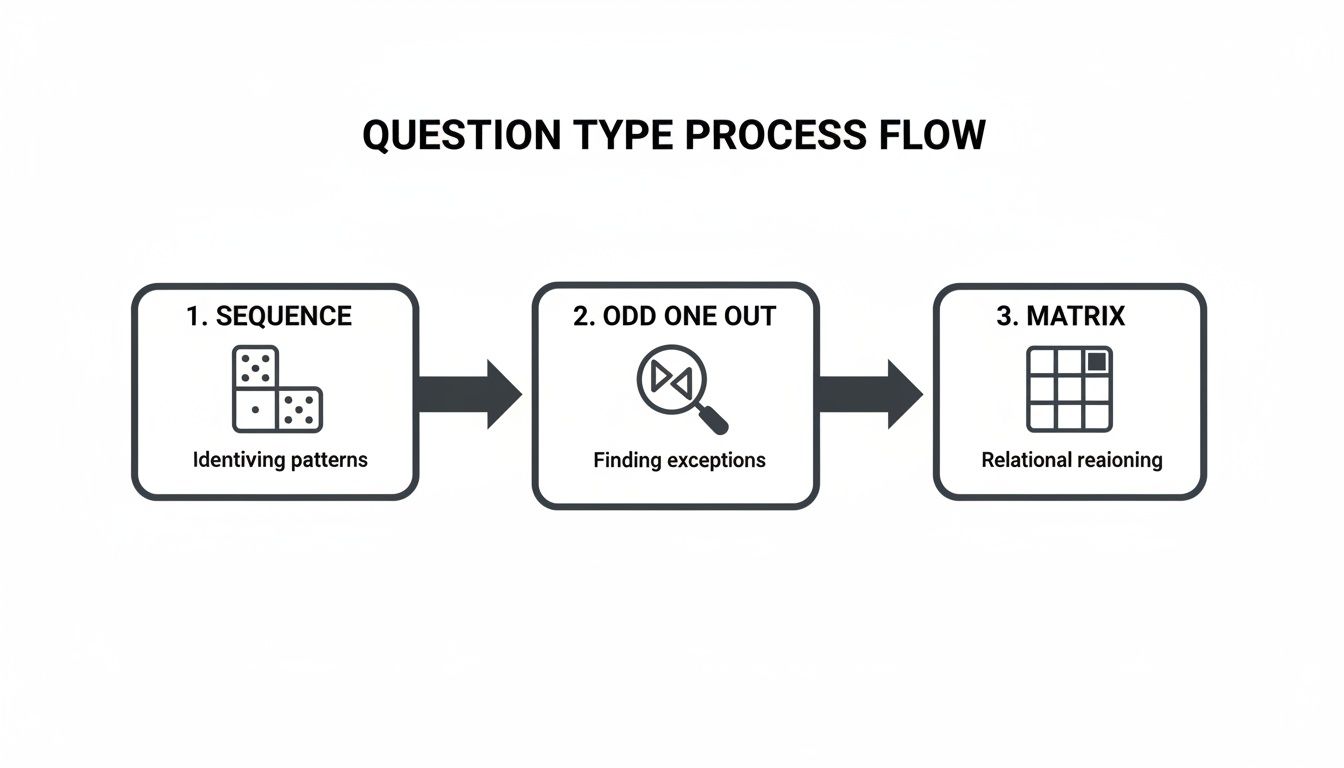
By breaking down your practice by question type—like sequence, odd one out, or matrix—you can isolate and sharpen specific pattern-spotting skills one at a time.
Introducing Time Pressure Gradually
Once you feel solid on identifying the core patterns, it’s time to introduce the clock. But don't jump straight into the deep end. Start by giving yourself a generous time limit, maybe even double the official time allowed per question. Your first goal could be solving a small set of 10-15 questions within this relaxed timeframe.
As you get more comfortable, start tightening the timeframe. Shave 10-15 seconds off your per-question allowance every few days. This method helps your brain adapt to working faster without triggering the panic that leads to silly mistakes.
Key Takeaway: The sweet spot is when you're working quickly but not frantically. You're aiming for 'controlled speed,' not rushed guessing. Pushing the time limit down in small, manageable steps makes this totally achievable.
Using Logic Games To Sharpen Your Mind
Effective abstract reasoning test practice isn't just about grinding through test papers. Weaving logic games into your routine can develop the underlying cognitive skills in a way that feels less like a chore and more like a challenge.
Games that rely on systematic thinking and testing ideas, like the Queens Game puzzle, are especially useful. They train you to:
- Think several moves ahead.
- Systematically test rules and constraints.
- Visualise spatial relationships under pressure.
These skills translate directly to the test environment. Plus, playing these sorts of puzzles consistently is a great way to build mental stamina. Facing a screen of complex shapes for 20-30 minutes straight requires serious concentration. For more tips on that, check out our guide on how to improve concentration and focus.
How to Get Your Strategy Right
Knowing the patterns is one thing, but performing under pressure on test day? That’s a whole different game. A smart strategy is just as important as your ability to spot the rules.
The ticking clock is designed to create pressure. It's so easy to get sucked into a single, tough question, burning precious minutes you could have used to answer several easier ones. You need a plan to stop that from happening.
Master the Clock
Here’s a practical rule I tell everyone to use: the 70-second rule. Most UK graduate-level tests give you about that much time per question. If you haven't figured it out in 70 seconds, staring at it longer probably won't help. It's your cue to make an educated guess and move on.
Plenty of great practice sites mimic this exact pressure. The free test from AssessmentDay is a perfect example—it gives you 10 questions at 70 seconds each, just like the real thing. It’s worth remembering that pass marks are often set by how you perform against other candidates. You can learn more about how UK employers use these tests on AssessmentDay.co.uk.
Following this rule stops one hard puzzle from tanking your whole score. It's far better to answer 15 questions with decent accuracy than to get 10 perfect and leave the last five blank.
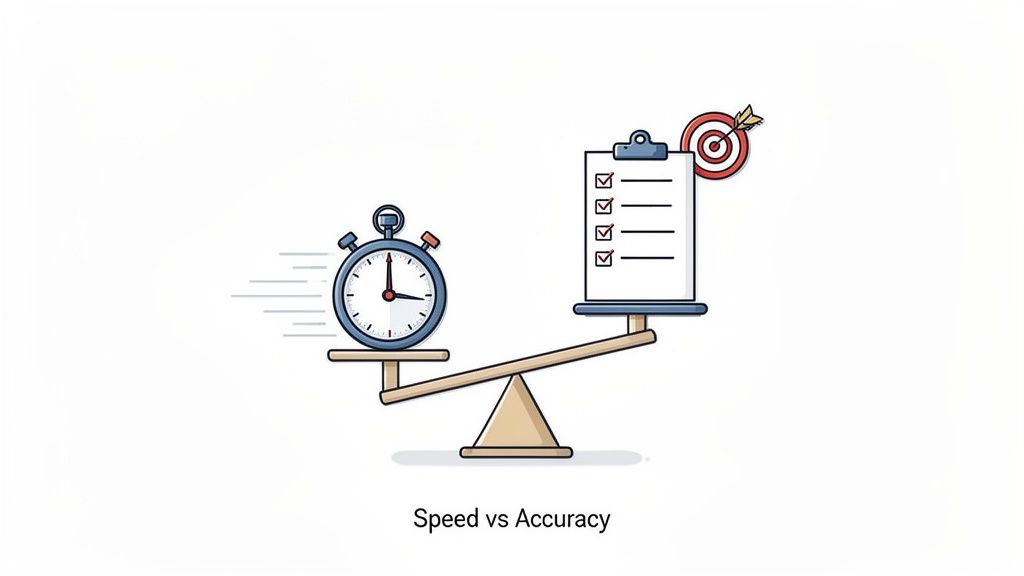
The real skill is finding that sweet spot between speed and accuracy. Go too fast, and you make silly mistakes. Go too slow, and you leave easy points behind. Timed practice is the only way to find your rhythm.
The Art of the Educated Guess
When that 70-second timer is up, don’t just click a random answer. You can seriously boost your odds by quickly eliminating the obvious duds.
Even if you don't know the full pattern, you can often spot options that break a simple rule you have figured out.
- Spot the rule-breakers. If you know a shape rotates clockwise, instantly get rid of any options where it moves anti-clockwise. Easy.
- Identify the decoys. Test makers love including answers that are almost right, but with one tiny detail wrong. A quick scan can often narrow your choices from five down to just two or three.
Winning the Mental Game
Finally, your mindset is everything. Panic is the enemy of logic. When you feel that sense of overwhelm creeping in, just stop. Take a single deep breath for five seconds. It’s a tiny reset that can clear your head enough to refocus.
Remember, you don't need a perfect score. You just need to do well enough compared to everyone else taking the test.
If you want to sharpen your thinking under pressure, check out some of the best brain training games. They are a great way to build the focus and strategic thinking you need. Combine that with your technical practice, and you'll be in the best possible shape to succeed.
How To Analyse Your Performance And Track Improvement
Practising without getting feedback is like running in circles. To genuinely get better at abstract reasoning, you have to learn from every single attempt. This is where you switch from just doing questions to strategically sharpening your problem-solving mind.
The best tool for this is simple but incredibly powerful: an error log. This isn't just a list of your wrong answers. Think of it as a diagnostic journal where you dig into why you made a specific mistake.
Creating Your Error Log
After each practice session, don't just glance at your score and move on. Grab a simple spreadsheet or a notebook and, for every single question you got wrong, jot down these three things:
- Question Type: Was it a 'Next in Sequence', an 'Odd One Out', or a 'Matrix' puzzle? Naming it helps you categorise your weak points.
- The Mistake: Be brutally honest. Did you misread a rotation? Completely miss a numerical pattern? Run out of time? Or was it just a careless click under pressure?
- The Correct Logic: Write down the actual rule or pattern you should have spotted. Forcing yourself to explain it in your own words is what makes the lesson stick.
This process feels a bit slow at first, I'll admit. But the payoff is huge. After a week or two, you’ll start seeing your own personal patterns emerge. Maybe you consistently struggle with puzzles that involve two or three transformations happening at once. Or maybe reflective symmetry always trips you up.
Tracking your errors isn't just about practice; it's a targeted analysis of your own cognitive habits. This lets you focus your next abstract reasoning test practice sessions on the exact areas that need work, turning your weak spots into your strengths.
Understanding How UK Employers Score These Tests
It’s also crucial to know what you’re aiming for. Employers in the UK don't use a simple "pass" or "fail" system. They use percentile scores, which measure your performance against a huge pool of other candidates.
If you score in the 75th percentile, it means you performed better than 75% of the people in that comparison group. This context is everything. What's considered a "good" score can change dramatically depending on the job you're going for.
For instance, dedicated abstract reasoning test practice is essential because UK recruiters take these benchmarks very seriously. Scoring in the 90th percentile or higher often signals the kind of outstanding performance needed for highly analytical roles in engineering or data science. On the other hand, a score in the 75-89th percentile range is usually very competitive for management or consulting positions. You can find more insights into how UK recruiters use these benchmarks at AssessCandidates.com.
Knowing these targets helps you set realistic goals for yourself. You can aim for a specific percentile in your mock tests, which gives your practice a clear purpose beyond just "getting more questions right." It helps you measure what actually matters to the people doing the hiring.
Common Questions About Abstract Reasoning Tests
Even with the best prep plan, a few questions always pop up. It's completely natural. Let's run through some of the most common ones I hear from candidates. Getting clear answers on these can settle your nerves and help you focus on what really matters: your practice.
A big one is whether you can actually get better at these tests, or if it's just something you're born with. The good news? You can absolutely improve. Like any other skill, your performance can get a massive boost with the right kind of abstract reasoning test practice.
How Long Should I Practice For An Abstract Reasoning Test?
There's no magic number here, but what I've seen work time and time again is consistent practice over two to four weeks. This is so much better than a last-minute cram session.
Try to carve out 30-60 minutes a day for focused practice. This gives your brain time to actually absorb the patterns and build up recognition speed without burning out. Always, always start untimed. Get the logic down first. Only then should you start adding the pressure of the clock to simulate real test conditions.
Is It Possible To Fail An Abstract Reasoning Test?
This is a common source of anxiety, but it's a bit of a misconception. You don't really "pass" or "fail" these tests in the way you would a school exam. Instead, UK employers use percentile scores.
Your score simply shows how you performed compared to a huge pool of other people who've taken the same test. A "good" score is completely relative to the job you're applying for. For a competitive grad scheme in finance, you might need to be in the top 20% of candidates (which is the 80th percentile or higher). A lower score isn’t a failure—it just might not be competitive enough for that specific role.
Remember, your score is just a snapshot of your performance on one day, against one group of people. It’s not a final verdict on your intelligence or your potential.
Are Logic Games Genuinely Useful For Test Practice?
Yes, one hundred percent. While they aren't carbon copies of test questions, logic games are a brilliant way to sharpen the exact cognitive skills you need. Think of them as a powerful, and more enjoyable, supplement to formal practice.
Games that force you to think systematically, reason spatially, or test rules under pressure are gold. They train your brain to untangle complex patterns and work methodically, which is the core of any abstract reasoning test. Weaving them into your routine can make the whole process feel less like a chore and really strengthen your foundational problem-solving skills.
Ready to sharpen your logical thinking in a fun, engaging way? Queens Game offers the perfect puzzle environment to build the systematic reasoning and pattern-spotting skills you need. Challenge yourself at https://queens.game.