

Let's be honest, trying to improve your concentration and focus isn't about one single trick. It’s about building a system. Think of it as three core pillars: dialling in your environment, sharpening your cognitive skills, and adopting a few key lifestyle habits. When you start to reduce distractions, practise actual attention-training exercises, and get your sleep right, you create a powerful setup for getting real work done.
Reclaiming Your Attention in a Distracted World

If you find yourself struggling to stay on task, you’re not alone. This isn't a personal failing; it’s a modern reality. Our minds are constantly being pulled in a dozen different directions by notifications, never-ending to-do lists, and the simple mental drain of everyday life. This constant tug-of-war for our attention makes deep concentration feel almost impossible.
But here’s the good news: focus is a skill. It’s not some innate talent you either have or you don't. Just like a muscle, you can strengthen it with the right techniques and consistent practice. This guide is your practical roadmap. We're going to skip the vague advice like "just try harder" and get straight to actionable strategies that help you take back control.
Why Is Sustained Focus So Difficult Today?
The struggle is real, and the numbers back it up. Take a look at the typical workplace. The gap between hours worked and genuine productivity is massive. The average UK employee is only productively engaged for 2 hours and 53 minutes of an eight-hour day.
That means a huge chunk of the workday is lost to distractions. In fact, only 21% of employees feel they are productive for the entire day. You can read more about these workplace productivity statistics and see just how common this issue has become.
This all points to one crucial fact: just being present isn't enough. Real progress demands deep, uninterrupted focus—the very thing our modern environment makes so difficult.
Improving your concentration is less about sheer willpower and more about building an intelligent system of habits and environmental controls that work for you, not against you.
This guide will walk you through creating that very system. We'll explore practical, no-nonsense methods for:
- Optimising your environment to shut out interruptions.
- Training your cognitive skills with targeted exercises.
- Adjusting your lifestyle to build a solid foundation for deep work.
By the end, you’ll have a clear toolkit to cut through the noise, hit your goals more effectively, and reclaim your most valuable asset: your attention.
Designing Your Ultimate Focus Environment

Your environment is constantly sending signals to your brain. Those signals either help you concentrate or they actively sabotage your efforts. If you want to improve your focus without relying purely on willpower, designing a better workspace is one of the most powerful things you can do.
This isn’t just about tidying up. It’s about consciously creating a space where interruptions are minimised and your brain gets the cue that it's time to perform. The goal is to spend less mental energy fighting distractions so you can use it for the task at hand.
Optimising Your Physical Space
Start with what’s right in front of you. Your physical workspace should be a sanctuary for productivity, not a minefield of distractions. A few small tweaks can make a huge difference in signalling to your brain that it’s time for deep work.
Here are a few practical changes to try:
- Control the Sound: Use noise-cancelling headphones or play some low-key ambient soundscapes (like rain or white noise). This masks unpredictable sounds and gives your brain a consistent audio backdrop it can easily ignore.
- Manage the Light: If possible, position your desk to get plenty of natural light, which is a known alertness booster. In the evenings, switch to warmer, softer lighting to help your body wind down and protect your sleep cycle.
- Declutter Deliberately: A messy desk leads to a messy mind. Keep only the absolute essentials within arm’s reach. Everything else needs a designated home, preferably out of your direct line of sight.
The power to control one's environment is a key reason remote work has been linked to better focus. With 64% of UK workers now fully remote, people are discovering new ways to manage their concentration. In fact, 52% say the flexibility has made them more productive. You can find more UK productivity statistics on Clockify.me to see how work-life balance and reduced fatigue are helping people align tasks with their peak focus hours.
Taming Your Digital Environment
Your digital workspace is just as important as your physical one. Notifications, disorganised files, and the endless pull of the internet create a constant threat to your focus.
Creating digital boundaries isn't about restriction; it's about liberation. By curating what gets your attention, you free your mind to engage deeply with what truly matters.
Take back control with these simple tactics:
- Silence the Pings: Turn off every non-essential notification on your computer and phone. Check emails and messages in batches at set times instead of letting them dictate your workflow.
- Organise Your Desktop: A chaotic desktop is just visual noise. Use folders to organise your files and keep your main screen clean and minimal.
- Use Focus Tools: Install a browser extension or app that temporarily blocks distracting websites. That little bit of friction makes you far less likely to mindlessly scroll when you should be working.
Distractions pop up in both our physical and digital spaces, but the strategies for dealing with them share a common theme: be intentional.
Digital vs Physical Distraction Management
| Distraction Type | Physical Environment Fix | Digital Environment Fix | | :--- | :--- | :--- | | Noise & Interruptions | Noise-cancelling headphones, "do not disturb" sign on your door. | Turn off all notifications, use "Focus Mode" on devices. | | Visual Clutter | Clear your desk, keep only essential items in sight. | Organise desktop files into folders, use a clean wallpaper. | | Tempting Alternatives | Move distracting items (books, phone, hobbies) to another room. | Use website/app blockers (like Freedom or Cold Turkey). | | Lack of Clear Purpose | Have a dedicated, single-purpose workspace. | Close unused tabs and apps before starting a new task. |
By actively managing both worlds, you build an ecosystem that nurtures deep concentration. It’s about making focus the path of least resistance.
For more ways to build your attention span, you might like our guide on the top brain-training games.
Cognitive Techniques for Sharpening Your Mind

Just like hitting the gym to train your body, you can train your brain with specific cognitive exercises. Real concentration isn't some hidden talent people are born with; it’s a skill you can build, one rep at a time.
These mental workouts strengthen the neural pathways that control your attention span, making deep, focused work feel less like a struggle and more like a natural state. They give you a framework to cut through the chaos and direct your mental energy where it actually counts.
Practise Mindfulness to Train Your Attention
Think of mindfulness as doing reps for your prefrontal cortex—the part of your brain that handles focus and decision-making. The goal is simple: pay attention to the present moment without judging it.
This practice helps you catch your mind wandering and gently pull it back. You don’t need to meditate for an hour a day to feel the effects. Just five minutes can make a surprising difference.
Here’s a simple way to start:
- Find a quiet spot where you can sit comfortably.
- Close your eyes and just notice the feeling of your breath.
- Your mind will wander. When it does, don't get frustrated. Just acknowledge the thought and guide your focus back to your breath.
That simple act of noticing and redirecting is the core of attention training. It builds the mental muscle you need to stay on task when things get tough.
Mindfulness isn't about silencing your thoughts. It's about becoming the master of your attention, so you choose where it goes.
Structure Your Work with the Pomodoro Technique
Burnout is the enemy of focus. If you try to force yourself to concentrate for hours on end, you’ll just end up mentally exhausted with little to show for it. The Pomodoro Technique flips this on its head by breaking your work into focused sprints.
The method is dead simple:
- Pick one task. Just one.
- Set a timer for 25 minutes and work on nothing else.
- When the timer rings, take a 5-minute break. Do something completely different.
- After four of these cycles (or "Pomodoros"), take a longer break of 15–30 minutes.
This rhythm prevents mental fatigue by building rest directly into your workflow. The short, timed bursts also create a healthy sense of urgency, making it much easier to resist checking your phone or jumping between tasks.
Use Goal Setting for Clarity and Motivation
A wandering mind is often a sign of a vague goal. When a project feels huge or undefined, your brain will naturally look for an easier, more satisfying distraction. The trick is to break down big goals into small, concrete tasks.
Instead of a to-do list item like, "Work on the report," get specific:
- Research competitor data for Section 1.
- Outline the key findings for Section 2.
- Write the first draft of the introduction.
Each tiny task gives you a clear target. Checking it off provides a little hit of dopamine, which reinforces your motivation and makes it easier to keep the momentum going. If you really want to level this up, learning how to improve strategic thinking will give you a major edge in both planning your work and executing it.
Fuel Your Focus with Smarter Lifestyle Habits
What you do outside of work has a massive impact on your ability to concentrate. Think of your lifestyle as the foundation for your mental performance. If that foundation is shaky, even the best focus techniques will eventually fail you.
To really get a grip on concentration, we have to look beyond the desk and at the three things that actually fuel your brain: sleep, nutrition, and exercise. These aren’t just wellness trends; they’re the core biological engines that power deep work.
Prioritise Sleep for Mental Restoration
Quality sleep isn't just about resting. It’s an active process where your brain clears out metabolic junk, cements memories, and resets the circuits you need for sharp thinking. Skimping on sleep is like trying to run a marathon on an empty stomach—you just won't have the mental stamina.
Here’s how you can start getting better sleep tonight:
- Create a Wind-Down Routine: An hour before bed, put your screens away. The blue light they give off can suppress melatonin, the hormone that tells your brain it's time to sleep. Read a book, listen to some calm music, or do a bit of light stretching instead.
- Keep a Consistent Schedule: Try to go to bed and wake up at roughly the same time every day, weekends included. This regulates your body’s internal clock, making it far easier to fall asleep and wake up feeling refreshed.
Sleep isn't a luxury; it's a biological necessity. It's the single most effective thing you can do to reset your brain and body each day.
Eat to Boost Your Brainpower
The food you eat directly shapes your brain's structure and function. Sugary snacks and heavily processed meals lead to energy crashes and brain fog, making it almost impossible to hold your focus. A diet packed with brain-friendly nutrients, on the other hand, provides a steady stream of energy that keeps you alert.
Try to work more of these into your meals:
- Complex Carbohydrates: Foods like oats, brown rice, and quinoa release glucose slowly. This gives you stable energy without that dreaded afternoon slump.
- Healthy Fats: Omega-3 fatty acids are vital for brain health. You’ll find them in oily fish like salmon, as well as in walnuts and flaxseeds.
- Antioxidant-Rich Foods: Berries, leafy greens, and even dark chocolate help protect your brain from oxidative stress, supporting long-term mental clarity.
Move Your Body to Sharpen Your Mind
Physical activity is one of the quickest ways to give your concentration a jolt. Exercise increases blood flow to the brain, delivering more oxygen and nutrients where they're needed. It also triggers the release of chemicals like dopamine and norepinephrine, which are central to attention and focus.
You don't need to live in the gym, either. Even short bursts of movement can be a secret weapon against mental fatigue. A brisk 15-minute walk during your lunch break can dramatically improve your focus for the rest of the afternoon.
This link between moving your body and clearing your mind is also vital for managing stress—a notorious focus-killer. In a major UK pilot study, 39% of participants felt less stressed and 71% experienced reduced burnout after making changes to improve their work-life balance. Chronic stress hammers your cognitive functions, so tackling it with better habits is non-negotiable. You can find more details in this revealing study on UK work patterns.
By integrating these habits, you’re not just improving your health; you’re building a more resilient brain.
Your Four-Week Plan for Unbreakable Concentration
Knowing the techniques is one thing, but turning them into lasting habits is where the real change happens. This four-week plan is designed to help you build these focus skills into your life without feeling overwhelmed. Each week builds on the last, giving you a clear path from knowing to doing.
Think of this as a flexible blueprint, not a rigid schedule. The goal here is consistency, not perfection.
Week One: Create Your Focus Sanctuary
The first week is all about laying the groundwork. Your main goal is to consciously design your physical and digital spaces to minimise distractions and signal to your brain that it’s time for deep work.
You're simply removing the friction that pulls you off task.
- Physical Space: Spend just 15 minutes decluttering your main workspace. Get rid of anything that isn't essential for what you're doing right now. Next, sort out your lighting and figure out how to manage sound—whether that’s noise-cancelling headphones or just closing the door.
- Digital Space: It's time for a "notification audit." Go through your phone and computer and be ruthless. Turn off every single alert that isn't absolutely critical. Then, clean up your desktop by organising files into a simple folder system.
Week Two: Begin Core Mental Training
With a less distracting environment, you can start training your attention muscle. This week introduces the basic cognitive exercises that improve your ability to direct and hold your focus on purpose.
Start small. The idea is to build momentum and make these exercises a regular, non-negotiable part of your day.
Focus is a dynamic skill, not a static trait. Like any muscle, it strengthens with consistent, targeted training and weakens with neglect.
For example, try practising mindfulness for just five minutes a day. You can use a guided app or simply sit and pay attention to your breath. When your mind wanders (and it will), just gently guide it back. You should also experiment with the Pomodoro Technique for at least one work block per day to get a feel for the rhythm of focused sprints and short breaks.
Week Three: Sync Your Lifestyle Habits
Your ability to concentrate is directly tied to your physical well-being. This week, the focus shifts to the three pillars of cognitive performance: sleep, nutrition, and exercise. Small tweaks here provide the raw energy your brain needs to perform at its best.
This simple flow shows how these wellness habits fuel your focus.
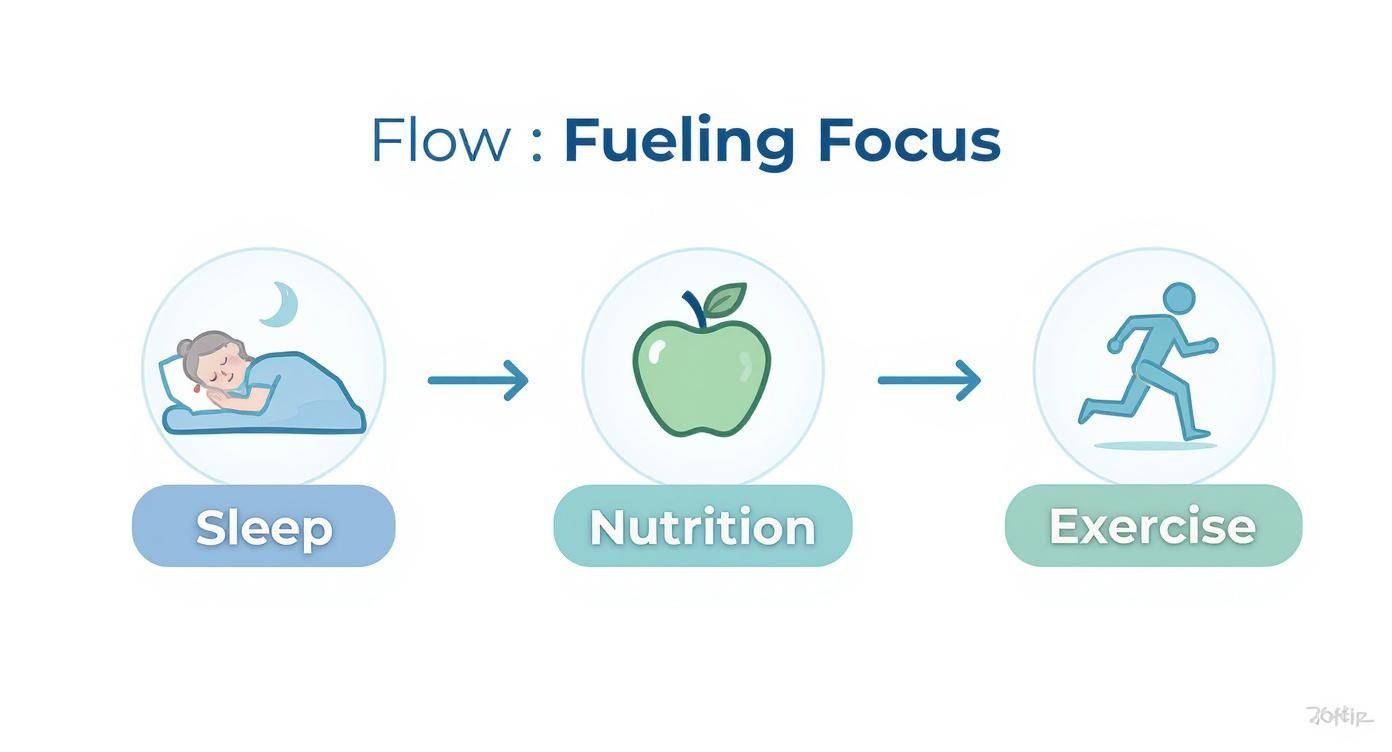
As you can see, consistent sleep, mindful nutrition, and regular exercise aren't separate activities. They form an interconnected system that directly supports mental clarity.
Week Four: Solidify and Troubleshoot
The final week is about cementing your new habits and learning how to adapt when things go wrong. You will absolutely have days where your focus feels shot. The key is having a plan to get back on track quickly.
Develop a simple "focus reset" routine. This could be a short walk, a few minutes of stretching, or switching to a low-effort task for a bit. You can also start working in more complex brain-training puzzles, which is a great way to learn how to improve problem-solving skills while sharpening your attention.
By making these practices routine, you build a resilient system for concentration that actually works.
To make this even clearer, here's a quick overview of how the four weeks come together.
4-Week Focus Improvement Plan Overview
| Week | Main Goal | Key Actions | | :--- | :--- | :--- | | Week 1 | Build a Distraction-Free Environment | Declutter physical space; conduct a digital "notification audit". | | Week 2 | Start Foundational Mental Training | Practise 5 minutes of daily mindfulness; use Pomodoro for one work block. | | Week 3 | Align Lifestyle Habits with Focus | Prioritise sleep schedule; focus on brain-friendly foods; add short walks. | | Week 4 | Make Habits Stick and Troubleshoot | Develop a "focus reset" routine; integrate targeted brain-training puzzles. |
This table maps out the progression, showing how each week adds a new layer to your focus toolkit. By the end of the month, these actions won't feel like a plan anymore—they'll just be how you work.
Common Questions About Improving Focus
As you start weaving these new focus-building habits into your life, a few questions are bound to come up. It's totally normal. Knowing what to expect—from how long it takes to what to do when your brain just checks out—helps you stick with it. Let's get into some of the most common ones.
How Long Does It Really Take to See Results?
This is the big one, and the answer is actually pretty encouraging: consistency is so much more important than intensity. You don’t need to be perfect from day one to see a real difference. Most people start to feel small, noticeable wins within the first couple of weeks.
For instance, after a week of using the Pomodoro Technique, you might realise you can get through a whole 25-minute block without instinctively reaching for your phone. A few weeks of better sleep might mean that mid-afternoon brain fog finally starts to lift. The big, lasting improvements—that feeling of being able to sustain deep focus for long stretches—usually build up over one to three months of regular practice.
The goal isn't instant perfection. It's about building a rhythm that works for you. Small, consistent efforts compound over time and create a seriously powerful foundation for concentration.
Can What I Eat Truly Affect My Concentration?
Absolutely. Your brain is a high-performance engine, and it needs high-quality fuel to run properly. What you eat directly impacts your cognitive performance, mostly by messing with your blood sugar levels.
Sugary snacks and refined carbs give you a quick spike in blood sugar, which is always followed by a crash. That crash is what we call "brain fog"—it leaves you feeling sluggish, fuzzy, and unable to think straight.
On the other hand, a balanced meal with protein, healthy fats, and complex carbs (like oats or brown rice) provides a slow, steady release of energy. That stable fuel is exactly what your brain needs to stay alert and focused all day.
What Is the Best Thing to Do When My Focus Disappears?
It happens to all of us. One minute you’re in the zone, the next your focus has completely vanished. Don't try to force it—that almost never works. Instead, use a simple 'focus reset' routine to get back on track.
- Step Away. Seriously, get up from your desk. Walk into another room, do a quick stretch, or grab a glass of water. A change of scenery, even for 60 seconds, helps break the mental gridlock.
- Engage Your Senses. Do something that doesn't need intense thought. Look out of a window and just notice the details. Or listen to a single piece of music without doing anything else. It gives your brain a much-needed break.
- Reset with a Micro-Task. When you return to your work, start with something tiny and ridiculously easy. Instead of thinking "write the report," make the task "open the document" or "write one sentence." That tiny win is often all you need to rebuild momentum.
Ready to sharpen your logical thinking and give your brain a focused workout? Queens Game offers a perfect way to practise strategic thinking in a calm, engaging environment. Challenge your mind today at https://queens.game.