

Your Secret Weapon for Chess Improvement
If you're looking for the single fastest way to get better at chess, the answer is simple: solve puzzles. They aren't just random board problems; they are hand-picked, decisive moments from actual games that teach you the essential language of tactics.
Think of it like a musician running through scales before tackling a complex symphony. Puzzles are the scales of chess. They build the foundational pattern recognition you need to start spotting winning chances in your own games.
This kind of focused practice is a game-changer for new players. Puzzles let you learn critical skills without the pressure of playing a full, timed game against an opponent. They isolate one key concept at a time, letting you absorb it at your own pace.
Why Puzzles Are So Effective
Engaging with chess puzzles helps build a powerful tactical foundation. Instead of just playing game after game and hoping for the best, you’re actively training your brain to see the patterns that win games. This leads to several huge benefits that translate directly to better results over the board.
Puzzles are so powerful because they teach you to think in a structured way. Here’s a quick rundown of the immediate advantages you’ll see.
Key Benefits of Solving Chess Puzzles for New Players
| Benefit | How It Helps You Win More Games | | :--- | :--- | | Sharpened Board Vision | You start seeing the whole board, not just one piece. Threats and opportunities that were invisible before suddenly pop out. | | Improved Calculation | Puzzles force you to think several moves ahead, training you to calculate different variations to find the very best move. | | Greater Confidence | Nailing a tricky puzzle gives you an immediate shot of confidence. This helps you make decisive moves in real games without second-guessing. | | Tactical Mastery | You'll become fluent in fundamental tactics like forks, pins, and skewers until they become second nature. |
By working through these problems, you're not just memorising moves; you're developing the mental reflexes that separate strong players from novices.
It’s all about turning conscious, slow calculation into quick, intuitive understanding. You see the pattern, and you know the move.
The recent explosion in chess popularity means more people than ever are looking for these exact tools. In fact, recent surveys show that 12% of British adults play chess, creating a massive community of new players who rely on puzzles to get better, fast.
Ultimately, puzzles give you a structured way to learn. They are the core of developing the analytical skills you need to succeed. By dedicating time to solving them, you actively strengthen your chess mind and improve your problem-solving skills in the process.
Understanding Core Tactical Patterns
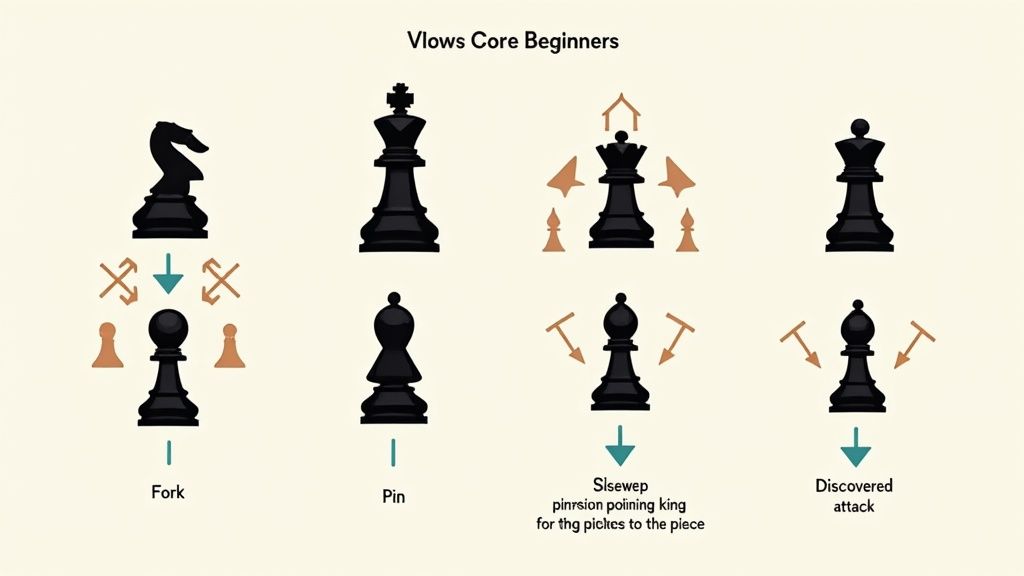
Solving chess puzzles for beginners is all about pattern recognition. These tactical patterns are the fundamental building blocks of attack and defence that pop up in almost every single game. Once you start seeing them, winning moves that were invisible before will suddenly jump out at you.
Think of these patterns as your tactical vocabulary. Instead of staring at a random jumble of pieces, you'll see a board brimming with opportunities. Getting these core ideas locked in is the first major step towards solving puzzles consistently and levelling up your entire game.
The Fork: An Overwhelming Attack
The fork is one of the most common and devastating tactics you'll learn. It's when a single piece attacks two or more enemy pieces at the same time. This simple move creates an instant headache for your opponent because they can usually only save one of the threatened pieces.
Imagine your knight landing in the middle of the board, hitting both the enemy king and queen. That's a royal fork, a game-winning shot that often ends things on the spot. Knights are the undisputed masters of the fork, but pawns, bishops, rooks, and queens can all get in on the action.
The Pin: Freezing an Enemy Piece
A pin is a beautiful tactic that paralyses an opponent's piece. It happens when one of your long-range attackers (like a bishop, rook, or queen) puts a defending piece in the line of fire with a more valuable target sitting behind it. The defending piece is now "pinned" to its square because moving it would expose the bigger prize.
You'll see two main types of pins in chess puzzles for beginners:
- Absolute Pin: The piece is pinned to the king. Moving it is flat-out illegal because it would put the king in check.
- Relative Pin: The piece is pinned to something else valuable, like a queen or rook. Moving it is legal, but it’s a terrible idea because you’d lose that key piece.
Pins are fantastic because they handcuff your opponent's options and build suffocating pressure. A pinned piece is a vulnerable piece, making it a perfect target for follow-up attacks.
The secret to many beginner puzzles is exploiting a piece that can't move. If you spot a piece that seems stuck, ask yourself: is it pinned, and how can I punish it?
The Skewer: The X-Ray Attack
The skewer is often called a "reverse pin," and for good reason. Just like a pin, it involves attacking two pieces along a single line. The crucial difference is that with a skewer, the more valuable piece is in front, and the less valuable one is hiding behind it.
For instance, your bishop checks the enemy king. The king is forced to move out of the way, exposing the queen that was right behind it. On your next turn, your bishop swoops in and snags the queen. This powerful tactic weaponises your opponent's most valuable pieces against them. Only rooks, bishops, and queens can perform a skewer, so keep an eye out for these straight-line opportunities.
A Step-by-Step Method for Solving Puzzles
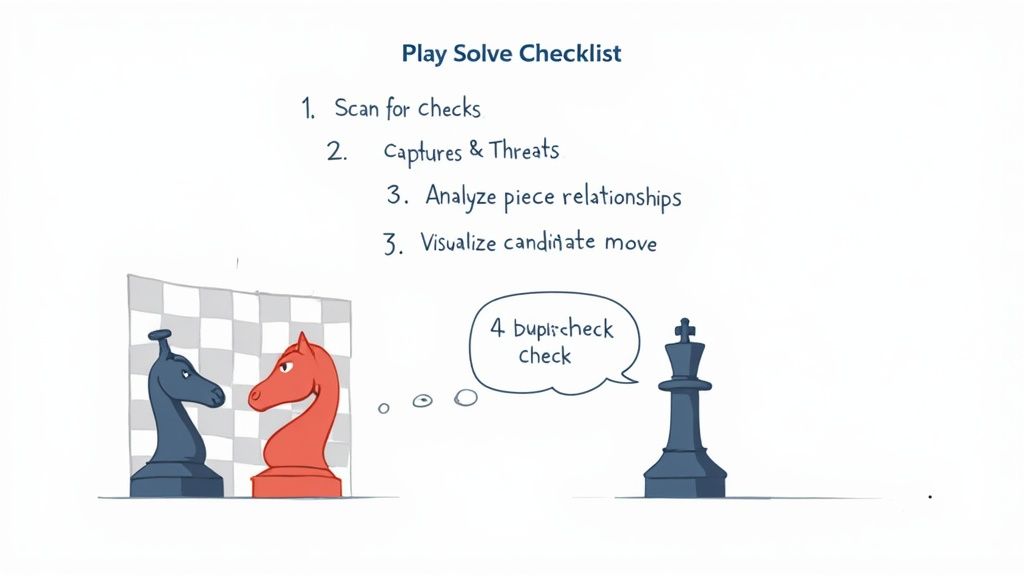
The secret to solving chess puzzles for beginners isn't about having a flash of genius; it's about having a process you can trust. It’s the difference between making hopeful, impulsive moves and building a real analytical skill.
By slowing down and following a simple checklist, you can turn what looks like a confusing mess into a solved puzzle. This approach stops you from getting overwhelmed by all the possibilities on the board and guides you towards the moves that actually matter.
The CCT Scanning Method
The bedrock of any solid puzzle-solving technique is to look for the most forceful moves first. These are the moves that completely change the game and give your opponent almost no good options. We call this the CCT method.
- Checks: Your first instinct should be to look for any move that puts the enemy king in check. Checks are the most forcing moves in chess because your opponent has to deal with them.
- Captures: Next, scan for any captures you can make. Simply removing an enemy piece from the board is often the easiest way to gain an advantage.
- Threats: Finally, identify moves that create a serious problem, like attacking a valuable piece or setting up an unavoidable checkmate.
Starting with CCT forces you to prioritise the moves that have the biggest impact, and that’s almost always where the puzzle's solution is hiding. This framework is a fantastic starting point, and for more advanced ideas, you can explore our guide on how to solve logic puzzles.
The goal is to train your brain to stop guessing and start calculating. A systematic approach is your toolkit for finding the correct move, every single time.
Visualising and Verifying Your Idea
Once you've found a promising move using the CCT method, the next step is crucial: visualisation. Before you even think about touching a piece, play the sequence out in your mind. Ask yourself one simple question: "What is my opponent's best reply to this?"
Think about their most likely defensive moves. Can they escape the threat? Can they turn the tables on you? If your move still looks good after considering their strongest defence, you're almost certainly on the right track. This final check is what stops you from making simple blunders and confirms that your idea actually works.
This methodical approach is mirrored in how chess is structured at every level. In the UK, organisations like the English Chess Federation have clear pathways for new players, even requiring just five games for an initial rating. It shows just how valuable methodical training is right from the start. You can find out more about how the UK chess system supports beginners.
Beginner Puzzles with Annotated Solutions
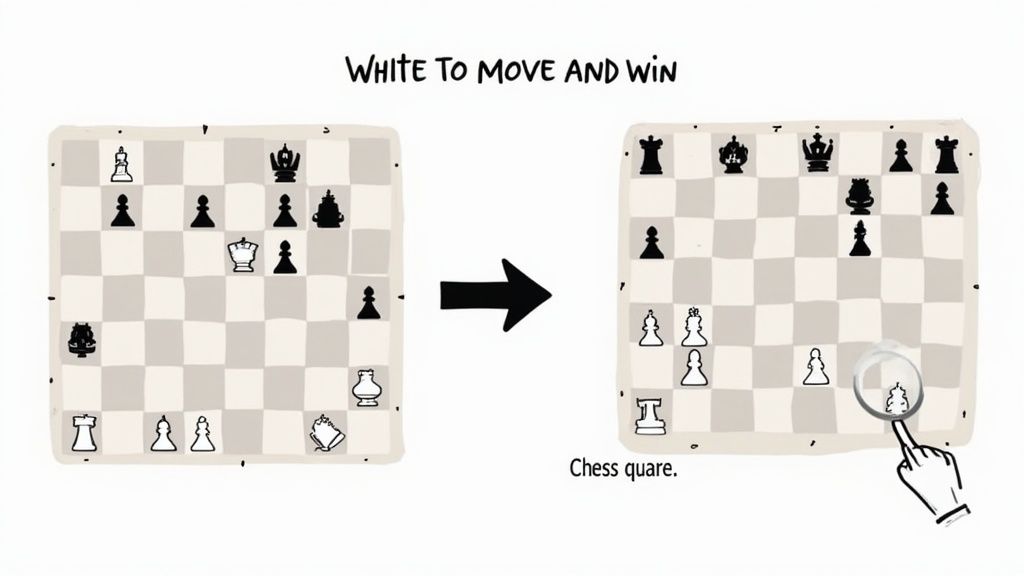
Alright, time to put some of this theory into practice. The fastest way to make tactical patterns stick is to get your hands dirty and solve them yourself. Let’s walk through a few chess puzzles for beginners, each one built around the ideas we've covered.
We'll start with the basics—simple checkmates—and then slowly ramp up to more complex tactical shots. Each puzzle has a diagram and a prompt, but more importantly, a detailed solution. The real goal here isn't just finding the right move, but understanding why it's so powerful.
Working through these examples will help turn abstract concepts into a real, practical skill you can pull out in your own games. That immediate feedback is exactly what builds tactical instinct and confidence.
Puzzle 1 A Simple Back-Rank Mate
Prompt: White to move and deliver checkmate in one move.
Look at Black's king. It’s completely trapped behind its own wall of pawns. This is a textbook back-rank weakness, a theme you’ll see again and again in beginner puzzles. Your job is to find the single move that shuts the game down.
Solution: The winning move is 1. Re8#. The white rook slides to the back rank, delivering a check the king can't escape. Since it’s boxed in by its own pawns, there are no escape squares. It’s a classic, clean execution.
Puzzle 2 The Classic Knight Fork
Prompt: White to move and win material.
See how the black king and queen are sitting on squares of the same colour? That should set off alarm bells. It’s prime territory for a knight fork. Can you find the square where your knight attacks both at once?
Solution: The killer move is 1. Nf7+. This is what's called a royal fork—it hits the king and queen simultaneously. The knight on f7 attacks the king on e8 and the queen on h8. Black has to move the king, which means White gets to snatch the queen with 2. Nxh8.
Many beginner puzzles hinge on a single, devastating move that completely changes the game. The fork is often that move, turning a quiet position into a winning one in an instant.
Puzzle 3 Pin and Win
Prompt: White to move and win a piece.
Notice the alignment on the e-file. The black king on e8 and the black rook on e7 are lined up perfectly with White's rook on e1. That rook on e7 is the only thing shielding its king. This is the key.
Solution: The idea here is to exploit that pin with 1. Be3. The bishop attacks the black rook. Because that rook is pinned to the king (an absolute pin), it can't legally move away without exposing its king to check.
Black has no good way to defend the rook. After any move Black makes, White simply plays 2. Bxe7, winning the piece and building a massive advantage. This is a great example of how you can pile up on a pinned piece to win material.
Progressive Puzzle Difficulty and Key Tactics
To help you track your progress, here’s a quick breakdown of the puzzles we just covered and the main tactical idea behind each one.
| Puzzle Number | Main Tactical Theme | Difficulty Level | | :------------ | :------------------ | :--------------- | | Puzzle 1 | Back-Rank Checkmate | Easy | | Puzzle 2 | Royal Fork | Easy | | Puzzle 3 | Absolute Pin | Medium |
As you can see, we're building from simple checkmates to slightly more layered tactical ideas.
Getting a puzzle wrong is part of the process, so don’t just skip to the next one. Take a moment. Use the analysis tools on a chess site to understand why your move didn't work and why the correct one did. This simple habit will speed up your improvement more than anything else. Consistency is what separates good players from great ones.
Building a Consistent Practice Habit
Knowing the tactical patterns is one thing, but the real secret to getting good is consistency. A steady practice habit is what turns that head-knowledge into pure intuition. Think of it like a muscle—the more you train pattern recognition, the stronger and faster it gets.
The key here is frequency, not long, draining sessions. A marathon puzzle session once a week is far less effective than short, focused bursts every day. Just aim for 10-15 minutes. It’s a small commitment that's easy to stick with, and it's more than enough to keep your tactical mind sharp.
This daily approach stops you from burning out and makes learning feel manageable. It keeps the patterns you’re learning fresh until they become second nature.
Set Realistic and Measurable Goals
To stay motivated, you need clear goals. Vaguely deciding to "get better" doesn't work. Instead, set specific targets that let you see your progress, creating a positive feedback loop that keeps you going.
Here are a few simple goals to start with:
- Solve a Set Number: Aim to correctly solve 3 to 5 chess puzzles for beginners each day.
- Time Commitment: Block out a consistent 15-minute slot in your daily schedule just for puzzles.
- Rating Target: Use the puzzle rating on a site like Lichess or Chess.com to set a small weekly goal, like gaining 25 points.
Tracking these small wins is incredibly powerful. It’s tangible proof that your hard work is paying off, which is crucial for staying motivated long-term. When you see the numbers go up, you know it's working.
"If I stop practicing tactics for one day, I notice; if I stop two days, my opponent notices it; if I stop three days, the world notices it."
This old saying gets to the heart of it. Daily practice isn't just about learning new things; it's about maintaining the skills you already have. It keeps your brain tuned into the tactical frequencies of chess.
Analyse Your Mistakes
Getting a puzzle wrong isn't a failure—it's a learning opportunity. The most important part of your training is figuring out why you made a mistake. Never just shrug and move on to the next one.
After an incorrect attempt, take a moment. Use the analysis tools on the puzzle platform and ask yourself:
- What tactical idea did I miss completely?
- Did I forget to consider my opponent's best reply?
- Was there a stronger, more forcing move I overlooked?
This habit of self-correction is what separates players who improve from those who get stuck. Building this routine is simple, especially with tools like the ones you'll find in our guide to daily challenge puzzles that help add structure to your practice. This analytical approach builds a much deeper understanding that will serve you well in every game you play.
Finding the Best Puzzles for Beginners
Okay, you’ve got a solid method for solving puzzles. Now, where do you go to practise? The good news is the chess world is overflowing with fantastic online resources, and many are perfect for newcomers. These sites have huge libraries of chess puzzles for beginners, letting you drill all the patterns we've talked about.
The UK has seen a massive surge in chess interest lately, and the online platforms have definitely kept up. The big names, like Chess.com and Lichess, offer adaptive puzzle ratings that grow with you. This is key. It means you’re always getting problems that are tricky but not impossible. As you get better, the puzzles get tougher, so you never stop learning.
Many of these sites also let you train specific themes, so you can spend a whole session just on forks or pins if you want. For a really clean experience designed to build your skills from square one, Queens Game is another superb option. This boom in resources makes sense when you look at the numbers; Chess.com alone reported around 4.5 million active UK members by early 2023. You can read more about the UK's recent chess explosion if you're curious.
Your Chess Puzzle Questions, Answered
Jumping into chess puzzles can bring up a few questions. Let's clear up the common ones so you can get straight to the good stuff—solving puzzles and getting better.
Think of this as a quick-start guide to get you over those first few hurdles.
How Many Puzzles Should I Solve Every Day?
For beginners, less is more. Aim for 5 to 10 puzzles a day. That’s it.
The real goal is to build a consistent habit without burning out. A focused 10-15 minute session every day will do more for your game than one long, random session once a week. This keeps the tactical patterns fresh in your mind until recognising them becomes second nature.
The point isn't to blast through hundreds of puzzles. It's to truly understand the solution to every single one you try. Quality always wins over quantity.
What’s a Good Puzzle Rating to Aim For?
Honestly? Don't even worry about your rating, especially when you're just starting. The rating's only job is to feed you problems that are at the right level—tricky, but not impossible. A good goal is simply to see it creep up slowly over a few weeks.
Focus on what you can learn from your mistakes instead of chasing a number. As your tactical vision sharpens, your rating will naturally follow.
Are Chess Puzzles Enough to Get Good at Chess?
Puzzles are probably the single best way to improve your tactical skill, but they’re just one part of a balanced chess diet. To become a solid, well-rounded player, you'll want to mix it up.
Make sure you also:
- Play full games: This is where you actually use the patterns you’ve been practising.
- Learn basic opening ideas: You need to know how to start a game without falling into an early trap.
- Study simple endgames: Knowing how to win a won position is a skill in itself.
When you combine puzzle practice with real gameplay, you create a powerful feedback loop that will speed up your improvement across the board.
Ready to sharpen your logical thinking with a fresh challenge? Try Queens Game, where the strategic elegance of chess is distilled into a captivating online puzzle. Start solving at queens.game and give your brain the workout it deserves.