

Every day, we face a cascade of choices, from the trivial to the transformative. In both life and complex puzzles like the Queens Game, the quality of our outcomes hinges on the quality of our decisions. But how do we move from guesswork and gut feelings to structured, confident choices? The answer lies in mastering a toolkit of proven decision making techniques.
This guide is designed to be your definitive resource, moving beyond abstract theory to provide actionable frameworks. We will explore 10 of the most effective models used by leaders, strategists, and puzzle enthusiasts to navigate complexity with clarity. You won't just learn what a SWOT analysis or a decision tree is; you will learn precisely how to build and use them.
For each technique, we provide:
- A clear, concise definition.
- Step-by-step instructions for practical application.
- An analysis of its distinct pros and cons.
- Specific scenarios where it proves most effective.
To make these concepts tangible, we will apply each method to solve challenging logic puzzles, including concrete examples from the Queens Game. This practical approach not only demonstrates the power of these techniques but also sharpens your analytical skills for any problem you encounter. Whether you're a student of algorithms, a chess player, or simply someone looking to improve your critical thinking, this structured approach will equip you to make better, more informed decisions with confidence and precision. Get ready to transform your approach to problem-solving.
1. SWOT Analysis
SWOT analysis is a foundational strategic planning framework used to evaluate the Strengths, Weaknesses, Opportunities, and Threats involved in a project or business venture. It provides a structured overview of both internal (Strengths, Weaknesses) and external (Opportunities, Threats) factors, making it one of the most versatile decision-making techniques for assessing a situation from a high level. By organising critical factors into a simple 2x2 grid, it helps you visualise your current position and identify strategic pathways.
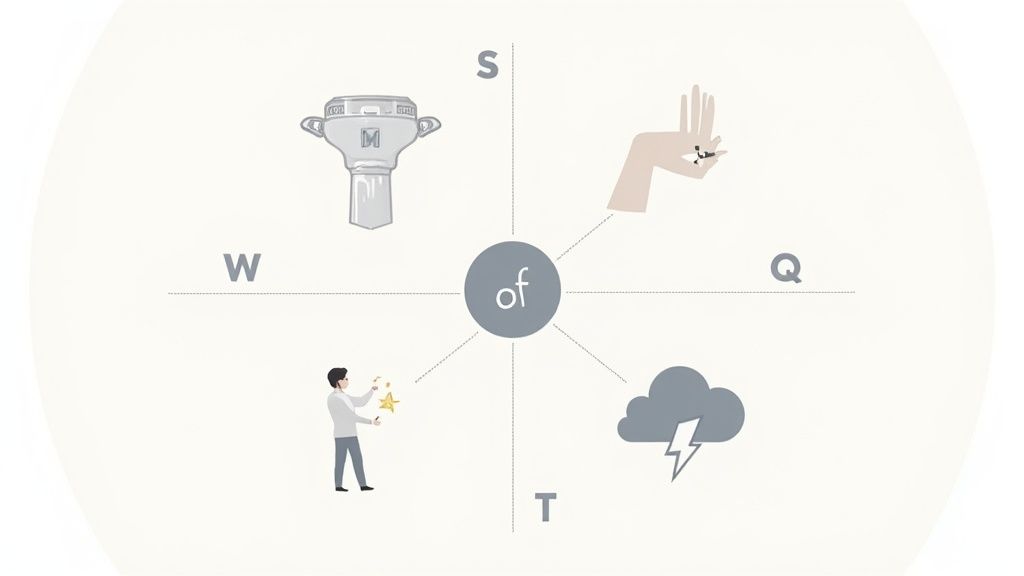
This method, popularised by Albert Humphrey in the 1960s, is widely applied in corporate strategic planning. For example, Apple might use a SWOT analysis to evaluate a new product launch. Its strengths could be brand loyalty and technological expertise, weaknesses might include a high price point, opportunities could involve emerging markets, and threats could be intense competition from other tech giants.
When to Use SWOT Analysis
This technique is most effective during the initial stages of planning. It’s ideal for brainstorming sessions, strategic planning meetings, or even personal career development. Use it to gain a broad perspective before diving into more detailed analytical methods.
How to Apply It
- Define Your Objective: Clearly state the decision you need to make (e.g., "Should we enter the European market?").
- Analyse Internal Factors:
- Strengths: What are your internal advantages? (e.g., a skilled team, unique technology).
- Weaknesses: What internal factors could hinder you? (e.g., lack of funding, poor brand recognition).
- Analyse External Factors:
- Opportunities: What external trends or conditions can you exploit? (e.g., favourable regulations, market gaps).
- Threats: What external challenges do you face? (e.g., new competitors, economic downturn).
- Formulate Strategy: Connect the quadrants. Use strengths to seize opportunities, minimise weaknesses to avoid threats, and develop a coherent plan.
Actionable Tip: Don’t perform a SWOT analysis in isolation. Involve diverse team members from different departments to gather varied perspectives and ensure a more comprehensive and realistic assessment of your situation.
2. Decision Matrix / Scoring Model
A decision matrix, also known as a scoring model, is a quantitative technique used to evaluate and compare multiple options against a set of weighted criteria. It works by assigning numerical scores to each option based on how well it meets these predetermined factors, making it an excellent tool for bringing objectivity to complex choices. By applying a weight to each criterion, you ensure that the most important factors have a greater influence on the final outcome, leading to a more logical and defensible decision.
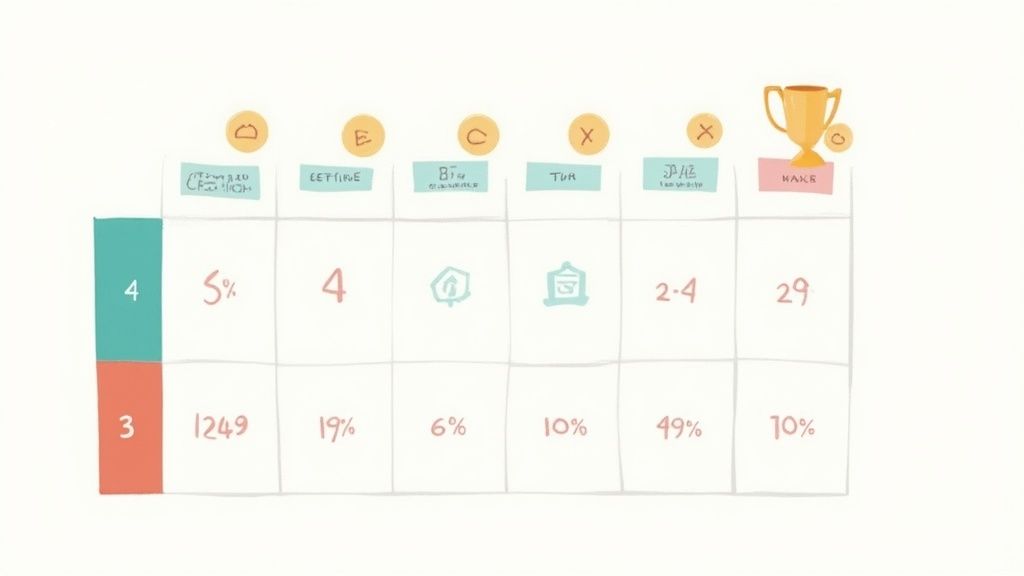
This method is a staple in operations research and management science, popularised for its clarity and systematic approach. For instance, a company selecting a new software vendor could use a decision matrix to compare options. Criteria might include cost (weighted 30%), user interface (weighted 25%), customer support (weighted 25%), and integration capabilities (weighted 20%). Each vendor is scored on a scale of 1-10 for each criterion, and the one with the highest total weighted score is chosen.
When to Use a Decision Matrix
This technique is most effective when you have multiple viable options and several important criteria to consider. It is ideal for high-stakes decisions where objectivity is crucial, such as selecting a vendor, hiring a key employee, or choosing a technology platform. It removes emotion and personal bias from the process.
How to Apply It
- Identify Your Options: List all the potential choices you are considering.
- Define Criteria: Determine the key factors that will influence your decision (e.g., cost, quality, ease of use).
- Assign Weights: Assign a weight (often a percentage or a value from 1-10) to each criterion based on its relative importance. The total weight should add up to 100% or a set number.
- Score Each Option: Rate each option against every criterion using a consistent scale (e.g., 1-5). A systematic approach like this can significantly improve your problem-solving skills.
- Calculate the Total Score: Multiply each option's score by the criterion's weight and sum the results for each option. The option with the highest total score is the most logical choice.
Actionable Tip: To reduce individual bias, have multiple stakeholders score the options independently first. Afterwards, bring everyone together to compare scores and discuss any significant discrepancies. This collaborative approach leads to a more robust and agreed-upon final decision.
3. Cost-Benefit Analysis
Cost-Benefit Analysis (CBA) is a systematic process for calculating and comparing the benefits and costs of a project or decision. This decision-making technique provides a rational, data-driven framework by assigning a monetary value to both the tangible and intangible aspects of a choice, helping you determine whether its potential rewards outweigh its outlays. By translating pros and cons into quantifiable financial terms, it allows for a clear-eyed comparison of different options.
This method, popularised in public policy by organisations like the World Bank for evaluating large infrastructure projects, is equally powerful in business. For instance, a company considering a new software implementation would use CBA to weigh the costs of licensing, training, and integration against benefits like increased productivity, reduced errors, and improved data security. The goal is to calculate the net benefit and ensure a positive return on investment.
When to Use Cost-Benefit Analysis
CBA is most effective when you need to make a significant financial decision or justify an investment. It is ideal for capital project appraisals, new technology adoption, policy changes, and any scenario where resources must be allocated efficiently. Use it to compare multiple competing projects and select the one with the highest net benefit.
How to Apply It
- Identify All Costs: Brainstorm and list every potential cost associated with the decision. Be thorough and include direct costs (e.g., equipment), indirect costs (e.g., administrative overhead), and intangible costs (e.g., impact on employee morale).
- Identify All Benefits: List all potential benefits, both tangible (e.g., increased revenue) and intangible (e.g., enhanced brand reputation). Assign a monetary value to each one, even if it requires estimation.
- Calculate and Compare: Sum the total value of the costs and the total value of the benefits. Subtract the total costs from the total benefits to find the net benefit. A positive result indicates the project is financially viable.
- Perform Sensitivity Analysis: Re-evaluate your calculations using different assumptions for your key variables (e.g., a more conservative estimate for revenue growth) to understand how sensitive the outcome is to change.
Actionable Tip: When assigning value to intangible benefits like "improved customer satisfaction", use proxy metrics. For example, you could estimate its value based on an expected reduction in customer churn or an increase in repeat purchases.
4. The Eisenhower Matrix / Urgency-Importance Matrix
The Eisenhower Matrix is a powerful time management and decision-making framework that helps you prioritise tasks by categorising them based on urgency and importance. This method organises decisions into a simple four-quadrant grid, allowing you to distinguish between activities that require immediate attention and those that contribute to long-term goals. By visually separating what is truly important from what is merely urgent, it prevents you from becoming bogged down in reactive, low-impact work.
This technique is often attributed to U.S. President Dwight D. Eisenhower, who was renowned for his incredible productivity. It was later popularised by Stephen Covey in his influential book, The 7 Habits of Highly Effective People. For example, a project manager might use the matrix to decide what to tackle first: an urgent but minor client email (Quadrant III) versus an important but not urgent task like strategic planning for the next quarter (Quadrant II). The matrix guides them to focus on Quadrant II.
When to Use The Eisenhower Matrix
This technique is exceptionally effective for daily, weekly, or monthly task planning. It’s ideal for professionals feeling overwhelmed by a long to-do list, leaders needing to allocate team resources effectively, or anyone looking to improve their personal productivity and focus on high-value activities.
How to Apply It
- List Your Tasks: Write down all the decisions and tasks you need to complete.
- Assess Urgency and Importance: Evaluate each item. Urgent tasks require immediate attention (e.g., deadlines, crises). Important tasks contribute to your long-term mission and goals.
- Place Tasks in Quadrants:
- Quadrant I (Urgent & Important): Do these tasks immediately (e.g., crises, pressing deadlines).
- Quadrant II (Not Urgent & Important): Schedule time for these tasks. This is where strategic growth happens (e.g., planning, relationship-building).
- Quadrant III (Urgent & Not Important): Delegate these tasks if possible. They are often distractions disguised as priorities (e.g., some meetings, interruptions).
- Quadrant IV (Not Urgent & Not Important): Eliminate these tasks. They are time-wasters (e.g., mindless browsing, trivial activities).
- Act Accordingly: Focus your energy on Quadrant I and II tasks, while actively delegating or deleting tasks from Quadrants III and IV.
Actionable Tip: Regularly review and re-categorise your tasks, as their urgency and importance can change. Block out dedicated "Quadrant II time" in your calendar to ensure you are consistently investing in prevention and long-term planning, not just reacting to fires.
5. Pros and Cons List
The Pros and Cons List is one of the most fundamental and intuitive decision-making techniques. It involves a simple yet powerful exercise: creating two columns to systematically list all the positive (Pros) and negative (Cons) aspects of a particular choice. This method forces you to move beyond gut feelings and organise your thoughts logically, providing a clear, visual comparison of the arguments for and against a decision.
This technique is often associated with Benjamin Franklin, who in 1772 described a process of "moral algebra" where he would list opposing arguments and weigh their importance to reach a conclusion. For instance, when deciding whether to accept a new job offer, you might list pros like a higher salary and better location, while cons could include a longer commute and less-than-ideal company culture. The visual layout makes it easier to evaluate whether the benefits outweigh the drawbacks.
When to Use a Pros and Cons List
This versatile tool is effective for a wide range of decisions, from everyday personal choices to significant business dilemmas. It is particularly useful for clarifying your thoughts when you feel stuck or overwhelmed by a decision with multiple competing factors. Use it as a starting point to structure your thinking before applying more complex analytical methods if needed.
How to Apply It
- Define Your Decision: Clearly articulate the specific question you need to answer (e.g., "Should I move to a new city for university?").
- Create Two Columns: Draw a line down the middle of a page, labelling one side "Pros" and the other "Cons".
- Brainstorm and List:
- Pros: List every potential positive outcome or advantage of making the decision.
- Cons: List every potential negative outcome or disadvantage. Be as thorough and honest as possible.
- Weigh the Factors (Optional but Recommended): Assign a score (e.g., 1-5) to each item based on its importance to you. Some factors will naturally carry more weight than others.
- Analyse and Decide: Tally the scores for each column. While the result isn't a definitive answer, it provides a clearer, more rational basis for your final choice.
Actionable Tip: Don't rush the process. After creating your initial list, set it aside for a day or two. Revisit it with fresh eyes to see if your perspective has changed or if you can think of any additional points you may have missed.
6. Six Thinking Hats
Six Thinking Hats is a parallel thinking technique developed by Edward de Bono that encourages participants to view a decision from six distinct perspectives. By metaphorically ‘wearing’ different coloured hats, the team shifts its thinking mode in unison. This method streamlines discussions by preventing people from simultaneously adopting opposing stances (e.g., one person being optimistic while another is critical), which often leads to conflict and unproductive debate. This makes it one of the most effective decision-making techniques for collaborative problem-solving.

This powerful framework, popularised by its creator, has been adopted by major corporations like IBM and Microsoft to enhance innovation and meeting efficiency. For instance, a tech company developing a new app might use the hats to systematically evaluate its features: gathering data (White), gauging user emotional reactions (Red), identifying potential risks (Black), exploring benefits (Yellow), brainstorming new ideas (Green), and managing the process (Blue).
When to Use Six Thinking Hats
This technique is exceptionally useful for group decision-making where diverse opinions could lead to conflict. It's ideal for innovation sessions, strategic planning meetings, and complex problem-solving scenarios where a comprehensive, 360-degree view is necessary. It ensures all angles of a decision are considered without personal egos getting in the way.
How to Apply It
- Introduce the Hats: Ensure everyone understands the role of each coloured hat.
- Blue (Process): Manages the thinking process. Sets the agenda and sequence.
- White (Facts): Focuses on objective data, figures, and available information.
- Red (Emotions): Expresses feelings, hunches, and intuition without justification.
- Black (Caution): Identifies risks, obstacles, and potential negative outcomes.
- Yellow (Optimism): Focuses on benefits, value, and positive aspects.
- Green (Creativity): Brainstorms new ideas, possibilities, and alternatives.
- Set the Agenda (Blue Hat): A facilitator wearing the Blue Hat defines the problem and decides the sequence of hats the group will use.
- Think in Parallel: The entire group ‘wears’ the same hat at the same time, contributing thoughts relevant only to that perspective.
- Sequence the Thinking: Move through the hats as planned (e.g., start with White for data, then Green for ideas, then Yellow and Black to evaluate them).
- Summarise and Decide (Blue Hat): The facilitator summarises the findings from each hat and guides the group towards a final decision.
Actionable Tip: Appoint a dedicated facilitator (the Blue Hat) to keep the discussion on track. Use a timer for each hat to ensure the meeting remains focused and efficient, preventing any single perspective from dominating the conversation.
7. Scenario Planning / What-If Analysis
Scenario planning is a strategic foresight technique used to make flexible long-term plans. Instead of trying to predict a single future, this method involves creating several plausible narratives, or scenarios, of how the future might unfold. By exploring different combinations of variables and their potential impacts, it helps decision-makers prepare for multiple outcomes, especially those involving high uncertainty. It's one of the most powerful decision-making techniques for navigating complex and unpredictable environments.
This approach was famously pioneered by Royal Dutch Shell in the 1970s, which helped them anticipate and weather the 1973 oil crisis far better than their competitors. By having already explored a "crisis" scenario, their leadership was mentally prepared to act decisively when it occurred. Today, governments use it for policy planning, and tech companies use it to forecast market disruptions.
When to Use Scenario Planning
This technique is most valuable for strategic decisions with long-term implications and high levels of uncertainty. Use it when you cannot rely on past data to predict the future, such as navigating technological disruption, climate change, or geopolitical shifts. It's ideal for strategic planning, risk management, and innovation.
How to Apply It
- Identify the Core Question: Clearly define the decision or strategic issue you are facing (e.g., "How can we ensure our supply chain is resilient over the next decade?").
- Determine Key Driving Forces: Brainstorm the major trends and forces that will shape the future, such as technological, economic, political, or social changes.
- Identify Critical Uncertainties: From your list of forces, pinpoint the two most important and most uncertain ones (e.g., the pace of AI adoption and the level of global trade regulation).
- Create a Scenario Framework: Use the two critical uncertainties as axes to create a 2x2 grid, which will define four distinct and plausible future worlds.
- Develop Scenario Narratives: Write a detailed, compelling story for each of the four scenarios. Describe what that world looks like and the challenges and opportunities it presents.
- Develop and Test Strategies: Assess your current strategy against each scenario. Develop robust options and contingency plans that would be effective across multiple potential futures. This process is central to developing your strategic thinking capabilities.
Actionable Tip: Focus on creating scenarios that are plausible and internally consistent, not just best-case or worst-case extremes. The goal is to stretch your thinking and challenge assumptions, not to predict the single most likely outcome.
8. Decision Tree Analysis
Decision Tree Analysis is a powerful and visual technique used to map out decisions and their potential consequences. It uses a tree-like model of choices and their possible outcomes, including chance events, resource costs, and utility. This hierarchical structure allows you to follow a logical path from an initial decision to a final outcome, making it one of the most transparent decision-making techniques for complex, multi-stage problems.
This method, rooted in operations research and decision theory, is widely applied in fields requiring systematic evaluation. For instance, a doctor might use a decision tree to determine the best treatment plan by mapping out different diagnostic tests, potential results, and subsequent therapies, each branch assigned a probability of success. Similarly, it's a foundational skill for tackling complex logic puzzles, where each choice eliminates certain possibilities.
When to Use Decision Tree Analysis
This technique is ideal for situations with sequential or interconnected decisions, where uncertainty and risk are significant factors. Use it for investment planning, medical diagnoses, legal strategy, or any scenario where you need to compare options with multiple, uncertain outcomes and calculate an expected value for each path.
How to Apply It
- Define the Core Decision: Start with a central decision node (a square) representing the primary choice you need to make.
- Add Branches for Choices: Draw lines outward from the square, one for each possible option or action.
- Introduce Chance Nodes: At the end of a choice branch, use a circle to represent uncertain outcomes. Draw branches from this circle for each possible outcome.
- Assign Probabilities and Values: Assign a probability to each chance outcome (the sum for each node must equal 100%). Assign a monetary or utility value to each final outcome at the end of a branch.
- Calculate Expected Value: Work backward from the right. For each chance node, multiply the outcome value by its probability and sum the results to get an "Expected Value" for that node. Compare these values to identify the optimal decision path.
Actionable Tip: For complex trees, use decision analysis software to manage calculations and visualise the paths. However, always start by sketching the tree on paper to ensure you have captured all critical choices, outcomes, and probabilities accurately.
9. Delphi Method
The Delphi Method is a structured communication technique designed to achieve a reliable consensus from a group of experts. It systematically gathers expert opinions through multiple rounds of anonymous surveys, refining the collective judgement with each iteration. This process minimises the influence of dominant personalities, social pressure, and groupthink, making it one of the most robust decision-making techniques for complex forecasting or policy-making.
This method was developed by Olaf Helmer and Norman Dalkey at the RAND Corporation during the Cold War to forecast the impact of technology on warfare. In a modern context, a healthcare organisation might use the Delphi Method to determine priorities for medical research funding. Experts would anonymously submit and rank proposals over several rounds, with a facilitator summarising the results and providing feedback until a consensus emerges on the most critical areas.
When to Use the Delphi Method
The Delphi Method is ideal for complex, ambiguous problems where expert opinions are the primary source of information. Use it for long-range forecasting, policy-making, risk identification, or when you need an objective consensus from geographically dispersed experts without the bias of face-to-face meetings.
How to Apply It
- Select a Facilitator and Experts: Choose an impartial facilitator to manage the process and a diverse panel of experts relevant to your decision.
- Round 1 - Brainstorming: The facilitator sends a broad, open-ended questionnaire to the experts to gather initial ideas and opinions on the topic.
- Round 2 - Structuring: The facilitator analyses the anonymous responses, consolidates them into a structured survey (e.g., a list of factors to rank or rate), and sends it back to the panel.
- Subsequent Rounds - Convergence: The facilitator shares a statistical summary of the group's ratings from the previous round. Experts can then revise their judgements based on this feedback. This process is repeated for 2-4 rounds until the responses stabilise and a consensus is reached.
Actionable Tip: To maintain momentum and prevent participant drop-off, clearly communicate the expected timeline and commitment from the outset. Providing summarised feedback promptly after each round is crucial for keeping the expert panel engaged.
10. Stakeholder Analysis and Engagement
Stakeholder Analysis is a systematic process for identifying and evaluating the individuals, groups, or organisations that have an interest in or are affected by a decision. This powerful decision-making technique maps out stakeholder power (their ability to influence the outcome) and interest (how much the outcome affects them), allowing you to develop tailored engagement strategies. By understanding who your stakeholders are and what they care about, you can build support, manage risks, and ensure the successful implementation of your decision.
This approach, rooted in the work of R. Edward Freeman and popularised by the Project Management Institute (PMI), moves beyond a narrow focus on shareholders to consider a wider ecosystem. For example, a city council planning a new public park must consider residents (high interest, varying power), local businesses (high interest, moderate power), environmental groups (high interest, high influence), and construction firms (moderate interest, moderate power). Ignoring any one of these groups could derail the entire project.
When to Use Stakeholder Analysis
This technique is essential for complex decisions with wide-ranging impacts, particularly in project management, policy-making, and organisational change. Use it when launching a new product, implementing new company-wide software, or planning public infrastructure projects. It is most effective when applied early in the decision-making process to proactively manage relationships and expectations.
How to Apply It
- Identify Your Stakeholders: Brainstorm a comprehensive list of everyone who is affected by or can influence your decision. Think broadly, including employees, customers, suppliers, government bodies, and community groups.
- Analyse and Prioritise: Map each stakeholder on a power/interest grid.
- High Power, High Interest: Manage closely. These are key players you must fully engage and satisfy.
- High Power, Low Interest: Keep satisfied. Engage them enough so they don't become an obstacle.
- Low Power, High Interest: Keep informed. Communicate regularly to ensure their concerns are heard.
- Low Power, Low Interest: Monitor. Minimal effort required, but keep an eye on any changes.
- Understand Their Perspectives: Determine what motivates each stakeholder. What are their interests, expectations, and potential concerns?
- Develop an Engagement Plan: Create a strategy for communicating and collaborating with each group based on their position in the grid. This could range from regular newsletters to one-on-one consultations.
Actionable Tip: Don't assume you know what stakeholders want. Engage in genuine two-way communication through surveys, interviews, or focus groups to understand their explicit and implicit interests, and document how their feedback influences your final decision.
Top 10 Decision-Making Techniques Comparison
| Method | Implementation complexity 🔄 | Resource & time ⚡ | Expected outcomes 📊⭐ | Ideal use cases 💡 | Key advantages ⭐ | |---|---:|---:|---|---|---| | SWOT Analysis | Low — simple four‑quadrant process | Low — workshop or brief analysis | Broad situational overview; internal/external factors identified | Early strategy, team brainstorming, quick assessments | Flexible, easy, low cost; encourages strategic thinking | | Decision Matrix / Scoring Model | Medium — define criteria and weights | Medium — scoring and validation effort | Quantified ranking of options with transparent rationale | Vendor selection, hiring, platform choices | Reduces bias; defensible and repeatable comparisons | | Cost-Benefit Analysis | Medium–High — monetary modeling required | Medium–High — data collection and financial analysis | Net benefit, ROI and prioritized investments | Capital projects, ROI assessments, budget allocation | Clear financial justification; comparable across projects | | Eisenhower Matrix | Low — two‑axis prioritization | Low — quick individual/team use | Clear task priorities by urgency/importance | Personal productivity, time management, crisis triage | Fast, intuitive; reduces reactive work | | Pros and Cons List | Very low — two‑column listing | Very low — minimal time/resources | Organized view of positives and negatives | Everyday choices, initial evaluations, personal decisions | Extremely accessible and quick to produce | | Six Thinking Hats | Medium — needs facilitation/training | Medium — structured group sessions | Balanced perspectives; creative and critical insights | Ideation sessions, strategic meetings, conflict resolution | Encourages diverse viewpoints; reduces groupthink | | Scenario Planning / What‑If Analysis | High — build multiple plausible futures | High — research, modeling, cross‑functional time | Robust contingency strategies and risk identification | Long‑term strategy, high‑uncertainty planning (energy, tech) | Improves resilience; exposes hidden risks | | Decision Tree Analysis | Medium–High — branching and probabilities | Medium — probability/data gathering; can scale up | Visual decision paths with expected value comparisons | Sequential decisions (medical, legal, investments) | Clarifies consequences; quantifies uncertainty | | Delphi Method | High — expert selection and iteration | High — multiple rounds, facilitation, expert time | Expert consensus forecasts and prioritized recommendations | Forecasting, policy, specialized technical decisions | Reduces dominant influence; leverages expert judgment | | Stakeholder Analysis & Engagement | Medium — mapping and strategy design | Medium–High — interviews, engagement and follow‑up | Stakeholder map and engagement plan; reduced resistance | Organizational change, public projects, regulated industries | Increases buy‑in; identifies conflicts early |
From Techniques to Action: Building Your Decision-Making Muscle
You’ve journeyed through a comprehensive toolkit of ten powerful decision making techniques, from the strategic foresight of SWOT Analysis to the collaborative wisdom of the Delphi Method. We've explored how a simple Pros and Cons list can clarify everyday choices, how a Decision Matrix brings objective logic to complex comparisons, and how Scenario Planning prepares you for an uncertain future. Each framework offers a unique lens through which to view a problem, providing a structured path where intuition alone might falter.
The true power, however, doesn't lie in simply knowing these models exist. It lies in the ability to diagnose a situation and select the most appropriate tool for the job. You wouldn't use a sledgehammer to crack a nut, and similarly, you wouldn't need a full Decision Tree Analysis to decide what to have for lunch. The goal is to cultivate a flexible, adaptive mindset, recognising the specific demands of each decision you face.
The Path from Knowledge to Mastery
The journey from learning these techniques to mastering them is one of active practice. The key is to start small and build momentum. Don't wait for a life-altering dilemma to try out a Cost-Benefit Analysis. Instead, integrate these frameworks into your daily and weekly routines.
- Start with the simple: Use the Eisenhower Matrix at the beginning of each day to prioritise your tasks. This simple act of categorising what is urgent versus what is important builds the foundational habit of strategic thinking.
- Embrace objective comparison: When faced with a purchasing decision, like choosing a new laptop or a holiday destination, sketch out a quick Decision Matrix. Forcing yourself to score options against defined criteria moves you from a purely emotional choice to a more rational one.
- Consider all perspectives: Before your next team meeting or project discussion, mentally run through the Six Thinking Hats. Considering the factual, emotional, critical, and creative angles beforehand will make your contributions far more insightful and well-rounded.
This deliberate practice is like strength training for your cognitive abilities. Each time you consciously apply one of these decision making techniques, you strengthen the neural pathways associated with logical reasoning, critical evaluation, and strategic foresight.
From Puzzles to Real-World Problems
As we've seen through our Queens Game examples, puzzles provide a perfect, low-stakes training ground. When you're deciding where to place a Queen, you are implicitly performing a rapid-fire analysis. You’re assessing threats (cons), controlling key squares (pros), and running what-if scenarios for your opponent’s potential moves. Games like this distil the essence of strategic decision-making into a pure, focused challenge.
The skills you hone on the board are directly transferable. The ability to see several moves ahead in a game is the same cognitive muscle used for long-term business strategy. The process of evaluating trade-offs between two equally viable moves mirrors the challenge of allocating a limited budget between competing projects. By mastering decisions in a controlled environment, you prepare yourself for the ambiguity and pressure of real-world choices.
Ultimately, the objective is not to eliminate uncertainty but to navigate it with confidence. These frameworks are your compass and map, guiding you toward more thoughtful, effective, and successful outcomes. They transform decision-making from an act of anxiety into an opportunity for strategic advantage.
The path forward is clear: choose one technique that resonates with you and apply it this week. Observe the clarity it brings. As you gain confidence, you'll find these structured approaches becoming second nature, seamlessly integrating into your thinking until you’re not just using the techniques, you are a more decisive, strategic, and effective thinker.
Ready to put your new skills to the test in a fun and challenging environment? Queens Game is the ultimate logic puzzle designed to sharpen the very decision making techniques you've just learned. Practise your strategic thinking and master the art of foresight by visiting the official website at Queens Game to play now.