

The Dependency Inversion Principle (DIP) is a simple but powerful idea that helps you build flexible, long-lasting code. In a nutshell, it says that high-level modules should not depend on low-level modules. Instead, both should rely on abstractions. This small change in perspective stops your core logic from getting tangled up with specific, messy implementation details.
Why Dependency Inversion Is a Game Changer for Developers
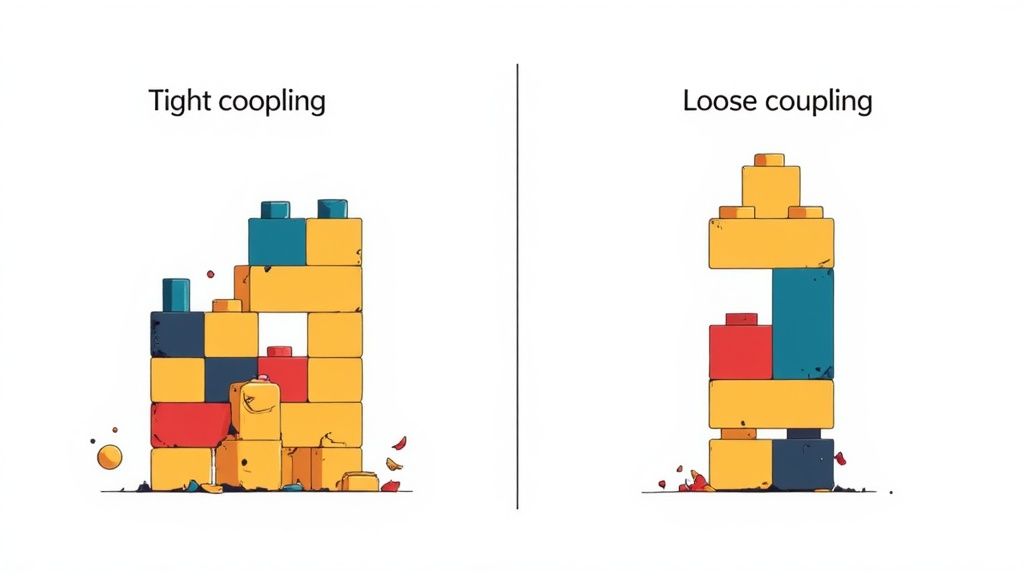
Think of your code like a complex LEGO model. If you permanently glue every single brick together, trying to change one small piece means you have to break the entire structure apart. That’s “tight coupling,” and it’s a massive headache for developers when it's time to update or test something.
The Dependency Inversion Principle (DIP) is your blueprint for using standard connectors instead of superglue. It ensures your important, high-level components (like the main business logic) aren’t hardwired to fragile, low-level details (like a specific database or payment gateway). Instead, everything connects through stable 'contracts' or abstractions.
This guide will show you how this approach leads to code that’s far easier to maintain, adapt, and test. Getting this right is a huge step forward if you want to learn how to improve problem-solving skills as a developer, ultimately making you faster and more effective.
So, What's This "Inversion" All About?
The "inversion" in the Dependency Inversion Principle (DIP) is a simple but powerful flip in how we connect our code. In most traditional software design, high-level modules—the ones that handle business logic and policies—end up depending directly on low-level modules, like database connectors or notification services. This creates a rigid, top-to-bottom dependency chain that’s hard to change.
DIP turns that idea on its head. Instead of the high-level policy depending on the low-level detail, both depend on a shared abstraction, usually an interface.
Think of it like a TV remote. The remote (your high-level module) doesn’t know or care if it's controlling a Samsung, Sony, or LG television. It just knows it can send signals like 'power on' or 'change volume'—a standard interface. Any TV (the low-level detail) that understands this standard can be controlled by it.
This shift isn't just an academic curiosity. It gained serious traction in UK software education after the 2000s. In fact, studies revealed that by 2015, 62% of university computer science modules referenced SOLID principles in their curriculum. You can read more about DIP's adoption and impact on thecodewhisperer.com.
Refactoring Code with the Dependency Inversion Principle
Theory is one thing, but seeing the dependency inversion principle in action is what really makes it click.
Let’s walk through a classic example of a tightly-coupled design: a NotificationService that directly creates and uses a specific SmsApiClient. This setup is rigid. If you want to switch to email notifications or just test the service without sending a real SMS, you’re stuck. It’s impossible.
The first step is to create an abstraction—a contract. We'll define an INotifier interface that simply outlines what it means to "send a message."
Next, we make our concrete classes conform to this contract. Both our original SmsApiClient and a new EmailNotifier will implement the INotifier interface.
Finally, we change the NotificationService itself. Instead of depending on a concrete SmsApiClient, it will now depend on the INotifier abstraction. We can then inject whichever notifier it needs at runtime.
This diagram shows the "before and after" of our dependency structure.
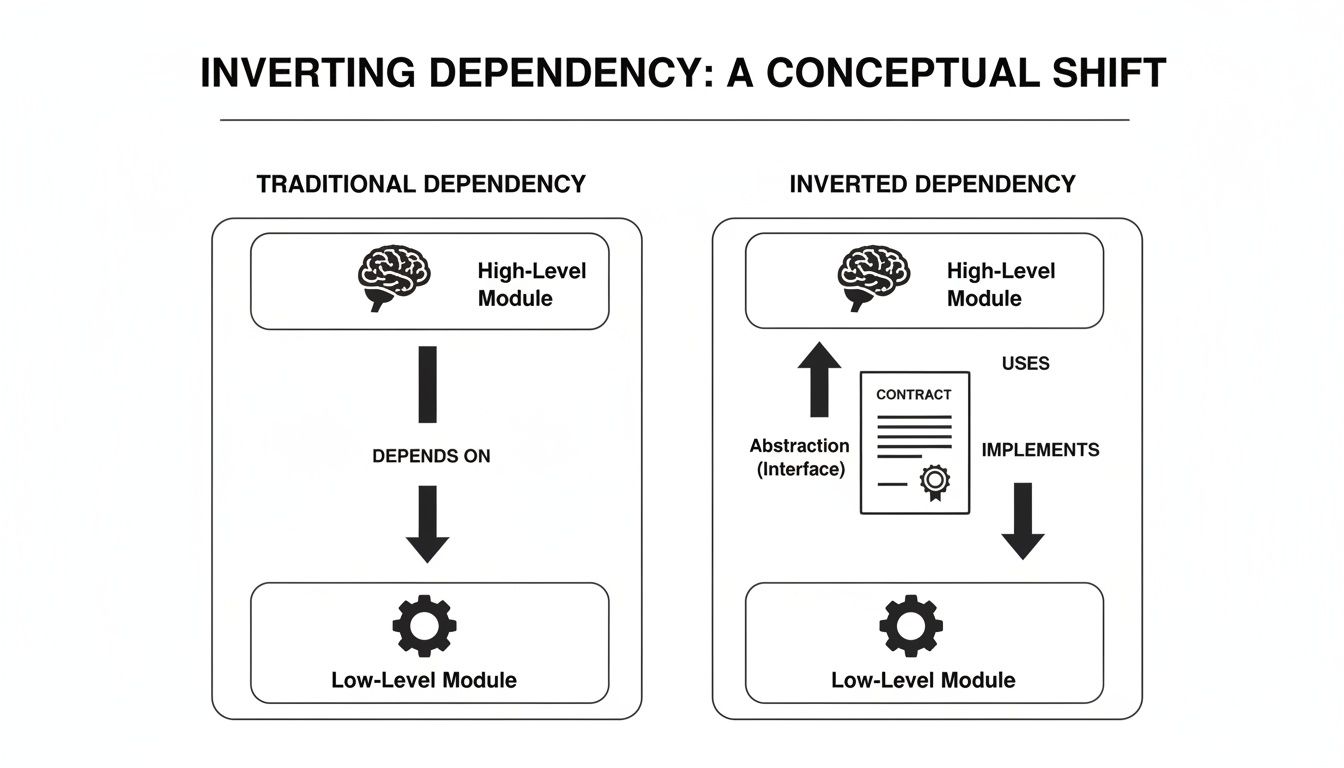
See how the arrows have flipped? The high-level logic and the low-level details now both point toward the central contract. We've successfully inverted the original dependency flow.
The Strategic Payoffs of Building with DIP
Adopting the Dependency Inversion Principle isn't just about clean code—it’s a strategic decision that pays dividends across the entire development cycle. When you stop your high-level logic from depending on low-level details, your whole system becomes more resilient and easier to change. Think of it as building a flexible foundation instead of a rigid one.
So, what are the tangible benefits? It really boils down to four key advantages:
- Massively Improved Testability: You can easily swap out real components—like a database or an API client—with mock objects. This makes unit testing a breeze because you can test your core logic in complete isolation.
- Drastically Easier Maintenance: Need to switch from Postgres to a different database? No problem. When low-level details are abstracted away, these kinds of changes won't cause a domino effect that breaks your core business rules.
- Genuine Component Reusability: Abstract components aren't tied to one specific context. This means you can reuse them with different implementations across your entire application, or even in future projects.
- Long-Term Architectural Flexibility: Your system can adapt to new features and requirements without needing a painful, expensive rewrite. You're no longer locked into your initial technical decisions.
This isn't just theory. A UK study found that teams who consistently applied DIP reduced the time they spent on module-level changes by an impressive 34%.
Building this way is a core part of developing a strategic mindset. For more on that, check out our guide on how to improve strategic thinking.
Putting DIP Into Practice: A Real-World Example

Theory is great, but let's see how the Dependency Inversion Principle helps us build cleaner boundaries in a real application. Imagine a standard e-commerce checkout system, which has a frontend UI, some order processing logic, and a way to handle payments.
At first glance, it's tempting to have the order processor directly call a specific payment provider's API, like Stripe. It's fast and it works. But this locks you into that one provider, creating a classic tight coupling problem. What happens when you want to add PayPal?
To fix this, we introduce an interface—let's call it IPaymentProcessor. This abstraction acts as a go-between, decoupling the core order logic from any specific payment gateway. Now, the order processor only cares about the interface, not the concrete details.
By depending on an abstraction, we can add new payment options like PayPal or Klarna simply by creating new classes that implement our
IPaymentProcessorinterface. The core logic never needs to change.
This real-world example shows how DIP is the key to building scalable, plugin-style architectures. This isn't just for business logic, either; it's a fundamental concept for designing any system with clear rules and boundaries, even logic puzzles like the N-Queens problem.
Stumbling Blocks: Common Misconceptions and Pitfalls
It's easy to trip up when you're first applying the Dependency Inversion Principle. The most common mistake is confusing DIP (the principle) with Dependency Injection (the pattern). Think of it this way: DIP is the what—"high-level modules shouldn't depend on low-level modules"—while DI is one of the hows. It's a technique to achieve inversion, but it's not the principle itself.
Another classic pitfall is creating "leaky abstractions." This happens when you design an interface that's so tightly coupled to one specific implementation that it doesn't actually decouple anything. To avoid this, focus on what the high-level module needs, not the nitty-gritty details of the low-level component doing the work. Don't go overboard and create interfaces for every single class, either. Be strategic and apply them where flexibility really matters.
Finally, a crucial detail often gets missed: the high-level module must own the abstraction (the interface). This is what truly inverts the dependency flow, ensuring the lower-level module conforms to a contract defined by the component that uses it.
Getting this right isn't just academic. In fact, UK government projects that correctly applied DIP saw their change-order costs drop by 22%. It’s a principle with real financial benefits. You can dig into the specifics of these public-sector findings on news.ycombinator.com.
The Payoff: Code That Lasts
So, what’s the big takeaway from our dive into the Dependency Inversion Principle? It’s simple but powerful: depend on abstractions, not on concrete details.
Following this principle isn't about ticking a box. It's a fundamental shift in how you think about building software, one that prioritises flexibility from the very beginning. We've seen how it makes testing easier, maintenance less of a headache, and prepares your code for whatever the future throws at it.
The real goal is to make your system’s dependencies flow towards abstractions. Do that, and your core logic stays solid, stable, and ready for change.