


Let's get one thing straight: the idea of a perfect, movie-style photographic memory is mostly a myth. Very few people have a true eidetic memory—the ability to recall an image in perfect detail after seeing it just once.
But here’s the good news. You can absolutely train your brain to develop a memory so powerful it feels photographic. This guide isn’t about chasing a superpower; it’s about giving you real, science-backed tools to dramatically improve your recall.
From Myth to Method
The journey to an exceptional memory isn’t about unlocking some hidden part of your brain. It’s about learning specific, actionable methods that change how you process the world around you.
Memory champions don't have different brains; they’ve just mastered the art of deliberately encoding and retrieving information.
The key is to shift from being a passive observer to an active participant in how you process and store information. Get ready to build a memory you never thought possible.
This means you'll learn to turn abstract facts and fleeting moments into vivid mental images that your brain can't help but remember.
What You Will Actually Learn
This guide moves beyond fantasy and gives you a practical framework for building a superior memory from the ground up. We'll focus on evidence-based strategies tested by cognitive science and used by top performers.
Here’s what you can expect to master:
- Active Encoding Techniques: You'll learn how to use methods like the Memory Palace (or Method of Loci) to create organised mental structures for storing huge amounts of information.
- Information Management: We'll cover chunking and vivid association—powerful tools for breaking down complex data into digestible, unforgettable pieces.
- Long-Term Retention: Discover the power of spaced repetition and active retrieval to fight the natural process of forgetting and lock information into your long-term memory.
By embracing these methods, you’ll go from someone who forgets names and details to someone who can consciously and reliably recall them. The goal isn’t a mythical “photographic” recall, but a dependable, high-performance memory built through deliberate practice.
Why Your Memory Struggles in the Digital Age
Ever wonder why it feels harder to remember things, even with a supercomputer in your pocket? You’re not alone. Our growing reliance on digital devices for everything from directions to memories is subtly weakening our brain's natural ability to recall information.

There’s even a name for it: the "photo-taking-impairment effect". When you snap a picture, you’re essentially telling your brain, "Don't worry about this one, the phone's got it." By constantly outsourcing memory tasks, we’re letting our mental muscles atrophy.
This isn’t just about photos. Think about it. We don't memorise phone numbers anymore. Birthdays are stored in apps. Shopping lists are typed into our notes. Each time we offload a small memory task, we miss a chance for a mental workout.
The Rise of Digital Hoarding
Our devices have turned into massive, cluttered digital attics. In the UK, we've become a nation of hoarders, collecting thousands of photos we rarely, if ever, look at again. This constant stream of information creates a serious bottleneck, both on our devices and in our minds.
The numbers are pretty telling. Research shows the average Brit snaps around 440 photos per year. What's truly staggering is that 69% of people store every single one only on their phones, tablets, or computers. That’s a lifetime of moments one cracked screen away from being lost forever.
Dr. Sandi Mann from the University of Central Lancashire points out a worrying trend: 16% of people fear that children in 50 years won't be able to access images stored on today's phones.
This over-reliance on external storage isn't just a technical risk; it's a cognitive one. When you know an image is safely stored away, your brain doesn't bother with the active observation needed to form a strong, lasting memory of the actual event.
Moving from Recorder to Observer
If you want to build a memory that feels photographic, you have to get more intentional about how you experience the world. The first step is simple: acknowledge this digital dependency and decide to reclaim your brain's natural power.
This means shifting from being a passive recorder to an active observer. Instead of immediately whipping out your phone to capture a moment, try this first:
- Pause and Observe: Just for 30 seconds, consciously soak in the details. What do you see, hear, and smell? What emotions are you feeling?
- Create Mental Snapshots: Intentionally try to "photograph" the scene with your mind. Lock onto specific, vivid details—the exact colour of the sky, the expression on someone's face, a particular sound.
- Engage Multiple Senses: Link what you see with other sensory inputs. The smell of rain on hot pavement during a holiday, for instance, creates a far stronger memory anchor than a silent, flat photo ever could.
These small shifts demand focus and attention, two skills that are constantly shattered by digital pings and multitasking. Sharpening your ability to stay present is the foundation of a better memory. For some practical exercises, you might find our guide on how to improve concentration and focus useful.
By consciously choosing when to use our devices and when to rely on our own minds, we can begin to strengthen the neural pathways responsible for recall. The journey to a superior memory doesn't start with a complex technique, but with a simple decision to be more present in your own life.
Core Techniques for Building a Superior Memory
Alright, let's move from theory to practice. Building a truly superior memory isn't about mindlessly repeating things over and over. It's about learning how to encode information in a way that’s active, creative, and sticky.
Here’s the secret: memory champions don’t have fundamentally different brains. They just use specific, trainable techniques to turn boring, abstract data into mental stories you can’t forget.
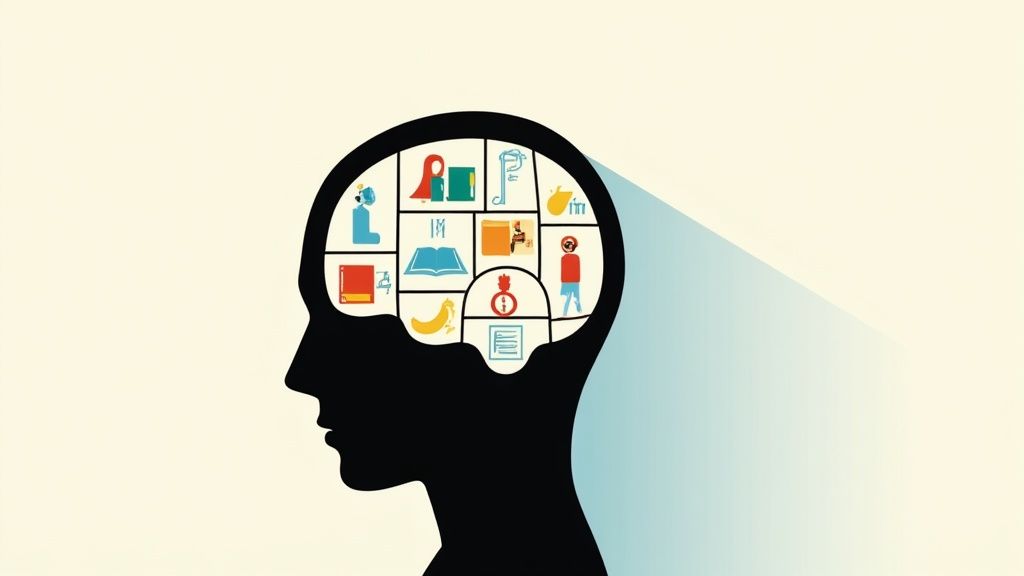
These methods are the foundation for anyone serious about upgrading their recall. We'll dig into the three pillars of active encoding: creating mental maps, breaking information down, and forging powerful mental links.
Construct Your Memory Palace
One of the oldest and most powerful mnemonic systems is the Method of Loci, known more casually as the Memory Palace. The idea is brilliant in its simplicity: you use a physical space you know intimately—your home, your commute—and "place" the things you want to remember at specific locations, or loci, along that path.
Why does this work so well? Because our brains are absolute wizards at spatial and visual memory. By attaching new, abstract information (like a list of historical dates or talking points for a speech) to a familiar location, you’re playing to your brain's natural strengths.
To build your first Memory Palace, just follow these simple steps:
- Pick a place you know backwards. Your childhood home, your current flat, or your daily walk to the gym are perfect candidates. The only rule is that you can navigate it in your mind's eye without any effort at all.
- Map out a clear, one-way route. Decide on a specific path you'll always follow. For example, you start at the front door, move into the hallway, then the living room, and then the kitchen. Don't deviate.
- Identify distinct spots (your loci). Within each room, pick out five to ten memorable locations. In your living room, this could be the sofa, the coffee table, the television, a bookshelf, and the window.
Now for the fun part. Let's say you need to memorise a shopping list: eggs, milk, bread, apples, and chicken. You would mentally place each item at one of your loci. You could imagine a giant, cracking egg splattering yolk all over your front doormat. Then, walking into the hallway, you see a river of milk flowing from under the coat rack. This approach transforms a boring list into a dynamic, unforgettable scene.
The more absurd, bizarre, or emotionally charged your mental images are, the more they will stick. Your brain is wired to remember things that are unusual and out of the ordinary.
Break It Down with Chunking
Our short-term memory has a pretty firm limit. Most research suggests we can only hold about seven pieces of information at once before things start getting fuzzy. This is where chunking saves the day. It's the simple strategy of breaking down long strings of information into smaller, more manageable units or "chunks".
You already do this constantly without even thinking about it. A phone number like 07700900345 is a nightmare to remember. But chunked into 07700 900 345? Suddenly, it’s easy. Instead of eleven individual digits, you only have three small groups to recall.
This technique is incredibly versatile. You can apply it to almost anything:
- Credit Card Numbers: Group the 16 digits into four easy chunks of four.
- Complex Concepts: When studying a new topic, group related ideas under one main heading instead of trying to memorise dozens of isolated facts.
- To-Do Lists: Organise your tasks by category (e.g., "Emails," "Calls," "Errands") instead of staring at one long, intimidating list.
Chunking works because it reduces cognitive load, making it far easier for your brain to process and encode information. It creates meaningful connections and patterns where none existed before, turning chaos into an organised structure.
Create Powerful Vivid Associations
The final core technique is vivid association—the art of linking new information to something you already know well. The trick is to make the connection as vivid, sensory, and unusual as you can. This is the creative engine that powers most memory systems, including the Memory Palace.
Let's say you need to remember a business meeting is at 3 PM. You could associate the number three with a tricycle. Now, picture your boss, wearing a full suit, frantically pedalling a tiny tricycle into the meeting room. It’s an absurd image, but you're definitely not going to forget it.
To see how these all fit together, here's a quick breakdown of how you might use each technique.
Comparing Memory Encoding Techniques
| Technique | Best For | Practical Example |
| :--- | :--- | :--- |
| Memory Palace | Ordered lists, speeches, sequences of information | Placing key points of a presentation on different pieces of furniture in your living room to remember the order. |
| Chunking | Numbers, long strings of text, complex data | Breaking down a long password like R$t8bN2qP!v7 into smaller parts: R$t8, bN2q, P!v7. |
| Vivid Association | Individual facts, names, vocabulary words | To remember the capital of Australia is Canberra, you might picture a can of berries (Can-berra) sitting on a map of Australia. |
These techniques all require active engagement and a bit of creativity, but that’s precisely why they’re so much more effective than just passively re-reading your notes. The mental effort you put into creating these connections is what forges strong neural pathways, making retrieval faster and more reliable.
Interestingly, integrating these skills also sharpens your underlying logical reasoning—the same kind of thinking needed for more structured challenges. To push those abilities even further, you could try to learn how to solve logic puzzles in your spare time. This is how you begin the journey to building a memory that feels genuinely photographic.
Locking in Information with Spaced Repetition
Getting information into your head with a Memory Palace is a brilliant start. But that’s just the first half of the job. The real trick is making sure it stays there, week after week, year after year.
This is where we switch gears from encoding to retention. To build a truly superior memory, you need to master two core principles: spaced repetition and active retrieval. These aren't just study hacks; they're the bedrock of how our brains forge lasting knowledge.
Defeating the Forgetting Curve
Back in the 1800s, a psychologist named Hermann Ebbinghaus proved what we all know from experience: memories fade fast. He mapped this decline as the "forgetting curve," showing a dramatic drop in recall right after learning something, which then levels off.
Spaced repetition is the perfect weapon against this natural decay. The idea is simple but powerful: you review information at progressively longer intervals. You hit the material just as your brain is about to let it go, forcing it to strengthen the connection. Each review flattens out that forgetting curve.
A solid starting schedule looks something like this:
- First Review: 1 day after learning.
- Second Review: 3 days later.
- Third Review: 7 days after that.
- Fourth Review: 21 days later.
This works because it makes your brain work a little harder each time. That effort is a signal that this information is important and worth holding onto.
The Power of Active Retrieval
Passively re-reading your notes is one of the worst ways to study. It feels productive, but it’s a trap—it creates an illusion of knowing without actually building recall strength.
To really cement a memory, you need active retrieval. This means pulling information out of your brain, not just passively absorbing it.
Think of it as the difference between watching someone lift weights and actually lifting them yourself. The struggle is what builds the muscle.
Active retrieval isn't about passing a test; the test is the training. The mental effort of recalling something is precisely what strengthens the neural pathways, making the memory faster and easier to access next time.
This is, hands down, one of the most effective learning techniques discovered.
Practical Retrieval Techniques
You don't need fancy software to start using active retrieval. Here are two simple but incredibly effective methods:
- Self-Quizzing: After reading a chapter or leaving a meeting, close your book or laptop. Now, write down everything you remember. The more specific, the better. This immediately reveals the difference between what you think you know and what you actually know.
- The Teach-Back Method: Try to explain a concept to someone else. If no one's around, just talk it out loud to yourself. If you can't explain it simply, you don't understand it well enough. Stumbling over a point shows you exactly where your knowledge is weak.
Even our modern habits can work against us. How often do you pull out your phone to snap a picture instead of truly looking at something? A study reviewed by the BPS found that participants who photographed paintings recalled 10-15% fewer details than those who just observed them.
To fight this, try this simple exercise: put your phone away, stare at an object for 20 seconds, then turn away and quiz yourself on its details. This little drill of active observation and retrieval can boost your recall by 25% per session. You can read more about the research on the BPS Research Digest website.
Combine these active retrieval exercises with a spaced repetition schedule, and you have a bulletproof system for turning fleeting facts into permanent knowledge. This is a crucial step towards building a memory that feels photographic.
Your Four-Week Memory Training Plan
Knowing the techniques is one thing, but turning them into a reliable, everyday skill is another challenge entirely. Real progress comes from consistent, structured practice. This four-week plan is designed to layer the methods we've covered into a manageable routine, building your skills progressively without it ever feeling like a chore.
The goal isn't perfection. It's about committing to just 15-20 minutes a day. That's it. This small habit is what turns abstract concepts into concrete abilities you can actually use.
Think of memory as a cycle: learn, review, and recall. This simple process is the engine behind everything we're about to do.
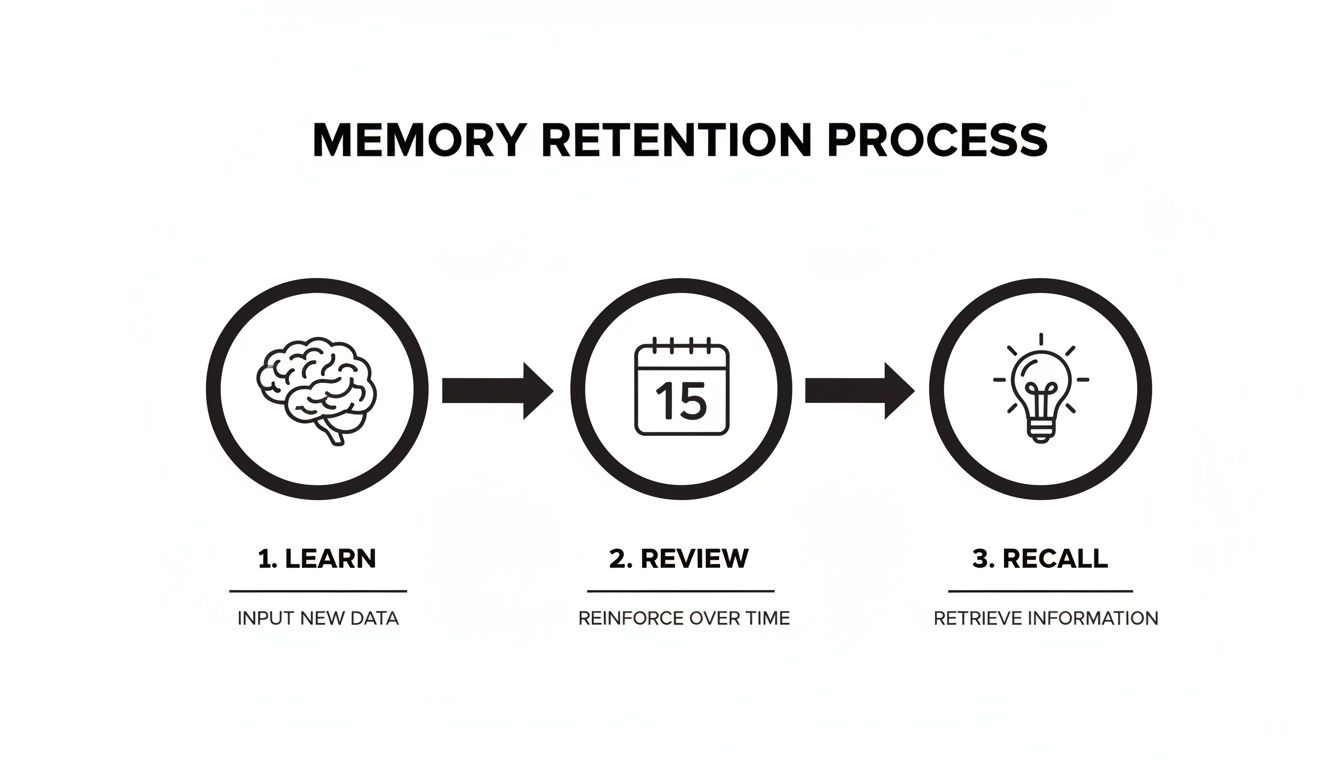
This visual is key. A strong memory isn't a one-time event; it’s a continuous loop where actively pulling information back out makes it stick for good.
Week One: Foundation in the Memory Palace
This first week is all about getting comfortable inside your own head. Your mission is to master the Memory Palace—creating vivid mental images and "placing" them in a location you know like the back of your hand. Forget about speed for now. Just focus on making your visualisations as absurd and memorable as possible.
Here's your daily 15-minute drill:
- Choose Your Palace: Pick somewhere simple and familiar, like your bedroom or kitchen. Mentally walk through it and pinpoint 10 distinct locations (loci) in a set order.
- Memorise a List: Grab a random 10-item list each day—a shopping list, a list of countries, whatever.
- Place and Visualise: Walk through your palace, anchoring one item at each spot. If the item is "bananas," don't just see a banana on your bed. Picture giant, dancing bananas using your duvet as a stage. The weirder, the better.
- Recall: A few minutes later, mentally walk back through your palace and see what you remember.
By the end of the week, you should feel confident navigating your first palace and dropping items along the way.
Week Two: Tackling Numbers and Names
Now that your visualisation muscles are warmed up, we're adding a new layer: chunking and association. These are for the common memory weak spots like phone numbers and names, so you'll see the real-world benefits almost immediately.
Your daily exercises:
- Number Chunking (10 mins): Find a long number, like a phone number or the first 10 digits of pi. Break it down into smaller, rhythmic chunks. So, 3.141592653 becomes 3.14 | 159 | 2653. Practice saying it out loud in that rhythm.
- Name Association (5 mins): Think of three people you met recently or saw on the news. Instantly link their name to a vivid image. For a person named "Baker," you might picture them wearing a massive chef's hat covered in flour.
The secret to remembering names is to forge an instant, strong, and often ridiculous association the second you hear it. This active engagement is what stops the name from slipping away.
Week Three: Making It Stick with Spaced Repetition
This week, we shift from just encoding information to making it permanent. You'll keep using your Memory Palace, but now we'll add a spaced repetition schedule to really lock in the knowledge.
Your weekly plan looks like this:
- Day 1: Learn a new 10-item list using your palace.
- Day 2: Before learning today's new list, first recall yesterday's list. This is your first taste of active retrieval.
- Day 4: Try to recall the list from Day 1 again. It should feel a bit easier this time.
- Day 7: Recall the Day 1 list one last time this week.
By testing yourself at increasing intervals, you’re signalling to your brain that this information is important and worth keeping. This simple review loop is a cornerstone of building a memory that feels almost photographic.
Week Four: Complex Information and Tracking Progress
In the final week, we put it all together. The goal is to move beyond simple lists and start memorising key facts and concepts from real-world material.
Your daily 20-minute exercise:
- Read an Article: Pick a short news article or blog post. After reading it once, your job is to identify and memorise its five key takeaways.
- Encode: Use a Memory Palace or vivid associations to lock in those key points. For a fact about Amazon rainforest deforestation, you might picture a giant chainsaw cutting through your coffee table.
- Track Your Progress: Keep a simple journal. Note what you memorised and give your recall accuracy a score out of 10. This simple feedback loop keeps you motivated and shows you where you need to focus.
To keep your mind sharp between sessions, it helps to mix in other mental workouts. You can find some of the best brain training games online that challenge different cognitive skills like logic and spatial reasoning—a perfect complement to your memory training.
By the end of this month, you won’t have a mythical photographic memory. You’ll have something much better: a disciplined, reliable, and significantly more powerful one.
Lifestyle Habits That Boost Cognitive Function
While memory techniques are a game-changer, they're only half the story. You can't build a world-class memory on a shaky foundation. To get results that stick, you need to create a brain-friendly environment from the inside out.
Think of it like this: your lifestyle habits are the soil, and your mental training is the seed. You need fertile ground for anything to grow. This means getting serious about how you sleep, eat, exercise, and manage stress.
The Undeniable Power of a Positive Mindset
Your mental state has a direct, physical impact on your ability to remember things. A positive outlook isn't just about feeling good; it's a critical tool for cognitive health, especially as you get older.
This isn't just wishful thinking. A major UK study tracked over 10,000 adults in England starting in 2002. The results were clear: those who reported higher levels of wellbeing also performed significantly better on memory tests over a 16-year period.
This link held strong even after accounting for symptoms of depression. It’s a powerful reminder that our attitude shapes our mental longevity. You can read more about how mindset matters for memory on sciencefocus.com.
Fuel Your Brain with the Right Diet
Your brain is a high-performance engine, and it needs premium fuel. The right diet protects brain cells, cuts down on inflammation, and improves the signalling between neurons—all essential for locking in memories.
You don't need a complicated plan. Just focus on adding more of these:
- Omega-3 Fatty Acids: Found in oily fish like salmon and mackerel, plus walnuts and flaxseeds. These are the literal building blocks for your brain and nerve cells.
- Antioxidants: Berries, dark chocolate, and leafy greens like spinach and kale are your brain's bodyguards, fighting off the oxidative stress that damages cells.
- Flavonoids: These compounds, found in tea, citrus fruits, and dark-coloured vegetables, have been directly linked to better memory function.
Cutting back on processed foods and sugar while adding more of these whole foods can make a surprisingly fast difference to your mental clarity.
You cannot expect to build an elite memory on a diet of junk food. What you eat directly feeds your brain's ability to learn, store, and retrieve information.
Solidify Memories with Quality Sleep
Sleep isn't downtime for your brain. It's when the real work happens. While you're sleeping, your brain is busy organising the day's events, strengthening important connections, and consolidating them into long-term memories.
Aim for 7-9 hours of good, uninterrupted sleep a night. Skimping on sleep, even for just one night, throws a spanner in the works, making it much harder to recall what you learned the day before.
Exercise and Stress Management
Physical activity might be the single best thing you can do for your brain. A brisk walk or a workout increases blood flow, pumping vital oxygen and nutrients to your brain. It also triggers the growth of new neurons.
At the same time, you have to get a handle on stress. Chronic stress floods your system with cortisol, a hormone that can damage the hippocampus—the brain region critical for forming new memories.
Simple practices like mindfulness meditation or deep breathing can lower cortisol levels, creating a calmer internal state that’s far better for learning and recall.
Nailing these habits creates the ideal biological backdrop for the memory techniques we’ve covered. And if you're looking for a fun way to sharpen the logical thinking skills that go hand-in-hand with memory training, give the puzzles at Queens Game a try at https://queens.game.