

The 24 game is one of those classic puzzles that’s both incredibly simple and surprisingly deep. The goal is to take four numbers and, using only basic arithmetic, make them equal exactly 24. You have to use each number once—no more, no less—along with addition, subtraction, multiplication, and division. The real magic happens when you start using parentheses to control the order of operations.
The Foundations of the 24 Game
At its core, the 24 Game is a fantastic workout for your mental maths and creative thinking. The rules are elegant: you get four numbers, and you need to hit the target of 24 using addition (+), subtraction (-), multiplication (×), and division (÷).
This simplicity is why it's a favourite in classrooms. It’s not about just finding an answer; it encourages you to explore different pathways, building a much deeper feel for how numbers actually work together. For a closer look at boosting these kinds of abilities, check out our guide on how to improve your problem-solving skills.
Don't Worry, Most Puzzles Have a Solution
One of the most engaging things about the 24 game is that most hands are, in fact, solvable. It’s easy to stare at a set of four numbers and think it’s impossible, but that’s rarely the case.
When you draw four cards from a standard deck, the probability of getting a solvable hand is remarkably high. In a UK-style deck, it works out to about 80.46%. Knowing this completely changes your mindset. You stop asking "is this possible?" and start asking "how do I find the path?"
The high success rate transforms the game from a test of possibility into a hunt for a solution. Knowing an answer likely exists is a powerful motivator. It pushes you to keep trying instead of giving up too soon.
Ultimately, this puzzle gives you the confidence to tackle any set of numbers. It teaches you to look past the obvious combinations, experiment with different operations, and stick with it until you uncover one of the many solutions hidden in the numbers.
Mastering Key Patterns and Mental Shortcuts
To get really fast at the 24 game, you have to stop thinking about brute-force calculation. Instead, you need to start seeing the patterns.
Experienced players don't just mash numbers together randomly. They use mental shortcuts to spot potential answers almost instantly. This isn't some kind of magic—it's just a well-practised form of pattern recognition.
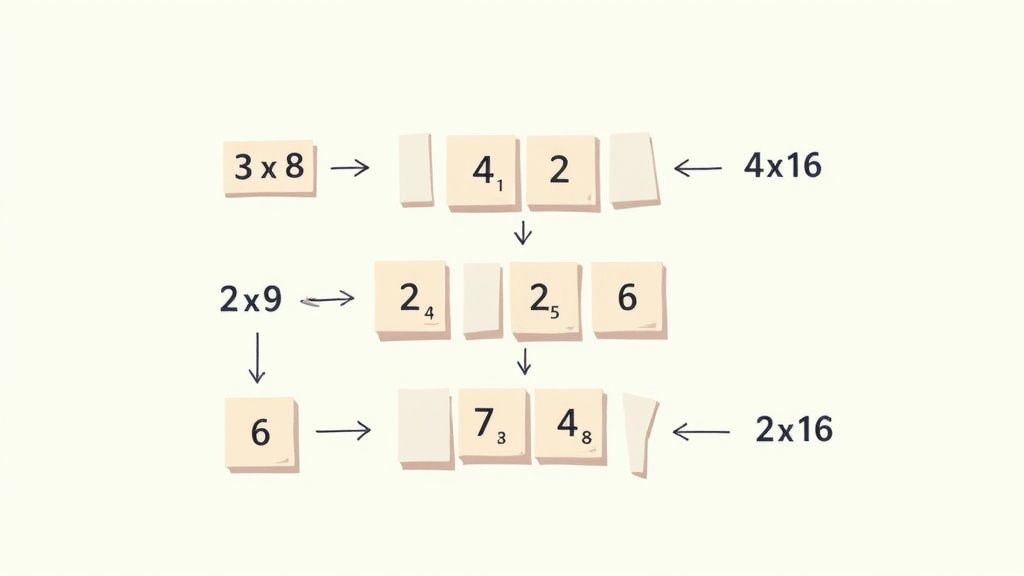
The biggest shortcut is to stop seeing four separate numbers. View them as building blocks you can combine to create the factors of 24.
The Power of Factor Pairs
Your main goal should always be to create the key factor pairs of 24. Burn these into your memory, as they give you a clear target for every calculation:
- 4 x 6
- 3 x 8
- 2 x 12
- 1 x 24
Now, every puzzle becomes a two-step process. First, can you use two of your numbers to make one of these factors? Second, can you use the other two numbers to create its partner?
Let's try this with the numbers (2, 2, 6, 8).
Your brain might immediately lock onto the 6 and think, "Okay, I need a 4." A quick scan of the other numbers (2, 2, 8) shows that 2 + 2 = 4. And there it is: (2 + 2) x 6 = 24.
Or maybe you saw the 8 first and thought, "I need a 3." Can you make a 3 from (2, 2, 6)? Absolutely: 6 ÷ 2 = 3. So, (6 ÷ 2) x 8 = 24.
This 'pairing' strategy completely changes the game. You're no longer wrestling with four numbers at once. You're just solving two tiny puzzles to create a matching pair.
Breaking down a complex problem like this is a core technique you'll find in many of the best brain training games.
A Classroom Favourite for a Reason
This factor-first approach is so powerful that it's become a cornerstone for teaching mental arithmetic. In the UK, the 24 game has been a popular classroom tool for decades, helping students build speed and number confidence.
Educational resources often highlight these exact techniques—pairing and factorisation—as the secret to success. You can actually find a lot of interesting history about the puzzle's adoption in schools if you dig around.
Let's try one more: (1, 2, 3, 4).
Could we make a 4 and a 6? Not easily. How about a 3 and an 8? Again, that looks tricky. What about a 2 and a 12? Well, we already have a 2. So, can we make 12 with (1, 3, 4)? Yes, 3 x 4 = 12. And we're done: 2 x (3 x 4) = 24.
By constantly asking yourself how to build these crucial factors, you develop a mental checklist that cuts straight through the noise. This is how you move from slow, deliberate calculation to the quick, intuitive leaps that make solving these puzzles so satisfying.
Working with Fractions and Grouping
Sooner or later, you'll hit a hand where the simple stuff—like aiming for a 3x8 or a 4x6—just won't cut it. This is where the real game begins. The trickiest puzzles are often impossible to solve using whole numbers alone.
This is the moment you need to embrace division not just as a way to get a smaller integer, but as a tool for creating fractions. These little fractional steps are the key to unlocking solutions you’d otherwise never see.
Think Like a Fraction Pro
Most people have a mental block against answers that aren't clean, whole numbers. We're trained to avoid them. But in the 24 game, a fraction is often the perfect stepping stone to the final solution.
Take a tough hand like (3, 3, 8, 8).
At first glance, it looks like a dead end. There's no obvious way to make the standard factor pairs of 24. The solution requires you to look at the numbers in a completely different light: 8 ÷ (3 - 8/3). It looks messy, but it’s built on a pattern you can learn to spot.
Let's walk through the thinking:
- Create a Fraction: First, take two of the numbers and make a fraction. The leap of insight here is creating 8/3.
- Build a Denominator: Now, use the other two numbers to create a denominator that simplifies things. In this case, (3 - 8/3) becomes (9/3 - 8/3), which cleans up nicely to just 1/3.
- Solve It: The puzzle is now just 8 ÷ (1/3). Remember, dividing by a fraction is the same as multiplying by its inverse. So, it’s just 8 x 3, which gets you to 24.
Once you start seeing pairs of numbers as potential fractions, you open up a whole new world of possibilities.
This technique of creating a fractional denominator is the single biggest jump you can make from being a casual player to someone who can solve almost any 24 puzzle thrown at them.
Master Strategic Grouping
Parentheses are your secret weapon. They let you control the order of operations, forcing certain calculations to happen first and completely changing an expression's outcome. When you feel stuck, just trying out different groupings can crack the puzzle wide open.
Let's look at another classic stumper: (1, 3, 4, 6).
Again, the simple factor pairs aren't showing up. The answer here also depends on creating a fraction inside a set of parentheses: 6 ÷ (1 - 3/4).
- First, the parentheses force you to calculate (1 - 3/4), which gives you 1/4.
- The problem then simplifies down to a much friendlier 6 ÷ (1/4).
- This is the same thing as 6 x 4, landing you right on 24.
The ability to spot these opportunities is what separates the good players from the great ones. It’s all about looking past the face value of the integers and seeing the hidden relationships between them. Practise these techniques, and you’ll build the intuition to spot these elegant solutions every time.
A Systematic Approach When You Get Stuck
Even seasoned players hit a wall. You’ve tried the usual factor pairs, scanned for fraction opportunities, and still, the solution is nowhere to be found. When your intuition runs dry, it’s time to switch from creative pattern-spotting to a more methodical process.
Randomly trying combinations is a fast track to frustration. A much better way forward is to anchor your calculations. This gives you a structured path to follow, turning a chaotic guessing game into a logical search.
Anchor Your Calculations
The idea is simple: instead of trying to solve the entire puzzle at once, you solve part of it first. Just pick two of the four numbers and perform a single operation on them. That gives you a new, intermediate number.
Suddenly, the problem is much simpler. You’re left with only three numbers to manage: the new one you just made and the two you haven’t touched yet. The goal is still to make 24, but the puzzle is far less intimidating.
Let's walk through it with the numbers (2, 6, 7, 8).
- You could start by anchoring with 6 × 2 = 12.
- Your new, simpler puzzle is making 24 using the numbers (12, 7, 8).
- This is much easier to wrap your head around. With a 12, you know you need to make either a 2 (for 12 × 2) or another 12 (for 12 + 12). A quick look at 7 and 8 shows neither is possible.
Okay, that anchor was a dead end. No problem. You just pick a new one and try again.
What about anchoring with 8 − 2 = 6? Your new set of numbers is (6, 6, 7). A solution might jump out, but maybe not. You see 6 × (7 − 6), but that only gets you to 6. Still no luck.
This deliberate process of anchoring and re-evaluating keeps you from trying the same failed combinations over and over. It’s a way to methodically explore every real possibility. With (2, 6, 7, 8), the actual solution is (8 ÷ 2) × 6 = 24. The 7 wasn't needed, but you'd find that out by systematically checking pairs.
This flowchart maps out the mental checklist for tough puzzles, guiding you from simple whole numbers to the more complex operations and regrouping needed for stubborn cards.
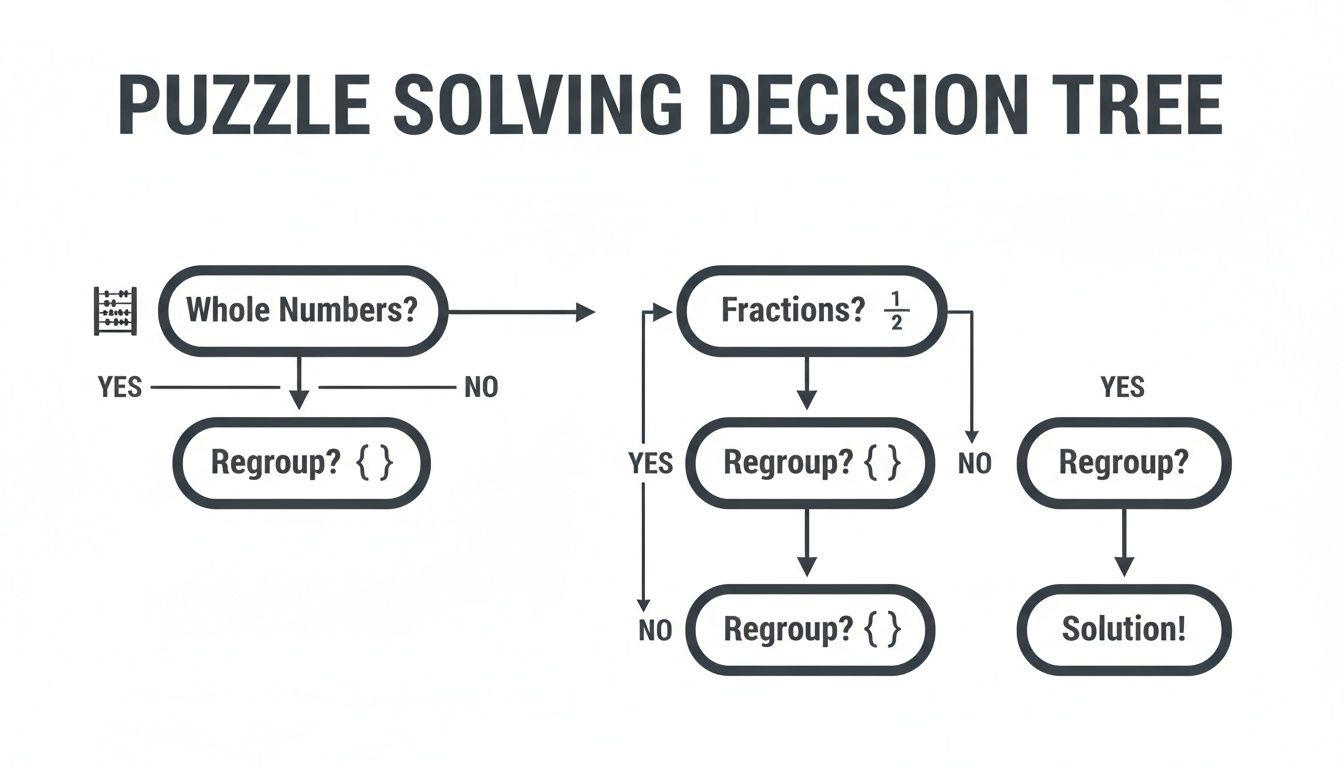
The diagram just reinforces the core idea: when the easy stuff doesn’t work, you need to escalate your thinking in a structured way.
By systematically trying one pair and one operation at a time, you build a reliable mental checklist. This ensures you explore every potential path without getting lost in the numbers—providing a guaranteed way to find a solution if one exists.
Practice Puzzles to Sharpen Your Skills
Knowing the strategies is one thing, but finding solutions instinctively? That only comes with repetition. True mastery isn't just about calculation; it's about training your brain to see the patterns faster each time you play. This is where practice becomes everything.
Consistent practice builds the mental muscle you need, turning clumsy arithmetic into a fluid, intuitive process. It’s the same reason maths classrooms in the UK use targeted drills—it helps students develop a much stronger number sense.
This kind of focused repetition is especially crucial for locking in the advanced techniques we've covered, like using fractions or spotting complex groupings. Without practice, they're just abstract ideas. By actually working through puzzles that demand these skills, you internalise the patterns and make them part of your core problem-solving toolkit.
Drills for Building Speed and Accuracy
To get the most out of your practice, you need a strategy. Don't just solve random puzzles. Focus your effort on specific types of challenges to shore up your weak spots. It's the difference between just playing and actively getting better.
Here are a few drills to try:
- Factor-Finding Focus: Grab a set of numbers, but instead of aiming for 24, your only goal is to create its key factors: 3, 4, 6, 8, and 12. This drill hones your ability to spot the building blocks of a solution in seconds.
- Fraction Challenges: Intentionally seek out puzzles known to require fractions. Forcing yourself to work through these tricky combinations makes you much more comfortable with non-integer steps.
- Timed Rounds: Give yourself one minute per puzzle. The pressure trains you to quickly evaluate the most likely paths instead of getting bogged down in dead ends.
Effective practice is about quality, not just quantity. Focusing on the specific puzzle types you find difficult is far more beneficial than solving dozens of easy ones. This is how you turn struggle into skill.
The impact of this kind of training is well-documented. UK maths coaches often see huge boosts in students' arithmetic fluency after just a few weeks of targeted work with 24-style problems. Teachers report class-wide improvements in mental-maths speed of 10% to 35%. Students simply get quicker at spotting factor pairs and become more flexible in their calculations—skills that pay off in non-calculator exams. You can see more about how these puzzles boost arithmetic skills on YouTube.
Putting in this kind of deliberate work won't just help you solve 24 puzzles faster; it will sharpen your overall mental agility. Of course, this takes endurance. For more on that, see our article on how to improve concentration and focus.
Common Puzzle Types and Solution Patterns
Recognising these common puzzle structures will dramatically increase your solving speed. Once you see the pattern, the solution often clicks into place instantly.
| Pattern Type | Example Numbers | Typical Solution Structure | | :--- | :--- | :--- | | Multiplication Focus | 2, 3, 4, 5 | Look for 6 x 4 or 8 x 3. Here, (5 - 2) x (4 + 4) = 24. | | Division to Simplify | 3, 7, 7, 9 | Often involves dividing two numbers to get a small, useful integer. (9 / 3) x 7 + 7 = 24. | | Addition/Subtraction First | 1, 5, 5, 5 | Pair numbers to create factors of 24. For instance, 5 x 5 - 1 = 24. | | Fractional Result | 3, 3, 7, 7 | Requires division to create a fraction. Here, (7 - (3 / 7)) x 3 is a possibility. | | The "8 & 3" Pattern | 2, 2, 6, 6 | Aim to create an 8 and a 3. For example, (6 + 2) x (6 / 2) = 24. |
Keep these structures in mind as you practise. The more you look for them, the more you'll see them, and the faster your puzzle-solving will become.
Your Top Questions About the 24 Game
Once you start getting into the 24 Game, a few questions always seem to surface. You might hit a combination that feels utterly impossible, or you might wonder about the rules for using numbers.
Getting these details sorted helps clear the fog, letting you focus on the fun part: finding that clever solution. Let's tackle the most common ones.
Is Every Hand Solvable?
It’s a classic moment of frustration: staring at four cards, convinced there's no way to make 24. And sometimes, you're right. The honest answer is no, not every combination of four numbers can be solved.
If you're using a standard deck (Aces are 1, face cards removed), it's estimated that around 80% of hands have a solution. That means roughly one out of every five hands you draw could be a dead end.
Learning to recognise when a puzzle might be unsolvable is a skill in itself. It saves you from burning out on a lost cause and lets you jump to the next challenge.
Can I Use a Number More Than Once?
This one trips up a lot of new players, but the rule is straightforward and strict: each number on the four cards must be used exactly once. No more, no less. You can't just ignore a card, and you can't reuse a number from a card you've already played.
The twist comes from using intermediate results. The answer from one calculation is fair game for the next step. For example, with the numbers (2, 2, 6, 8), a perfectly valid solution is (8 - 2) * (6 - 2) = 24. Here, you used the number '2' twice in the equation, but each '2' came from a different physical card.
The rule is simple: each card gets used once. The new numbers you create along the way can be used as much as you need to reach the final answer.
What’s the Hardest 24 Puzzle?
While "hardest" is always a bit subjective, the puzzles that stump even seasoned players almost always involve fractions and a few non-obvious steps. They demand that you stop looking for simple multiplication pairs.
A famously tricky set of cards is (1, 3, 4, 6).
Most people get completely stuck here because they’re hunting for whole-number solutions. The elegant—and often missed—answer is 6 / (1 - 3/4) = 24. It requires you to first build a fraction (3/4), subtract it from 1 to get another fraction (1/4), and then perform the final division.
Puzzles like this are the ultimate test of mental flexibility. Solving one is a sure sign you've moved from just playing the game to truly understanding its strategic depth.
Is There a Real Benefit to Solving These?
Absolutely. The 24 Game is so much more than a way to pass the time. Playing it regularly is a powerful mental workout with some very real cognitive perks.
- Sharpens Mental Arithmetic: You get much faster and more accurate at doing calculations in your head.
- Builds Number Sense: You start to develop a gut feeling for how numbers can be twisted and combined.
- Boosts Creative Problem-Solving: The game literally trains your brain to hunt for unconventional answers and look at problems from new angles.
Think of it as strength training for the logical and creative parts of your mind. Those are skills that pay off everywhere.
If you enjoy the logical deduction and pattern recognition needed to solve 24, you'll love the strategic challenges offered by Queens Game. Sharpen your problem-solving skills with our unique chess-based puzzles at https://queens.game.