

Ever tried to follow a badly written recipe? It’s frustrating. You’re left with a confusing mess instead of a delicious cake. Algorithmic thinking is the skill of writing a perfect recipe—not just for baking, but for solving any problem imaginable.
It's a way of thinking you already use, probably without even realising it.
The Art of Creating a Perfect Recipe for Any Problem
So, what is algorithmic thinking at its core? It's the mental discipline of taking a big, messy challenge and breaking it down into a clean, logical sequence of steps. Think about the last time you assembled flat-pack furniture. You didn't just start hammering bits together at random, did you? You followed the instructions—an algorithm—to turn chaos into a bookcase.
But this skill isn't just about following the steps; it's about creating them. It’s about looking at a problem, figuring out what needs to happen, and putting those actions in the right order. This systematic approach removes the guesswork, ensuring anyone (or any computer) can repeat your process and get the same successful result.
More Than Just Following Steps
Algorithmic thinking is a creative, proactive skill. It’s not about mindlessly ticking off a checklist someone else wrote. It's about designing the checklist in the first place. This skill empowers you to look at any goal—from planning the most efficient route for your Saturday errands to solving a tricky puzzle—and map out a clear path to success. You’re turning a vague idea into a concrete plan.
Giving a friend directions to your house is a perfect, everyday example. You instinctively create a simple algorithm:
- Establish a starting point: "Start from the town hall."
- Provide clear, sequential steps: "Go straight until you hit the big roundabout, then take the second exit."
- Include conditions: "If you see the petrol station on your left, you've gone too far."
- Define the end state: "My house is the one with the bright red door, number 22."
That simple set of instructions is an algorithm. You deconstructed the journey into small, foolproof steps.
An algorithm is a finite sequence of well-defined instructions to solve a problem. Algorithmic thinking is the human skill of designing those instructions.
The Foundational Components of This Skill
To get really good at this, you need to understand the four pillars that hold it all up. These components are the building blocks for every solution you'll ever design, working together to turn overwhelming challenges into something manageable.
Let's take a quick look at the core components.
The Core Components of Algorithmic Thinking at a Glance
Here’s a quick overview of the four foundational pillars that turn complex challenges into manageable steps. We'll explore each of these in depth shortly.
| Component | What It Means | Simple Example | | :--- | :--- | :--- | | Decomposition | Breaking a large, complex problem into smaller, more manageable sub-problems. | Planning a holiday by separating tasks like booking flights, finding accommodation, and creating an itinerary. | | Pattern Recognition | Identifying trends, similarities, or recurring elements within and among problems. | Noticing that multiple difficult maths problems can be solved using the same formula. | | Abstraction | Focusing on the essential details while ignoring irrelevant information to simplify the problem. | Using a London Underground map, which shows stations and lines but omits street-level details. | | Algorithm Design | Developing the step-by-step instructions to solve the problem and its smaller parts. | Writing down the exact recipe steps to bake a perfect Victoria sponge cake. |
By mastering these four elements, you’re not just solving one-off problems. You're building a powerful, universal toolkit for thinking more clearly and effectively in every part of your life. You become the architect of your own solutions.
The Four Pillars of Algorithmic Thinking
To really get what algorithmic thinking is all about, we need to lift the bonnet and see how the engine runs. It isn't some single, mysterious skill but a blend of four distinct mental processes that work together. Think of them as the pillars supporting every logical solution you build, whether you're organising a surprise party or tackling something like the N-Queens puzzle.
Each pillar is a crucial step that helps turn a messy, chaotic problem into a clear, actionable plan. By getting good at each one, you build a powerful and systematic way of thinking. Let's break them down.
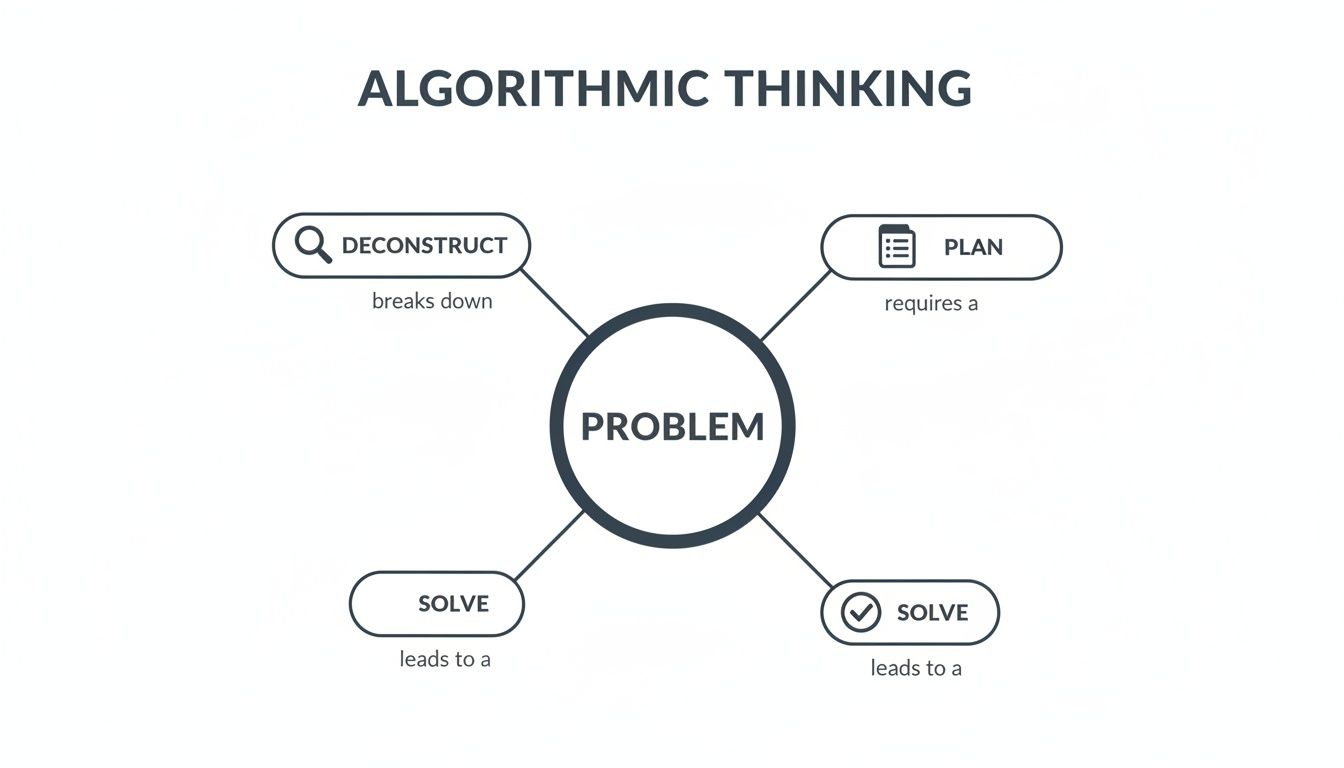
This map shows how any solution starts not with an answer, but with methodically taking the question itself apart.
Pillar 1: Decomposition
Decomposition is simply the art of breaking a big, intimidating problem into smaller, more manageable chunks. Instead of trying to untangle a giant knot all at once, you find the individual strands. This simple act makes the whole thing feel less overwhelming and much easier to get your head around.
Think about planning a big event, like a wedding. The idea of "planning a wedding" is massive. But you can decompose it into smaller jobs:
- Create the guest list.
- Find and book a venue.
- Hire a caterer.
- Send out the invitations.
- Sort out the music.
Each of those smaller tasks is far easier to handle than the entire project. In the N-Queens puzzle, decomposition means you don't try to solve the whole board in one go. Instead, you focus on placing just one queen at a time, row by row, solving a series of tiny problems to reach the final solution.
Pillar 2: Pattern Recognition
Once you’ve broken a problem down, the next step is to look for similarities or recurring themes. Pattern recognition is all about spotting trends, both within the little pieces of your current problem and by comparing it to problems you've solved before. This helps you work much more efficiently because you can reuse solutions that have worked in the past.
Imagine you're a detective investigating a string of burglaries. You notice every break-in happened on a Tuesday, at a house with a blue door, and the thief only took electronics. This pattern is a massive clue. It helps you predict where they might strike next and narrow down your search.
Applying this to N-Queens, you quickly start to see patterns of attack. A queen placed in any corner immediately creates diagonal, horizontal, and vertical "no-go" zones. Recognising this pattern means you don't waste time testing squares you know are invalid; you can rule out huge chunks of the board right away, making your search for a solution much faster.
Pillar 3: Abstraction
Abstraction is one of the most powerful ideas in problem-solving. It’s all about focusing on the essential details while deliberately ignoring the irrelevant ones. You’re creating a simplified model of the problem that contains only the information needed to find a solution.
Abstraction isn't about being vague; it's about being precise in what you choose to ignore. It’s the skill of seeing the forest without getting lost in the individual leaves.
A perfect real-world example is the London Underground map. It's a masterpiece of abstraction. It shows you the stations, the lines connecting them, and where they cross. It completely ignores the actual geographical twists and turns of the tracks, the streets above, or the buildings. All that extra detail would just be distracting. The map gives you only what you need to plan your journey.
For the N-Queens puzzle, abstraction means you only care about the rules of attack. You ignore the colour of the squares, what the queen piece looks like, or any other visual fluff. The only things that matter are the grid coordinates and the rules: a queen on (x1, y1) attacks a queen on (x2, y2) if x1=x2, y1=y2, or |x1-x2| = |y1-y2|. That's it. Everything else is just noise.
Pillar 4: Algorithm Design
The final pillar brings everything together. Algorithm design is where you create the clear, step-by-step instructions needed to solve the problem. Using what you’ve learned from decomposition, pattern recognition, and abstraction, you build a repeatable recipe that guarantees a successful outcome.
Your algorithm has to be precise and unambiguous. It should work every single time, no matter who (or what) is following it. Think of a simple recipe for making tea:
- Boil water.
- Put a teabag in a mug.
- Pour boiling water into the mug.
- Wait three minutes.
- Remove the teabag.
That's a simple but effective algorithm. For the N-Queens puzzle, a basic algorithm might use a "backtracking" strategy. You place a queen in the first valid square of the first row, move to the next row, find its first valid square, and repeat. If you hit a row with no valid squares, you "backtrack" to the previous row and move its queen to the next valid square. This systematic process guarantees you'll find a solution if one exists.
Together, these four pillars provide a solid framework for turning any challenge into a solvable puzzle. Developing these skills is a journey, and you can learn more about how to improve problem-solving skills in our detailed guide. They are the true foundation of algorithmic thinking.
Algorithmic vs Computational Thinking Explained
You’ll often hear two terms thrown around together in problem-solving circles: algorithmic thinking and computational thinking. They sound similar, and people often use them interchangeably. But they’re not the same.
Getting the distinction right is key, because it helps you understand how to attack complex problems in a truly structured way.
Think of it like building a house. Computational thinking is the architect’s grand vision. It’s the high-level strategy—understanding what the client wants, surveying the land, breaking the whole massive project down into logical phases like the foundation, framing, and wiring. It’s the entire conceptual framework.
Algorithmic thinking, on the other hand, is the builder's instruction manual. It’s the nitty-gritty, step-by-step process for getting one specific job done. For example, the algorithm for laying the foundation would be a precise sequence of actions that anyone could follow to get it right every single time.
The Big Picture vs The To-Do List
Computational thinking is the umbrella. Algorithmic thinking sits underneath it.
The broad strategy of computational thinking involves deconstructing the problem, spotting patterns, and stripping away irrelevant details—the core pillars we talked about earlier. It’s a complete mindset for framing problems so that a computer (or a person working systematically) can understand and solve them.
Algorithmic thinking is the sharpest tool in that box. It’s the direct output of the process: the finished recipe, the final blueprint, the clear set of instructions. It's less about how to think about the problem and more about the exact steps you do to solve it. This is a crucial skill for anyone wanting to get better at creative problem solving, as it turns big ideas into a concrete plan.
Computational thinking is the strategy for solving a problem using computer science concepts. Algorithmic thinking is the tactic of creating the specific, repeatable steps to implement that solution.
Why Does This Distinction Matter?
This isn’t just academic nitpicking. It has real-world consequences, especially in education.
Back in 2013, the UK made a huge shift, making computing a mandatory subject for all pupils from the age of four. This move put algorithmic principles at the centre of learning, aiming to arm every child with skills like decomposition and pattern recognition. These are the exact skills you need for everything from coding to systematically cracking puzzles like the N-Queens problem. If you're interested, you can read the full research from the OECD on why this curriculum was seen as such a pioneering move.
This table should clear things up even more.
Algorithmic Thinking vs Computational Thinking Key Distinctions
Here’s a clear comparison between these two closely related but distinct problem-solving frameworks.
| Aspect | Algorithmic Thinking | Computational Thinking | | :--- | :--- | :--- | | Scope | Narrow and specific. | Broad and holistic. | | Focus | Creating a precise, ordered sequence of steps to solve a defined problem. | The entire process of formulating a problem and expressing its solution in a computational way. | | Output | A specific algorithm (a set of instructions, a recipe, a flowchart). | A conceptual solution that includes decomposition, pattern recognition, and abstraction. | | Analogy | Writing the detailed recipe for a cake. | Being the head chef who designs the entire menu, considering ingredients, kitchen workflow, and presentation. |
Ultimately, you need both. You need the architect's vision and the builder's detailed plan to get the job done right.
How to Practise Algorithmic Thinking Every Day
Knowing the theory behind algorithmic thinking is a great start, but like any skill, you only get good with practice. The good news? You don’t need a powerful computer or a complex coding environment to start sharpening your mind. Everyday activities and simple puzzles are the perfect mental gym.
The real goal is to go from passively understanding the four pillars—Decomposition, Pattern Recognition, Abstraction, and Algorithm Design—to actively using them. This section shows you how, starting with a classic logic puzzle and then moving into scenarios you see all the time.
Deconstructing a Puzzle: The N-Queens Game
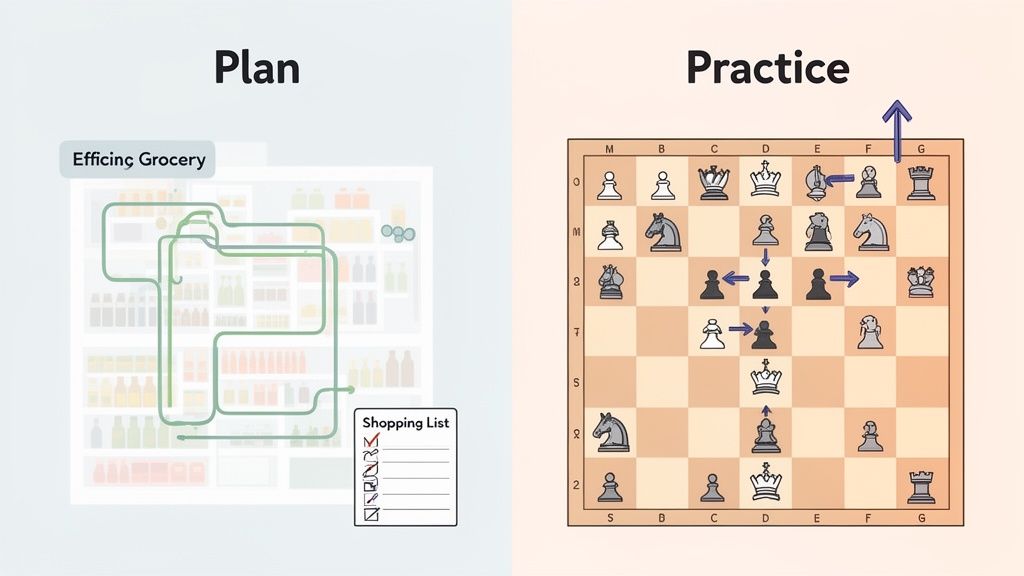
Let's put this into action with a perfect example: the N-Queens problem. The goal is simple: place N chess queens on an N×N board so that no two queens can attack each other. It’s a brilliant training ground because it forces you to think systematically.
Here’s how you’d apply the four pillars to solve it:
-
Decomposition: The big problem, "solve the 8-Queens puzzle," is intimidating. So, you break it down into a smaller, repeatable task: "place one queen in a valid square, one row at a time." A single huge challenge becomes eight small, manageable steps.
-
Pattern Recognition: As you place queens, you’ll quickly notice recurring invalid patterns. For example, a queen on a corner square (like a1) immediately blocks off 21 other squares on an 8x8 board. Recognising these attack patterns—horizontal, vertical, and diagonal—stops you from wasting time on squares you already know are out of play.
-
Abstraction: To solve this, you have to ignore the fluff. The look of the pieces, the colour of the squares, whether you’re playing online or on a real board—none of that matters. All you need are the grid coordinates and the rules of attack. That's abstraction in its purest form.
-
Algorithm Design: Finally, you build a step-by-step strategy. A common one is backtracking. You place a queen in the first safe square of the first row. You move to the next row and do the same. If you hit a row with no safe squares, you go back to the previous row and move its queen to the next safe spot. This methodical process makes sure you check every possibility without getting lost.
By consciously walking through these steps, you’re not just playing a game; you’re running a sophisticated problem-solving procedure. For a deeper dive, check out our guide on the N-Queens problem, which breaks down even more strategies.
Finding Algorithms in Your Daily Routine
You don't need a chessboard to get your reps in. Algorithmic thinking is all around you, hiding in plain sight. If you start paying attention, you can turn your daily routines into training exercises.
The key is to treat mundane tasks like logic puzzles waiting to be optimised. Just ask yourself: "What's the most efficient, repeatable sequence of steps to get this done?"
Thinking algorithmically isn't about making life robotic; it's about making it smoother. By designing better "algorithms" for your tasks, you free up mental energy for more important things.
Here are a few practical ways to weave this mindset into your day.
Everyday Algorithmic Challenges
Turning your routine into practice starts with spotting opportunities to be more efficient. Look for any task that involves multiple steps, decisions, or things that just feel clumsy.
Challenge 1: Plan Your Grocery Shopping The goal is to get in and out of the supermarket as fast as possible.
- Decomposition: Break it down. You have to create a shopping list, travel to the shop, navigate the aisles, and check out.
- Pattern Recognition: You know the shop’s layout. Milk is always at the back, bread is near the front. You also know it gets packed around 5 PM.
- Abstraction: Forget specific brands for a moment and think in categories: dairy, produce, frozen goods, household items.
- Algorithm Design: Group your shopping list by the shop’s layout to create an optimal path. This stops you from backtracking for that one thing you forgot. Your final "algorithm" is a route that saves you time and stress.
Challenge 2: Organise Your Digital Files The goal is to create a system where you can find any file in seconds.
- Decomposition: The problem is "my computer is a mess." The sub-problems are sorting documents, photos, and project files separately.
- Pattern Recognition: You notice tons of files named "report_final_v2.docx" or "Untitled." The pattern is a total lack of a clear naming system.
- Abstraction: You don’t need to know what’s inside every file. You just need a universal structure based on key info: the project, the date, and the document type.
- Algorithm Design: Create a strict naming rule, like [YYYY-MM-DD]-[ProjectName]-[DocumentType].pdf. Then, build a folder structure (e.g., /Work/ClientA/ProjectX/) and make a rule that all new files go in the right place, named correctly, from the start.
By consistently applying these principles, you build the mental muscles that make algorithmic thinking feel natural. You start seeing the world less as a series of chaotic events and more as a set of systems you can understand, deconstruct, and improve.
Why This Skill Matters in the Real World
Algorithmic thinking isn’t some dry, academic skill just for coders. It’s a powerful way of thinking that quietly shapes our daily lives, often in ways we don’t even notice. This step-by-step logic is the engine running countless systems our modern world relies on.
Think about it. From the complex logistics that get your online order to your door on time to the financial models executing stock trades in microseconds, algorithms are everywhere. They decide the news you see, the music you hear, and even how efficiently traffic flows through a city.
Mastering algorithmic thinking isn't just about solving puzzles—it's about understanding the hidden rules that run the world around you.

From Puzzles to Public Policy
The same skills you sharpen with games and brain-teasers apply directly to high-stakes, real-world problems. An operations manager uses algorithmic thinking to plot the most efficient delivery routes, saving time and fuel. A doctor follows a diagnostic algorithm—a clear flowchart of questions and tests—to figure out what's wrong with a patient.
This becomes critical when automated systems start making decisions that affect people’s lives. When designed with care and a solid grasp of the consequences, algorithms can build fair and efficient systems. But when the design is sloppy, the results can be a disaster. This is why clear, human-led algorithmic thinking is more important than ever.
A Cautionary Tale: The 2020 A-Level Fiasco
Nothing shows the danger of a bad algorithm better than the 2020 A-level exam crisis in the UK. With exams cancelled due to the pandemic, an algorithm was built to assign grades. It was supposed to be a fair, standardised fix, using data like mock results, teacher rankings, and a school's past performance.
The outcome was a complete mess. The algorithm backfired, downgrading over 40% of A-level results from what teachers predicted. The model unfairly punished bright students from schools that hadn't historically performed well, causing a massive public outcry over its built-in bias.
In the end, the government had to make a humiliating U-turn, scrapping the algorithm and using teacher-assessed grades instead. The chaos revealed what critic Conrad Wolfram called a "failure of computational thinking"—officials chose a broken model without understanding its real-world impact. You can read a detailed breakdown of the exam algorithm failure to see just how it all went wrong.
This real-world example is a stark reminder: the logical precision you build with puzzles isn't trivial. It is the exact skill needed to prevent systemic failures and build fairer, more effective solutions.
The A-level saga proves that a poorly designed algorithm isn't just a technical glitch; it can cause real social harm. It highlights the urgent need for people in every field—not just tech—to develop strong algorithmic thinking skills.
Being able to break down a problem, spot potential biases, and design a clear, ethical sequence of steps is a vital skill for any modern professional. It’s the difference between creating a system that helps and one that hurts.
How to Continue Your Mastery Journey
You’ve got the foundation. You now see that algorithmic thinking isn’t just for coders — it’s a way of looking at any problem by creating a clear recipe for solving it. It’s all built on those four pillars: decomposition, pattern recognition, abstraction, and algorithm design.
Once you start thinking this way, complex challenges stop feeling so intimidating. They become manageable puzzles you can solve with confidence, whether you're organising a chaotic project or just figuring out a brain teaser. The next step is turning this understanding into a real, everyday habit.
Your Roadmap for Further Practice
Getting truly good at this comes down to one thing: consistent practice. The trick is to find fun ways to keep those mental muscles working. Here are a few concrete steps you can take to build on what you've learned.
-
Play More Logic Puzzles and Games: Making a habit of tackling puzzles like Sudoku, crosswords, or strategy games like chess is a fantastic workout for your brain. Games like the Queens Game are especially good because they force you to think systematically in a world of clear rules and constraints.
-
Dip Your Toes into Coding: You don't have to aim for a job as a software developer. Exploring free resources like freeCodeCamp or Codecademy is a powerful way to see algorithmic thinking in action. When you watch logical steps become working code, the concepts just click.
-
Read About How We Think: Pick up books that dig into mental models and problem-solving. Titles like Thinking, Fast and Slow by Daniel Kahneman or A Mind for Numbers by Barbara Oakley offer incredible insights into how our brains process information and find solutions.
The most important thing you can do is take these ideas and apply them to a real problem you're facing today. Pick one thing—big or small—and consciously walk through the steps: break it down, look for patterns, and map out a clear sequence of actions.
This is where the theory becomes a genuine, lasting skill.
A Few Common Questions About Algorithmic Thinking
Is This Just a Skill for Programmers?
Not at all. While algorithmic thinking is the bedrock of coding, it’s really just a powerful way of solving problems that anyone can use, in any field.
Think about it: planning a holiday, following a recipe, or even assembling flat-pack furniture involves breaking a goal down into a clear sequence of steps. That’s algorithmic thinking in action. It’s a skill that’s just as valuable for a project manager or a scientist as it is for a software developer.
What’s the Easiest Way to Start Practising?
Start with games. Seriously. Puzzles and strategy games are fantastic training grounds for your mind.
Things like Sudoku, brain teasers, or a good game of chess force you to think systematically, test out ideas, and work within a clear set of rules. This is the core of algorithmic thinking. You can start with simple challenges and level up as you get more confident.
The fastest way to get better at algorithmic thinking is to make it a habit. A little bit of practice every day with fun challenges builds the mental muscle you need for tackling bigger, real-world problems.
How Can This Actually Help My Career?
In any job, people who can think clearly and solve problems efficiently are gold dust. They’re the ones who can turn a chaotic project into a manageable plan.
Strong algorithmic thinkers naturally break down huge tasks into smaller steps (decomposition), spot where things are going wrong (pattern recognition), and design a clear strategy to fix it (algorithm design). This leads to smarter decisions, better results, and makes you an incredibly valuable member of any team.
Ready to put your own skills to the test? Queens Game is the perfect way to sharpen your logical and strategic mind, right in your browser. Start solving puzzles today at queens.game.