

Imagine having a seasoned mentor guiding every critical business choice—a clear, visual roadmap that turns uncertainty into confident action. That's what a decision tree does for your business. It's a structured flowchart that helps you weigh up your options, understand the risks, and make data-driven choices with confidence.
From Guesswork To Growth With Decision Trees
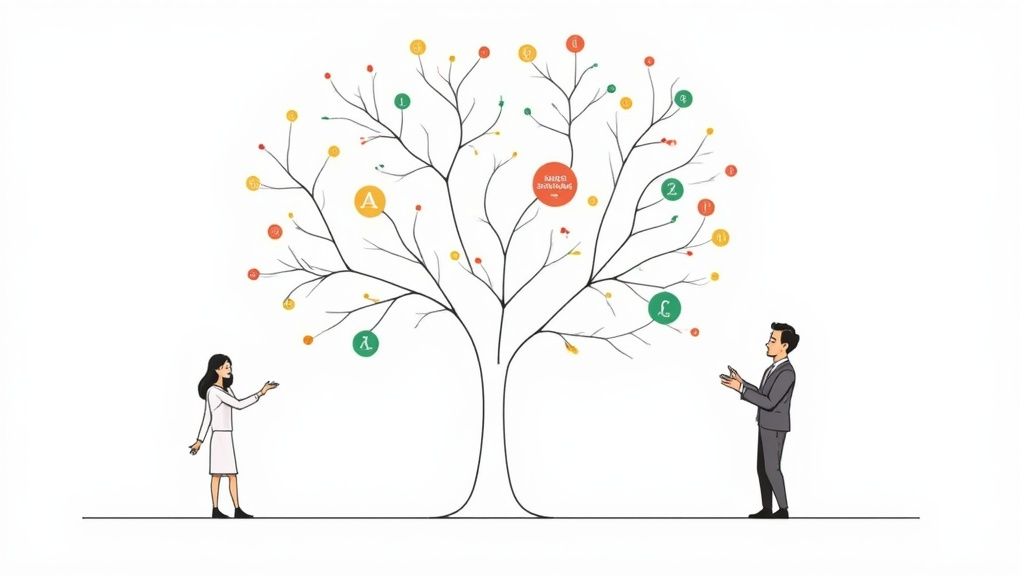
In any business, success often comes down to the quality of decisions made every single day. From small operational tweaks to major strategic shifts, every choice carries potential rewards and risks. Relying on intuition or "gut feelings" alone is a dangerous gamble in a competitive market. This is where a more structured approach becomes essential.
Decision trees provide that logical, visual framework for decision-making. They shift you away from ambiguous guesswork and towards a clear, justifiable path forward. Think of it as breaking down a complex problem into a series of simple, manageable questions.
The Core Components Of A Decision Tree
At its heart, a decision tree is incredibly simple and built from just three basic parts. Getting your head around these is the first step to using this powerful tool.
- Root Node: This is your starting point. It represents the main decision you need to make, like, "Should we launch a new marketing campaign?"
- Branches: These are the lines that connect everything, representing the different paths you can take. For our example, the branches might be a simple "Yes" or "No."
- Leaf Nodes: These are the endpoints. They show the final outcome of taking a particular path, such as the projected profit or loss from launching the campaign.
This structure forces you to map out every possibility in a clear, organised way. You have to consider not just the immediate choice, but the chain of consequences that follows. By visualising the whole process, you can easily compare outcomes and spot the most favourable route. This methodical approach is a cornerstone of strong leadership, and you can learn more about how to improve strategic thinking in our related guide.
A decision tree helps you see not just the choices you have, but the story that each choice will write for your business. It transforms abstract possibilities into a concrete map for action.
By bringing this level of clarity to complex problems, the applications for decision trees business-wide can dramatically reduce uncertainty. They make your reasoning transparent and easy to share with your team, helping build consensus around a data-backed strategy. This organised framework ensures every option gets a fair look, leading to more robust and confident growth.
Choosing The Right Type Of Decision Tree

When people talk about decision trees in a business setting, they're usually thinking of one of two very different tools. Getting the distinction right is vital because each one solves a completely different kind of problem. Picking the right one means you're not just using a fancy tool—you're using the correct tool for the job.
The first kind is the diagrammatic decision tree. This is the classic flowchart you'd sketch on a whiteboard. It’s a hands-on, visual method for mapping out choices, weighing up potential outcomes, and getting everyone on the same page for big strategic moves. It’s brilliant for team collaboration.
A diagrammatic tree helps a group wrestle with questions like, "Should we launch Product X or invest in marketing for Product Y?" You map out the costs, the likely returns, and the chances of success for each path. It's a tool for deliberate, human-led thinking.
The Power Of Algorithmic Decision Trees
Then there's its powerful cousin: the algorithmic decision tree. This isn't something you draw by hand. Instead, a machine learning algorithm builds it automatically using your historical data. Its goal isn't to map out a single choice, but to create a model that makes predictions.
This automated approach is where decision trees business-wide become a game-changer for forecasting. The algorithm sifts through your data, finds hidden patterns, and learns how to predict what's likely to happen next.
A good way to think about it: a diagrammatic tree is like a detailed road map you draw to plan a single, important journey. An algorithmic tree is like a satnav that’s learned from thousands of previous journeys to predict the fastest route for you automatically.
These algorithmic models are built to answer predictive questions, like:
- Which of our customers are most likely to leave in the next three months?
- What’s the probability this new lead will actually convert?
- Which marketing channel will give us the best return for this specific campaign?
Diagrammatic vs Algorithmic Decision Trees at a Glance
To make it even clearer, let's break down the key differences side-by-side.
| Attribute | Diagrammatic Decision Tree | Algorithmic (Machine Learning) Decision Tree | | :--- | :--- | :--- | | Purpose | To map out and clarify a specific, complex human decision. | To create a predictive model from data that makes future forecasts. | | Creation | Manually drawn by a person or team (e.g., on a whiteboard). | Automatically generated by a computer algorithm using a dataset. | | Complexity | Simple. Typically has a few branches and clear, logical steps. | Complex. Can have hundreds or thousands of branches, often unreadable by humans. | | Best For | Strategic planning, team discussions, one-off major decisions. | Forecasting, customer segmentation, risk analysis, repeatable predictions. |
Ultimately, one is for thinking through a decision, while the other is for automating thousands of them.
Deciding Which Tree To Use
So, which one do you need? The answer depends entirely on your goal.
Are you and your team trying to structure a complex, one-time strategic choice? The diagrammatic approach is your best bet. It brings clarity, encourages debate, and creates a clear record of why you made the decision you did.
But if your goal is to build a system that can make quick, repeatable predictions from large amounts of data, you need an algorithmic decision tree. It scales your decision-making, uncovers insights you'd never find by hand, and bakes predictive intelligence right into your day-to-day operations.
How Decision Trees Drive Business Strategy
Enough with the theory. Let's talk results. Decision trees aren't just abstract diagrams; they’re practical tools that pull clear, actionable insights from messy data. By mapping out potential outcomes, they turn business complexity into a real strategic advantage.
Here’s how decision trees solve some of the most critical challenges businesses face, transforming guesswork into a clear path forward.
Predicting And Reducing Customer Churn
For any subscription business, from streaming services to software, customer churn is a constant threat. A decision tree is your early warning system. You feed it historical data, and it starts spotting the patterns that precede a cancellation.
Imagine a streaming service. The tree might learn that customers who haven't logged in for 14 days and have submitted more than two support tickets are at high risk. That’s a crystal-clear insight. Now, the business can step in with a special offer or personalised support before the customer decides to leave.
- Input Data: Login frequency, subscription length, support ticket history, viewing habits.
- Actionable Insight: Pinpoint at-risk customer groups for targeted retention campaigns.
Optimising Pricing Strategies
Setting the right price is a notoriously tricky balancing act. A retailer can use a decision tree to model how different price points will likely affect sales and profit. The tree chews through past sales data, competitor prices, and seasonal demand to find the sweet spot.
The model might reveal that a 10% discount on a certain product in May leads to a 30% jump in sales volume, ultimately generating more net profit than keeping the original price. This data-driven approach takes the gut feeling out of pricing, letting you maximise revenue with confidence. To learn more about other frameworks, check out our guide on various decision-making techniques.
By structuring choices and outcomes, decision trees offer a powerful way to navigate the operational complexities that many businesses face. They provide a clear, logical basis for action where gut feelings often fall short.
Sharpening Investment And Operational Choices
Decision trees are also brilliant for big-picture strategic planning, like weighing up investments or boosting operational efficiency. A company can map out a potential project, with branches for outcomes like "high ROI with high risk" versus "moderate ROI with low risk." By assigning probabilities to each path, they can calculate the real expected value of an investment.
It works for logistics, too. A delivery company can use a decision tree to optimise its routes. By feeding it variables like traffic patterns, fuel costs, and delivery windows, the model can spit out the most cost-effective and time-efficient routes for its fleet. This directly impacts the bottom line.
The potential here is huge. A UK study found that a staggering 71% of high-value decisions in large firms are made with incomplete data—a gap that decision trees are perfectly built to fill. Discover more insights on how data improves UK business decision-making.
A Step-By-Step Guide To Building Your First Decision Tree
Building a decision tree might sound like something for the data science team, but it’s a surprisingly simple process. At its heart, it’s just a structured way to think through a problem, put some numbers to your gut feelings, and let a bit of logic guide you to a smarter conclusion.
Let’s walk through it with a classic business crossroads: "Should we hire another salesperson, or should we invest that money in marketing automation software?"
Step 1: Define Your Core Decision
First things first, you need to clearly state the decision you're facing. This becomes the starting point of your tree—what’s known as the root node.
A vague goal like “increase sales” won’t work. It has to be a specific, actionable question.
Our question is sharp: Invest in a new salesperson or a new marketing tool? This clarity is the foundation for the entire analysis.
Step 2: Map Out All Possible Choices
From that root question, draw a branch for each path you could take. In our case, it's pretty simple—there are two main options:
- Choice A: Hire a new sales representative.
- Choice B: Invest in marketing automation.
Now, for each choice, think about what could happen next. You don't control the market, right? So let's factor in two key scenarios: "High Market Demand" and "Low Market Demand." Add smaller branches coming off each main choice to represent these possible futures.
A decision tree forces you to confront the reality that you don't control every variable. By mapping out different potential futures, you can prepare a strategy that is robust, not just optimistic.
Step 3: Assign Probabilities And Financial Values
This is where your experience and data come together. For each potential outcome, you need to assign two things: a probability (how likely is it to happen?) and a financial value (what's the expected profit or loss?).
Let's plug in some realistic numbers:
- Hire Sales Rep:
- High Demand (60% chance): £80,000 net profit.
- Low Demand (40% chance): £10,000 net profit.
- Invest in Automation:
- High Demand (60% chance): £100,000 net profit.
- Low Demand (40% chance): -£5,000 net loss (thanks to the software subscription).
This is where the real power of this exercise kicks in. A staggering 71% of high-value business decisions are made without complete non-financial data, creating a massive blind spot. This structured approach helps fill that gap. If you're curious about how UK businesses operate, you can learn more from the government's business population estimates.
Step 4: Calculate The Expected Value
Okay, time for a little bit of simple maths. We need to calculate the Expected Value (EV) for each of our main choices. The formula is straightforward: (Outcome 1 Value × Outcome 1 Probability) + (Outcome 2 Value × Outcome 2 Probability).
- EV (Hire Sales Rep): (£80,000 × 0.60) + (£10,000 × 0.40) = £48,000 + £4,000 = £52,000
- EV (Invest in Automation): (£100,000 × 0.60) + (-£5,000 × 0.40) = £60,000 - £2,000 = £58,000
This calculation boils down all the possibilities into a single, clean number for each path, making them easy to compare.
Step 5: Make The Data-Backed Decision
The final step is the easiest. Just compare the numbers.
In our scenario, investing in marketing automation has an expected value of £58,000. That's a decent bit higher than the £52,000 we’d expect from hiring a new salesperson. Based on our estimates, the automation software is the smarter financial bet.
The flowchart below shows how a similar thought process helps predict customer churn by looking at user activity and support tickets.
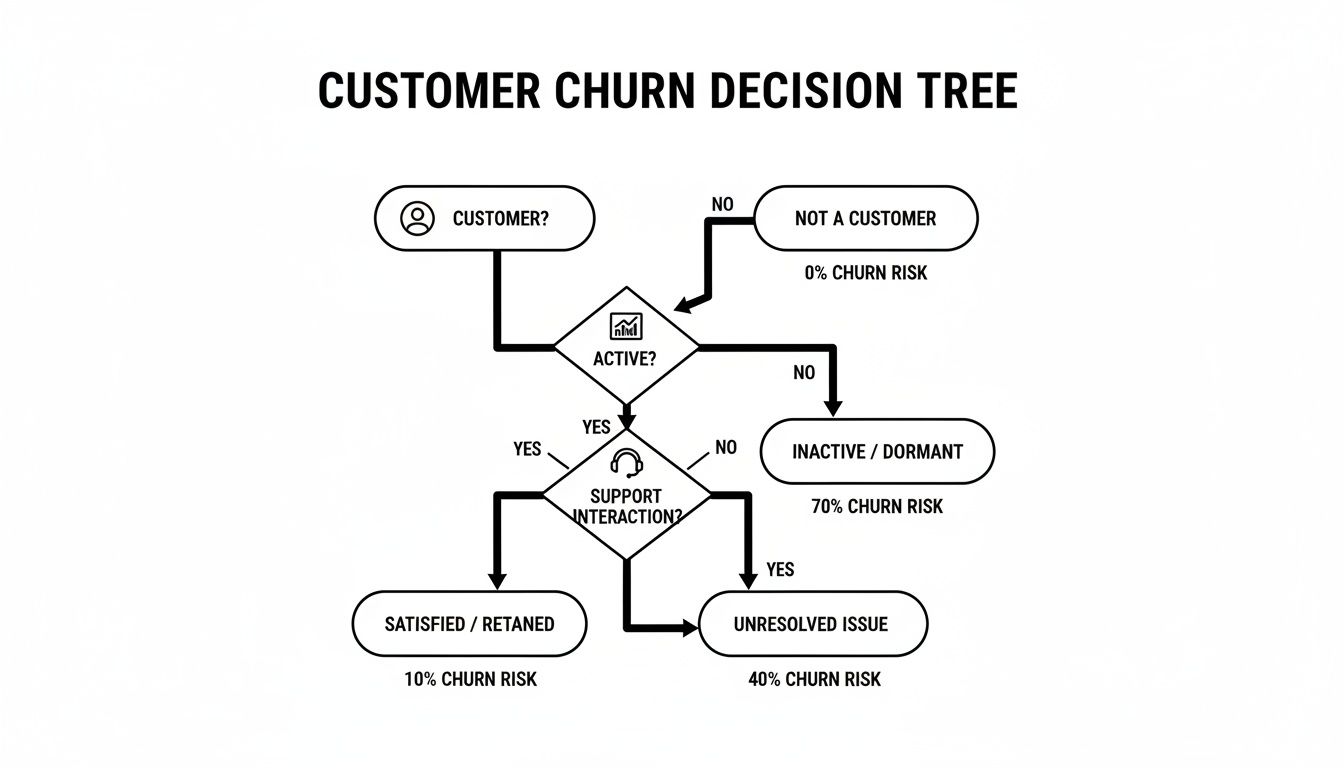
As you can see, inactive customers who have contacted support multiple times are flagged as high-risk. It’s a clear, actionable signal to step in before they leave.
Common Mistakes And Best Practices For Accurate Results
It’s one thing to build a decision tree; it’s another thing entirely to build one you can trust. A model full of hidden flaws can lead to some seriously poor business choices. This is your quality control checklist for creating decision trees that actually work in the real world.
One of the biggest traps is overfitting. This is what happens when your model gets too clever for its own good and learns the training data perfectly—noise, quirks, and all.
Think of it like a student who memorises the answers to a practice exam but doesn't actually understand the concepts. They'll ace the practice test, but when the real exam comes with slightly different questions, they completely fall apart. An overfitted tree is the same: brilliant on past data, useless for future predictions.
Best Practices For Building Robust Decision Trees
To make sure your decision trees are reliable, you need a disciplined approach. Sticking to a few best practices will protect your analysis from common errors and give you confidence in the results.
Here’s a simple checklist to get it right:
- Start with a Clear Question: Never start building without a sharp, well-defined business problem. Vague goals produce vague, useless models.
- Use Clean and Relevant Data: This is the classic "garbage in, garbage out" problem. Your data has to be accurate, complete, and directly related to the decision at hand.
- Keep It Simple (Occam's Razor): A simpler model is almost always a better model. Fight the urge to add extra branches that don't add real predictive power. This is your best defence against overfitting.
- Validate Your Model: Always test your tree's predictions against a separate chunk of data it has never seen before. This is the only way to know if it will actually work when it matters.
Building a decision tree without validation is like navigating with a map you haven't checked. It might look correct, but you won't know if it leads to the right destination until it's too late.
Avoiding Data Bias And Misinterpretation
Another critical error is feeding your model biased data. If your historical data doesn't properly represent your market or customers, your tree's predictions will be skewed from the start.
The UK business environment is a great example of how fast things change. With 73,450 new businesses created and 63,205 closing down in just one recent quarter, yesterday's data can quickly become obsolete. A decision tree can model survival odds in this volatile market, but only if the data is sound. You can see the latest figures in the UK business demography statistics from the ONS.
Finally, don't misread the results. A decision tree gives you probabilities, not certainties. It’s a powerful guide, not a crystal ball. Learning to interpret its outputs is a key part of sharpening your analytical thinking. For more on this, check out our guide on how to improve problem-solving skills.
Follow these practices, and you'll be on your way to building decision trees that drive genuinely better business outcomes.
Got Questions About Decision Trees?
As you start using these tools, you're bound to have some practical questions. Let's clear up the common ones so you can move from theory to action with confidence.
What Software Should I Use To Build A Decision Tree?
This really comes down to what kind of tree you're building. Are you sketching out a strategic plan with your team, or are you trying to get a computer to predict something?
- For whiteboarding and strategy (Diagrammatic Trees): Stick to visual collaboration tools. Think Miro, Lucidchart, or even a well-organised PowerPoint slide. The goal here is clarity and communication, not complex calculations.
- For predictive models (Algorithmic Trees): Now you need a bit more power. The industry standard is Python (using libraries like scikit-learn) or R. If you're not a coder, no worries. Platforms like Microsoft Azure Machine Learning or Google AI Platform give you powerful tools with a more user-friendly interface.
How Much Data Do I Actually Need For A Machine Learning Model?
This is the big one, and the honest answer is: it depends. There’s no magic number.
The quality of your data matters a thousand times more than the quantity. A few hundred clean, relevant records will always beat thousands of messy, irrelevant data points.
A decent rule of thumb is to have at least 10 to 20 times more data points (rows) than features (columns). So, if you're trying to predict customer churn using five features (like subscription length, login frequency, etc.), you’d want at least 50–100 customer records to build a basic model. For more complex problems, you'll need a lot more.
Think of data as the fuel for your decision tree. You don't just need a lot of it; you need the right kind of clean, high-octane fuel to get meaningful performance.
What Kind Of Business Problems Are Decision Trees Good For?
Decision trees are perfect for problems that boil down to classification or prediction based on a set of rules. Their real strength is that they’re easy for anyone to understand, not just data scientists.
They absolutely shine when you need to answer "if-then" style questions. Some classic use cases include:
- Customer Segmentation: Sorting customers into groups like 'high-value' or 'at-risk' based on their behaviour.
- Lead Scoring: Figuring out which sales leads are most likely to convert, so your team knows where to focus.
- Credit Risk Assessment: Classifying loan applicants as 'low-risk' or 'high-risk' based on their financial history.
- Operational Troubleshooting: Building a simple flowchart to help staff solve common problems by following a clear path of questions.
Basically, if you can break your problem down into a series of logical choices, a decision tree is an excellent tool for the job.
Ready to sharpen your logical thinking? Queens Game offers a series of chess-based puzzles designed to improve your problem-solving and strategic planning skills. Play now and build the mental discipline needed to make smarter decisions at https://queens.game.