

The grid method is one of those timeless drawing techniques artists swear by to accurately scale up and transfer an image. It works by breaking down a complex picture into a simple grid of squares, turning what feels like an intimidating challenge into a much more manageable, square-by-square process.
This isn't just about copying, though. It's a seriously powerful tool for training your eye and sharpening your observational skills.
Why the Grid Method Is Your Key to Accurate Drawing
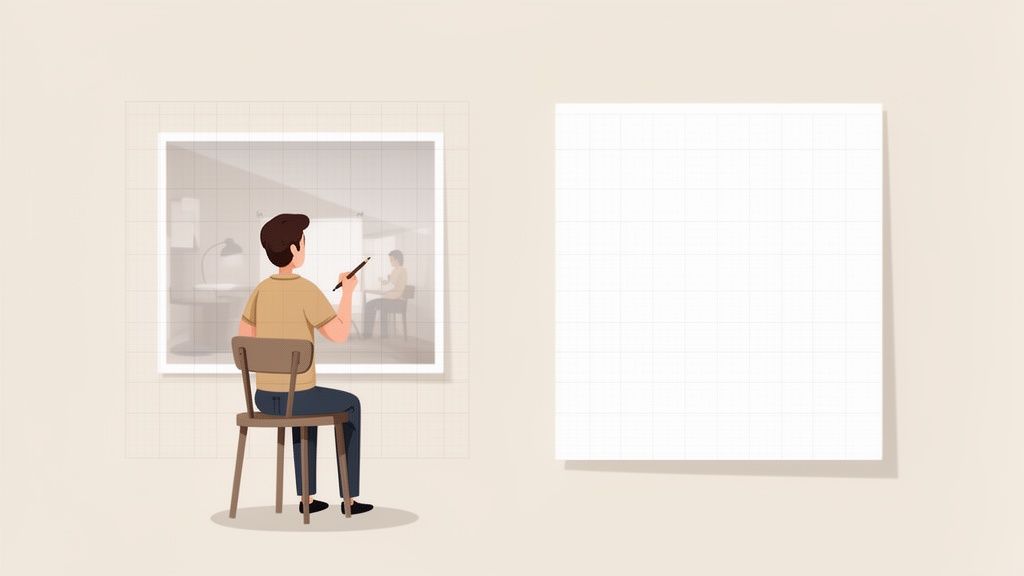
Ever get that sinking feeling when a drawing just looks… off? Getting proportions right is one of the toughest skills to master, but the grid method acts as a reliable guide, making sure every line and shape lands exactly where it should. It turns a big visual puzzle into a series of smaller, bite-sized problems.
This structured approach forces you to stop seeing the subject as a whole—like a face or a landscape—and instead see it as a collection of abstract lines and curves within each little square. That mental shift is what builds real artistic confidence and hones your ability to judge space and relationships.
A Legacy of Precision
The grid method is far from a modern trick; it has deep historical roots. It became a cornerstone of British art education during the 19th century, especially as the Industrial Revolution created a huge demand for precise technical drawing.
By 1850, it was part of over 80% of teaching curricula. One survey from 1885 found that 65% of students achieved 'excellent' proportions using grids—a massive jump from the 30% who didn’t. It just works. If you want to dive deeper into the history of grids in art, Artsy.net has some great insights.
The real magic of the grid method is how it trains your brain to see relationships. You’re not just drawing an eye; you're seeing exactly where a line crosses a grid boundary, how a curve fits into a corner, and how shapes connect from one square to the next.
More Than Just Copying
Ultimately, this technique is a bridge between what you see and what you can put on paper. It demystifies the process of creating accurate drawings, making it an invaluable tool for beginners and experienced artists who need to scale their work perfectly.
Think of it as a logical exercise that strengthens your artistic intuition. For anyone who enjoys that kind of structured thinking, you might also get a kick out of learning how to solve logic puzzles.
Choosing the Right Tools for Grid Drawing
Having the right kit can be the difference between a smooth, creative session and a frustrating one. You can absolutely start with just a pencil and paper, but picking a few specific tools will make the whole process far more precise and enjoyable.
Think of it less as a shopping list and more as building your own specialised toolkit.
Pencils, Rulers, and Erasers
The right pencils play very different roles. For drawing your grid lines, a hard graphite pencil like a 2H is your best friend. It leaves a very light, fine line that’s tough to smudge and, crucially, easy to erase completely later on. This keeps your final artwork clean.
Then, for the actual drawing inside the squares, switch to something softer, like a 2B. This pencil gives you a much darker, richer line that pops against the faint grid, making it easy to see your artwork separate from the guidelines.
Your choice of ruler matters more than you’d think, too. I always recommend a sturdy metal ruler, preferably with a cork back. It gives you that crisp, straight edge you need for perfect lines, and the cork base stops it from slipping around on the paper – a common cause of wonky grids.
Your most valuable tool, however, just might be a kneaded eraser. Unlike standard erasers that rub graphite away, a kneaded eraser lifts it cleanly off the paper. You can shape it to a tiny point to dab away small grid lines in tight corners without smudging your drawing.
Choosing Your Paper
Finally, let's talk paper. For your reference image, standard printer paper is perfectly fine. But for your final piece, you’ll want a heavier drawing paper (at least 120 gsm). It can handle all the drawing, erasing, and blending without tearing or buckling under pressure.
A smooth surface, like Bristol board, is excellent for highly detailed work because it lets you draw clean lines and makes erasing the grid a breeze.
Essential Toolkit for Grid Method Drawing
To make it simple, here’s a quick rundown of the gear I recommend keeping on hand. These tools will help you get clean, accurate results every time.
| Tool | Recommended Type | Primary Use | | :--- | :--- | :--- | | Grid Pencil | 2H Graphite Pencil | Drawing light, easily erasable grid lines that won't smudge. | | Drawing Pencil | 2B or HB Graphite Pencil | Sketching the image with darker lines that stand out from the grid. | | Ruler | Metal with a cork back | Ensuring straight, non-slip lines for an accurate grid. | | Eraser | Kneaded Eraser | Lifting grid lines cleanly without smudging the artwork. | | Drawing Surface | Heavy Paper (120+ gsm) | A durable surface that can handle drawing and erasing. |
Getting these basics right from the start removes a lot of potential headaches, letting you focus on the creative part: the drawing itself.
How to Prepare Your Grids for Perfect Proportions
Alright, this is where the magic really starts. Setting up your grids with care is the single most important part of the grid method drawing process. Trust me, a little patience now will save you a massive headache later on.
Accuracy is everything. The whole point is to create two perfectly matching grids—a small one on your reference photo and a larger, scaled-up version on your drawing paper. This is what lets you transfer every line and curve flawlessly from the photo to your final piece.
Calculating Your Scale
The math behind scaling is surprisingly simple. If you want to make your drawing twice as big as the reference, the squares on your drawing paper need to be exactly twice as big as the squares on your photo. It's this direct relationship that guarantees your proportions will be spot-on.
Let's walk through a quick example. Imagine you have a little 10cm x 15cm reference photo.
- First, you draw a 1cm grid over the photo. This gives you 10 squares across and 15 squares down.
- To double the size, you just need to draw a grid on your final paper using 2cm squares.
- Your drawing surface will now be 20cm x 30cm, but it will have the exact same number of squares (10x15).
This simple formula works for any scale you want. If you wanted a 1.5x enlargement, your 1cm squares would just become 1.5cm squares. For a 3x enlargement, they’d be 3cm. The key is that the number of squares never, ever changes.
This quick visual shows the only tools you'll really need to get this right.

As you can see, it all comes down to a few basic instruments used with precision—from picking the right pencil to start, to cleanly erasing the guides when you're done.
Drawing Your Grid Lines
When it's time to draw your grid, grab a hard pencil (a 2H is perfect) and use a very light touch. Remember, these lines are just temporary guides. You want them to be faint enough to disappear completely without leaving any ugly marks or dents in the paper.
A classic mistake is rushing this part and ending up with crooked lines. Use a good, solid ruler and make sure your corners are perfect 90-degree angles. A handy little trick is to use the corner of another sheet of paper as a quick set square to check your corners before you commit to a line.
Numbering and lettering your grid is non-negotiable. Seriously, don't skip this. Label the columns with letters (A, B, C...) across the top and the rows with numbers (1, 2, 3...) down the side. Do this on both your reference and your drawing paper. This simple system turns your drawing into a map and stops you from getting lost.
This labelling trick transforms a big, intimidating project into a series of small, easy wins. Instead of staring at a blank page, you can focus entirely on what's inside square C4, then move to D4, and so on. It breaks the whole process down, which is a core principle you'll also find in creative problem solving. By isolating one box at a time, you can give your full attention to the shapes and lines within it, making sure every detail ends up exactly where it should be.
Bringing Your Drawing to Life, Square by Square
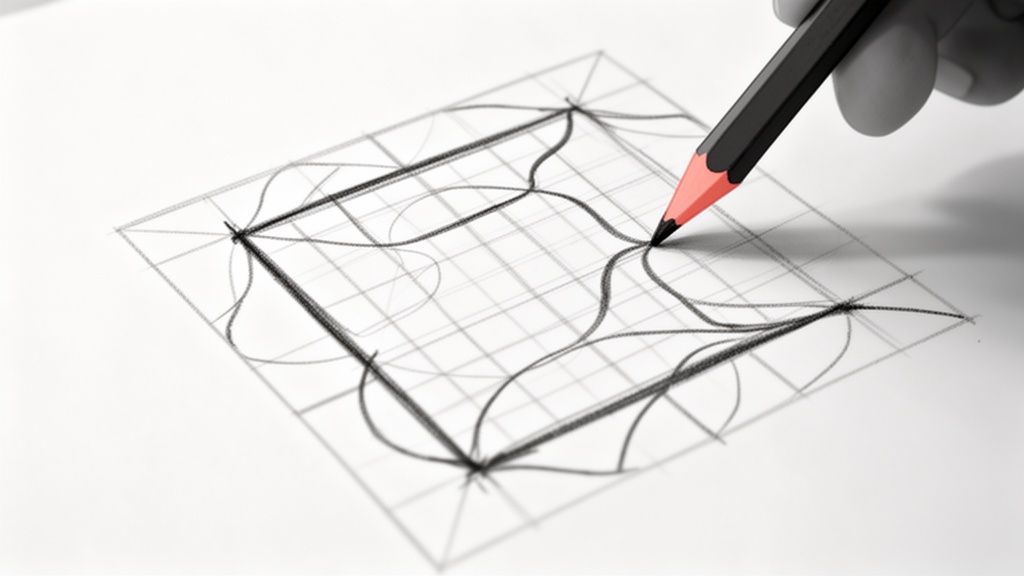
Alright, your grids are measured and drawn. Now for the satisfying part: transferring the image. The real magic of grid method drawing comes from a simple mental shift. You have to stop seeing a face, a building, or a landscape.
Instead, train your brain to see each square as its own little abstract composition of lines, curves, and shapes.
This is precisely why the technique is so powerful. By focusing on one tiny box at a time, you bypass the part of your brain that thinks it knows what an eye should look like. You just copy what you see inside those four little lines, trusting that the bigger picture will assemble itself from all the small, accurate pieces.
Your Starting Point Strategy
So, where do you actually start? There’s no single correct answer, but a smart starting point builds momentum and confidence. I usually tell people to find a corner square that has a clear, recognisable detail—the sharp corner of an eye, maybe, or a distinct shadow on a piece of clothing.
Nailing that first square gives you a solid anchor. From there, you can work your way outwards, tackling each adjacent box systematically. It’s a method that stops you from getting lost and ensures your lines flow smoothly from one square to the next.
The goal here is pure observation, not invention. Keep asking yourself: "Where does this line enter the box? Where does it leave? How far is that curve from the top edge?" This keeps your focus locked on what’s actually there.
This process demands real attention. If you're looking to sharpen that skill, it's worth exploring ways on how to improve concentration and focus, as the very same skills apply directly to creating accurate art.
Harnessing the Power of Negative Space
One of the most valuable skills the grid method teaches is seeing and using negative space—that’s the empty area around your main subject. Sometimes, it’s much, much easier to draw the shape of the empty background than it is to capture a complex object.
Look at a square and, instead of drawing the subject, try drawing the shapes of the background. You'll often find they're simpler forms and easier to replicate. This trick forces you to see the relationship between your subject and its surroundings, a fundamental skill for any artist.
The educational impact here is huge. A 2018 survey by the National Society for Education in Art and Design (NSEAD) across 500 UK schools found that 72% of teachers used grids to teach proportional accuracy. This led to a 35% improvement in student results in GCSE Art exams, with portraits made using the grid method scoring 15% higher on average. You can see how central this technique is by looking at research from sources like the Tate.
Building Your Drawing Box by Box
As you move from one square to the next, continuity is everything. The lines you draw have to connect perfectly with the ones in the boxes you've already finished. Here's a simple workflow that works every time:
- Pick a square. Choose your next target, ideally one touching a box you’ve already completed.
- Analyse the lines. Look at exactly where each line segment starts and ends inside that square. Is it halfway down the left side? A quarter of the way across the top?
- Sketch lightly. Use light, tentative strokes to place the lines in your new square. Don't commit yet.
- Check the flow. Glance back and forth between your reference and your drawing. Do the lines connect smoothly with the neighbouring squares?
- Commit. Once you're confident it's right, darken the lines.
By repeating this simple loop, you assemble your drawing piece by piece, like a mosaic. The accuracy doesn't come from one moment of genius, but from the combined effect of hundreds of small, careful observations. Before you know it, a complex, perfectly proportioned image emerges from the grid.
Finishing Your Artwork and Removing the Grid
You've done the hard graft, transferring your image square by square. Now, a perfectly proportioned sketch is sitting on your paper. This is a huge milestone, but what comes next is what turns a technical copy into a real piece of art.
It's all about refinement, blending, and carefully removing the scaffolding that got you to this point.
Erasing Your Grid Lines Safely
The first, and most delicate, task is getting rid of those grid lines. If you rush this part, you risk smudging all your hard work, so patience is everything here.
Your best friend for this job is a kneaded eraser. You can mould it into a fine point to lift the graphite out of tight corners without messing up your drawing. For those really intricate details, an eraser pencil is a game-changer.
To avoid a smudgy mess, here’s a simple process that works every time:
- Dab, Don't Rub: Gently press and lift the kneaded eraser onto the grid lines. This lifts the graphite cleanly instead of grinding it into the paper fibres.
- Work from the Centre Outwards: Start erasing in the middle and move towards the edges. This stops your hand from dragging across finished areas and causing smears.
- Use a Brush: Keep a soft, clean brush handy (a large, fluffy makeup brush is perfect for this) to sweep away eraser dust. Using your hand can transfer oils and smudges.
The goal is to make the grid completely vanish, as if it were never there. A clean finish keeps the focus on your artwork, not the process behind it.
Unifying Your Drawing
With the grid gone, your drawing might look a little… disconnected. Almost like a mosaic of individual squares pieced together. Now's the time to unify it.
Go back over your main contour lines with more confident, flowing strokes. This will connect the segments you drew in separate boxes and is where your own personal style really starts to emerge.
This technique has a long and respected history, by the way. Back in 18th-century Britain, it was a cornerstone of art education. Old manuals like William Salmon's Polygraphice gave explicit instructions for its use. Artist and theorist Jonathan Richardson even argued that grids ensured 95% accuracy in proportions, a method that influenced thousands of students in London's art scene. You can explore more about these historical drawing techniques and see just how deep these roots go.
Adding Depth and Final Touches
Alright, time for the final touches that bring your piece to life. This is where you can really play with shading, texture, and subtle changes in line weight.
Think about how light and shadow fall across your subject to create a sense of form and dimension. Blend your pencil strokes to create smooth gradients, and add those last few crisp details that will draw the viewer's eye.
This is the stage where you move beyond the technical precision of the grid method drawing and into pure artistic expression. It's how you infuse the work with personality, transforming that well-proportioned sketch into a finished piece you can be genuinely proud of.
Answering Your Questions About the Grid Method
So you're getting started with the grid method. It's a fantastic technique, but a few questions always seem to pop up for artists new to it. Let's clear up some of the most common ones so you can feel confident tackling any project.
Getting the small details right is what makes this method so powerful. A few clear answers will make the whole process feel much smoother.
What’s the Best Size for the Squares in My Grid?
There’s no magic number here. The right square size really comes down to two things: the complexity of your reference photo and the final size you want your drawing to be.
For anything highly detailed, like a portrait or an intricate pattern, you’ll want to go with smaller squares. Think 1cm or half-inch squares. This breaks down tricky features like eyes or fine hair into simple, manageable chunks of information.
On the other hand, if you're drawing a simpler subject or scaling up to a massive size (like a mural), you can get away with bigger squares. 2cm or one-inch blocks often work just fine. A good rule of thumb? Make sure no single square contains an overwhelming amount of detail. Don't be afraid to test a few sizes to see what feels right.
Can I Use This on My iPad or Computer?
Absolutely. The grid method is incredibly efficient in digital art software. Most programs like Procreate, Photoshop, or Krita have built-in grid tools you can switch on with a single click.
The workflow is a massive advantage here. You just create a grid on a separate layer over your reference image and a matching one on your digital canvas. When you're done with the sketch, there's no tedious erasing.
You simply hide or delete the grid layer, leaving your artwork completely clean. It’s faster, cleaner, and a brilliant way to practise the fundamentals without the manual cleanup.
Is Using a Grid Cheating?
I hear this a lot from new artists, and the answer is a firm no. The grid method is a traditional, legitimate tool for mastering proportion and accuracy. It’s been used by artists for centuries—even masters like Leonardo da Vinci and Albrecht Dürer relied on it.
Think of it like a musician using a metronome to nail their timing. It's a foundational technique designed to train your eye to see shapes, relationships, and negative space more accurately.
The skills you build are completely transferable. After you've spent time working with grids, you'll find your freehand drawing has improved dramatically. It's not a crutch; it's a stepping stone.
At Queens Game, we believe that structured thinking is the key to mastering complex challenges. Our chess-based logic puzzles are designed to sharpen the same skills of observation and systematic problem-solving that artists use in grid drawing. Test your strategic mind and see how far you can go by visiting us at https://queens.game.